Many boat owners discover the hard way that yacht insurance isn't a blanket protection policy. It's a layered system with defined coverage, specific exclusions, and optional add-ons that only apply if you've purchased them. The USCG's 2024 recreational boating statistics recorded approximately $88 million in property damage from boating incidents — a figure that underscores just how much is at stake when coverage gaps exist.
This article breaks down what yacht insurance actually covers, what it excludes, how agreed value and actual cash value differ, and how to build a policy that matches how you actually use your vessel.
Key Takeaways
- Yacht insurance combines hull coverage (physical damage) and Protection & Indemnity (liability) as its two core components
- Common exclusions include wear and tear, mold, mechanical breakdown, and racing
- Standard policies cover the basics; optional add-ons protect against risks specific to how and where you boat
- Agreed value vs. actual cash value is the most consequential policy decision yacht owners face
- New Mexico doesn't require yacht insurance by law — but lenders and marinas almost always do
What Yacht Insurance Actually Covers
Yacht insurance is a specialized marine policy built for high-value recreational vessels — generally those 27 feet and larger, though carrier eligibility varies. According to NMMA's Discover Boating guide, yacht coverage is broader than standard boat insurance because larger vessels travel farther, carry more exposure, and present legal complexity that smaller-craft policies simply aren't designed to handle.
Hull Coverage
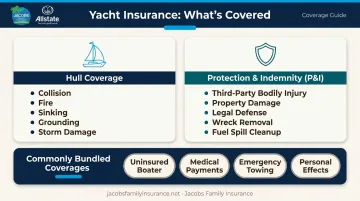
Hull insurance covers physical damage to the vessel's structure, engines, machinery, and permanently attached equipment. Covered causes typically include collisions, fire, sinking, grounding, and storm damage — sudden and accidental losses.
Most hull policies treat the vessel on an "all-risk" basis, meaning damage is covered unless specifically excluded. Most hull policies treat the vessel on an "all-risk" basis, meaning damage is covered unless specifically excluded. That said, sails, batteries, canvas covers, and outboard motors are often subject to depreciation even under policies that otherwise provide new-for-old replacement.
Before assuming full replacement coverage applies to every component, verify how your policy handles partial losses.
Hull coverage is written on either an agreed value or actual cash value basis — a distinction covered in detail below.
Protection & Indemnity (P&I)
P&I is the liability arm of yacht insurance. It covers:
- Third-party bodily injury or death
- Property damage to other vessels, docks, or structures
- Legal defense costs under admiralty law
- Wreck removal and salvage obligations
- Oil and fuel spill containment and cleanup
Standard auto or homeowners liability doesn't cover maritime exposures. Admiralty law operates under its own legal framework, and P&I policies are built for it — including crew exposures under the Jones Act and Harbor Workers' Compensation Act where applicable.
Additional coverages commonly bundled into comprehensive yacht policies:
- Uninsured boater coverage — protects you when the at-fault party carries no insurance
- Medical payments — covers injury costs for passengers and crew regardless of fault
- Pollution/fuel spill liability — addresses cleanup costs and regulatory exposure
- Emergency towing and assistance — covers getting a disabled vessel to safety
- Personal effects coverage — for clothing, electronics, and gear aboard
What Yacht Insurance Does NOT Cover
The exclusions section is what most policyholders skip — and where most claim denials originate. Reading it before a loss is far more useful than reading it after.
Common Exclusions Across Most Policies
Wear and tear: Normal deterioration isn't covered. Insurers treat maintenance as the owner's responsibility, not a covered peril. Corrosion, osmotic blistering, and gradual material fatigue all fall into this category.
Mechanical breakdown: A failed engine or transmission that isn't the result of a covered event (like a collision or sinking) is typically excluded. Some carriers offer mechanical breakdown coverage as an optional add-on with its own deductible, but don't expect it in a standard policy.
Mold and insect damage: Gradual biological damage tends to fall outside standard coverage. Some carriers offer endorsements specifically for consequential rot or mold — worth asking about if your vessel sits idle for extended periods.
Racing: Competitive events — even informal ones — are excluded from most standard yacht policies. If you plan to race, you'll need a racing endorsement or a supplemental policy that covers race-related incidents.
Charter and passengers-for-hire: Most personal yacht policies exclude carrying passengers for a fee unless a charter endorsement is in place.
Additional Exclusions to Know
- Acts of war — typically excluded due to the catastrophic and unpredictable nature of those losses; separate war risk coverage exists for owners operating in higher-risk waters
- Marine life encounters — animal damage may be excluded under many policies, including whale collisions and shark strikes in certain cruising areas; if you're operating in high-exposure waters, ask your agent specifically about this gap
- Intentional or criminal acts by the owner — losses resulting from deliberate misconduct aren't covered
That last point is worth clarifying. Ordinary negligent operation isn't automatically excluded — P&I coverage exists precisely to respond to liability from accidents caused by human error. The intentional/criminal conduct exclusion targets deliberate misconduct, not everyday mistakes at the helm.
Standard Coverage vs. Optional Add-Ons
Yacht policies generally break into two layers: standard coverages most comprehensive policies include by default, and optional add-ons you select based on how and where you use the vessel. Buying the cheapest base policy without reviewing your actual usage patterns is how owners end up underinsured — often without knowing it until a claim.
Standard Coverages Most Policies Include
Most comprehensive yacht policies include these as standard:
- Hull and machinery (physical damage)
- Protection & Indemnity (liability)
- Medical payments for passengers and crew
- Uninsured boater coverage
- Pollution liability
- Wreck removal and salvage
One caveat: the presence of a coverage type doesn't guarantee adequate limits. Sub-limits vary significantly between carriers, and a coverage that exists in name may be insufficient for a real claim against a high-value vessel.
Optional Coverages Worth Considering
| Add-On | Who Needs It |
|---|---|
| Captain and crew liability | Owners operating with paid crew |
| Windstorm/hurricane haul-out expense | Owners in hurricane-prone coastal waters |
| Trip interruption | Owners who charter or plan extended voyages |
| Tenders and personal watercraft | Owners with Jet Skis or dinghies aboard |
| Mexico watercraft liability | Owners cruising south of the border |
| Trailer coverage | Owners who trail their vessel to different launch points |
| Liveaboard coverage | Owners who reside aboard the vessel |
For high-net-worth owners, a personal umbrella policy layered above the primary yacht policy extends your liability protection when a claim exceeds the underlying policy's limit. Chubb, for example, offers personal excess liability capacity from $1 million to $100 million — the right amount depends on your total asset exposure, not a round-number guess.
Agreed Value vs. Actual Cash Value: A Critical Distinction
How your policy values the vessel determines how much you actually collect after a total loss. This is one of the most consequential decisions in yacht insurance, and many owners don't examine it closely until a claim forces the issue.
| Agreed Value | Actual Cash Value (ACV) | |
|---|---|---|
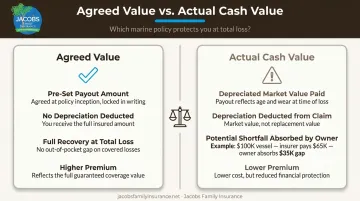
| How it works | Owner and insurer set the vessel's value at policy inception | Insurer pays the depreciated market value at time of loss |
| At total loss | Pre-set amount paid in full, no depreciation deducted | Payout reflects current market value, not purchase price |
| Premium cost | Higher | Lower |
| Best for | High-value vessels, especially as parts and labor costs rise | Owners prioritizing lower monthly cost over full recovery |
For a real-world illustration: Chubb paid $1.08 million on a 42-foot cruiser after it struck a rock, under a hull replacement-cost provision. That outcome is only possible with agreed value coverage.
With ACV, the math works against you. A yacht purchased for $100,000 that has depreciated to $65,000 at loss results in a $35,000 shortfall the owner absorbs out of pocket.
Worth confirming before you sign: even on agreed-value policies, partial losses on specific components — sails, batteries, electronics, outboard motors — may still be subject to depreciation. Ask your agent directly how partial losses are handled, not just total losses.
How to Choose the Right Yacht Policy
The right policy isn't defined by the vessel's purchase price alone. How, where, and how often you use it shapes what coverage is actually necessary.
Key factors that affect both coverage needs and premium:
- Cruising range — coastal, offshore, or international waters each carry different exposure
- Seasonal vs. year-round use — storage arrangements and seasonal layup conditions matter
- Liveaboard status — living aboard typically requires a specific endorsement
- Charter use — carrying paying passengers requires a charter endorsement or a commercial policy
- Crew — paid crew creates Jones Act and LHWCA exposure that standard policies may not address
- Vessel age — older vessels may require a recent marine survey from a SAMS- or NAMS-affiliated surveyor before an insurer will quote
An agent who understands marine exposures will know which of these factors apply to your situation — and which coverage gaps auto or homeowners frameworks simply can't address. Maritime liability, admiralty defense, and high-value vessel appraisal are specialized territory.
Jacobs Family Insurance works with New Mexico boat owners on watercraft coverage through Allstate's marine programs — whether you're boating on Navajo Lake or trailering to coastal waters. Call 505-557-2067 (Monday–Friday, 9 AM–5 PM) to talk through your options.
Before you finalize any policy, review the deductible structure. A lower premium often means a higher deductible. In a major loss, that trade-off can cost significantly more than the annual savings on premiums. Ask whether adjusting the deductible meaningfully shifts the premium, and whether the math actually works in your favor.
Frequently Asked Questions
What does yacht insurance cover?
Yacht insurance typically covers physical damage to the hull and machinery, P&I liability for third-party bodily injury or property damage, medical payments, uninsured boater incidents, fuel spill cleanup, and emergency towing. Optional add-ons extend coverage for crew, tenders, trip interruption, and more.
What is not covered by marine insurance?
Most marine policies exclude wear and tear, mold, insect damage, mechanical breakdown unrelated to a covered peril, racing, charter use without an endorsement, and losses from intentional or criminal acts. Exclusions vary by carrier, so reading the exclusions section of your specific policy is essential.
What affects the cost of a $1 million P&I liability policy?
Premiums for P&I coverage depend on vessel type, size, age, cruising area, owner experience, and loss history — no published standard rate applies across the market. A $1 million limit is a common starting point; an umbrella policy can extend that protection further at relatively modest additional cost.
Is yacht insurance required by law?
Requirements vary by state — New Mexico does not mandate boat insurance by law, but lenders require coverage as a condition of financing, marinas require it for docking privileges, and yacht clubs typically require proof of coverage for membership or event participation.
What is the difference between agreed value and actual cash value yacht insurance?
Agreed value pays a pre-set amount in a total loss with no depreciation deduction. Actual cash value pays the depreciated market value at the time of loss — which can be substantially less than your original purchase price.
Does homeowner's insurance cover a yacht?
No. Standard homeowners policies provide very limited watercraft coverage — the Insurance Information Institute notes that most home policies cover only about $1,500 in physical damage for small boats. Yachts require a dedicated marine insurance policy to be adequately protected.