Standard homeowners insurance often stops short of these exact perils, leaving families with a coverage gap they don't discover until they're filing a claim. This guide breaks down what catastrophe insurance actually is, what it covers, and how homeowners across Santa Fe and Northern New Mexico can close those gaps before disaster strikes.
Key Takeaways
- Standard home policies typically exclude flooding, earthquakes, and sinkhole damage
- Catastrophe protection usually requires a standalone policy or endorsement
- New Mexico's wildfire, flash-flood, and hail risks make this coverage especially relevant
- Each peril needs its own protection: no single "catastrophe policy" covers everything
- A local, licensed agent can match endorsements to your specific address and risk zone
What Is Catastrophe Insurance?
Catastrophe insurance covers high-severity perils that standard homeowners policies typically leave out, including:
- Flooding
- Earthquakes
- Severe wind events
- Ground-movement events
Rather than a single all-in-one product, it's a category of specialized coverage you layer on top of your existing policy.
Insurers exclude these risks from standard policies for a simple reason: catastrophic events hit entire communities at once. A single wildfire or flood can generate thousands of claims simultaneously, and spreading that financial risk across a small pool of premiums isn't sustainable for a standard homeowners product.
How the industry defines a "catastrophe": Property Claim Services (PCS), a Verisk business that tracks and classifies major loss events, uses a $25 million insured-loss threshold as its benchmark for designating a catastrophe, provided the event affects a significant number of policyholders and insurers. That's an industry classification tool, not a guarantee your policy covers the event.
Catastrophe insurance also gets confused with two unrelated terms:
- Catastrophic health insurance – a health plan for people under 30 or those with hardship exemptions, unrelated to property coverage
- Hazard insurance – the structural portion of a standard homeowners policy; catastrophe coverage sits outside that, covering perils hazard insurance was never designed to handle
Why This Matters More in New Mexico
New Mexico's wildfire exposure isn't hypothetical. In 2024 alone, the state recorded 823 wildfires that burned 82,531 acres, according to National Interagency Fire Center data. That's a lot of scorched ground feeding into runoff patterns that fuel flash flooding for years afterward.
Perils Typically Excluded from Standard Home Insurance
Most homeowners assume their policy has them covered until they read the exclusions list. Here's what's commonly left out, and why it matters in New Mexico specifically.
The main categories to know:
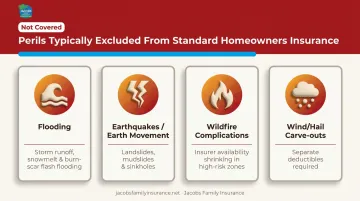
- Flooding: Includes storm runoff, snowmelt, monsoon rain, and burn-scar flash flooding from wildfire-scarred land. Mapped flood zones aren't the only risk area.
- Earthquakes and earth movement: Covers landslides, mudslides, and sinkholes tied to shifting ground.
- Wildfire complications: Fire itself is usually covered, but insurer availability is shrinking in high-risk wildland-urban interface areas.
- Wind and hail carve-outs: High-risk regions often require separate deductibles or standalone windstorm coverage.
New Mexico isn't California, but it's not seismically silent either, and some areas carry mine subsidence risk tied to historic mining activity. Wildfire-related nonrenewals are also becoming more common, as insurers grow more cautious in Northern New Mexico's high-risk wildland-urban interface zones, limiting terms or declining coverage altogether in the toughest spots.
Flooding deserves particular attention, since risk extends well beyond mapped high-risk zones. Nearly 29% of NFIP claims filed between 2014 and 2024 came from properties outside current high-risk flood areas, according to FEMA's flood risk data.
The average claim payment from 2020 to 2024 was $82,614. A low-risk map designation isn't the same as zero risk, and understanding these gaps helps homeowners choose the right supplemental coverage.
Types of Catastrophe Insurance Coverage
Here's the part that trips people up: there's no single "catastrophe policy" you buy once and forget. Coverage is peril-specific, meaning you insure against each risk individually.
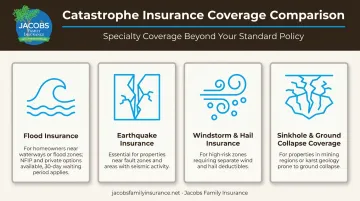
Flood Insurance
Flood coverage protects against rising water, storm surge, and the burn-scar flash flooding that's become increasingly common after Northern New Mexico wildfires. You can get it two ways:
- National Flood Insurance Program (NFIP): Federally backed, widely available
- Private flood carriers: Sometimes offer more flexible limits or faster underwriting
- Lender requirements: Often mandatory if you carry a federally backed mortgage in a high-risk flood zone
One detail that catches people off guard: NFIP policies usually carry a 30-day waiting period before coverage takes effect, with limited exceptions for loan closings, map changes, or certain wildfire-related circumstances. Buy ahead of monsoon season, not during it.
Earthquake Insurance
Standard homeowners policies exclude earthquake damage outright. New Mexico has 162 identified Quaternary faults, with 20 considered active based on surface rupture within the last 15,000 years, according to the New Mexico Bureau of Geology.
If you're near the Rio Grande rift or in an area with documented fault activity, this coverage deserves a second look, especially for older homes with less reinforced foundations.
Windstorm and Hail Insurance
Most homeowners policies include wind and hail coverage nationally, but that's not universal. High-risk wind zones sometimes carry separate deductibles or exclusions requiring a standalone endorsement. Given New Mexico's monsoon-season hail, it's worth confirming exactly how your policy treats this peril rather than assuming standard terms apply.
Sinkhole and Ground Collapse Coverage
This is a narrower, optional add-on most relevant in areas with historic mining activity, abandoned oil wells, or documented karst geology, particularly in east-central and southeastern New Mexico. It's not a common need for most Santa Fe homeowners, but if your property sits near known subsidence activity, ask your agent about it.
What catastrophe insurance does NOT cover:
- Fire and lightning damage (usually covered under your standard policy)
- Theft or vandalism
- Liability and medical payments
- Personal property, unless you've added it separately
Catastrophe coverage fills specific gaps. It's not a replacement for your base policy.
Who Needs Catastrophe Insurance in New Mexico?
Not every homeowner needs every type of catastrophe coverage. Your risk profile depends heavily on where you live and what you own.
- Wildfire-prone mountain and forested communities: Homes in Los Alamos, Taos, and Ruidoso face elevated fire risk, plus flash flooding across burn scars for years after a major fire. Flood coverage becomes relevant even for homes that never worried about water before.
- Rural and ranch property owners: Standard policies often underinsure outbuildings, land improvements, and equipment on larger parcels. If your property includes barns, equipment sheds, or fencing across acreage, confirm those structures carry adequate coverage separate from your main dwelling.
- High-value homeowners: If your home represents a significant investment, standard policy limits may not fully protect it after a catastrophic loss. Layered endorsements help close that gap.
If any of these describe your situation, Jacobs Family Insurance can walk through what applies to your specific property, including guidance covered in our piece on rural and ranch property coverage in southeast New Mexico.
How to Secure the Right Catastrophe Coverage
Closing your coverage gap starts with understanding what you already have, and don't have.
- Review your declarations page and exclusions list, where your current policy spells out exactly what's covered and what isn't. Most homeowners have never actually read this section.
- Get a professional risk assessment for your specific address, since flood zones, wildfire risk, and seismic exposure can vary block by block across New Mexico. A property one street over may carry a completely different risk profile than yours.
- Work with a local, independent agent rather than a call center. An agent who knows Santa Fe and Northern New Mexico can match endorsements and standalone policies to your actual risk instead of applying a generic checklist.
Putting these steps into practice is easier with a partner who already knows the local risk landscape. Jacobs Family Insurance has served Santa Fe and Northern New Mexico as an Allstate Elite Agency for more than a decade, and as a family-owned agency, we sit down with clients directly, no call center, no scripted runaround, to identify exactly which catastrophe endorsements make sense for your address.

Frequently Asked Questions
Is catastrophic home insurance worth it?
It depends on your regional risk exposure, mortgage requirements, and how much financial protection you want beyond a standard policy. Homeowners in wildfire, flood, or seismic zones typically see the most value.
What qualifies for catastrophic home insurance coverage?
Qualifying perils generally include floods, earthquakes, hurricanes, and other high-severity events usually excluded from standard homeowners policies. Coverage is typically peril-specific rather than bundled into one plan.
What should I not say to my home insurance company?
Avoid speculating about the cause of damage, admitting fault, or guessing at repair costs before an adjuster completes an assessment. Stick to facts and let the professionals evaluate the details.
Who declares an insurance catastrophe?
The insurance industry designates catastrophes through organizations like Property Claim Services (PCS). A catastrophe typically involves an insured-loss threshold of around $25 million that affects a significant number of policyholders and insurers.
What is the difference between catastrophe and hazard insurance?
Hazard insurance typically refers to the structural coverage built into a standard homeowners policy. Catastrophe insurance is broader, standalone protection for specific perils like flood or earthquake that hazard insurance doesn't touch.
How can I protect my home from catastrophic damage?
Practical steps include:
- Maintaining defensible space around your home to reduce wildfire risk
- Elevating utilities above base flood elevation
- Reinforcing foundations and roof connections for wind or seismic resistance