Bike theft isn't a minor inconvenience. Bike Index's 2025 Annual Bike Theft Report estimates that 2.4 million bicycles are stolen across the U.S. every year, with 59% of thefts happening right at home.
Many renters assume their policy treats a bike like any other belonging. That's mostly true, but e-bikes, sub-limits, and how (and where) your bike was stolen can complicate things. This guide breaks down coverage limits, common exclusions, and how Jacobs Family Insurance helps Santa Fe-area renters make sure their policy actually fits how they live.
Key Takeaways
- Standard renters insurance generally covers bike theft under personal property coverage
- Coverage extends both at home and off-premises, but sub-limits and deductibles affect your payout
- E-bikes, unlocked bikes, and wear-and-tear damage are common coverage exclusions
- Custom or high-value bikes often need a scheduled endorsement for full protection
Does Renters Insurance Cover Bike Theft?
Yes. Bicycles typically fall under the personal property section of a standard renters policy, the same category that covers your furniture, electronics, and clothing. Insurers classify a bike as personal property because it's a movable item you own, not a fixture attached to the rental unit.
That said, "covered" doesn't mean unlimited. Your payout still depends on the policy's coverage limits, deductible, and how the loss occurred. A bike stolen off your porch is treated differently than one that mysteriously vanished with no evidence of forced entry, in terms of the documentation you'll need.
Where Your Bike Is Protected
Most renters policies extend protection beyond your front door. According to the Insurance Information Institute, off-premises coverage generally caps at 10% of your total personal property limit. On a $25,000 policy, that's roughly $2,500 for anything stolen away from home.
This matters because bikes rarely stay indoors. Coverage generally applies to bikes stolen from:
- Your apartment, garage, or a rented storage unit
- A locked rack outside a coffee shop or campus building
- A bike rack mounted on your car in a public parking lot
Real-world example: Say you drive to the trailhead near Los Alamos with your mountain bike on a rooftop rack. You run into the visitor center for five minutes, and when you come back, the bike's gone. Because the theft happened off-premises, it's still covered, just subject to that off-premises sub-limit and your deductible.
Understanding Limits, Deductibles, and Payouts
Here's where things get more specific. Many insurers apply a bicycle sub-limit, a separate cap that applies regardless of what you originally paid for the bike. These caps vary by carrier and policy, so it's worth confirming the exact figure on your own policy rather than assuming a number.
Payouts also hinge on valuation method:
- Actual cash value (ACV): Pays the depreciated value of your bike, factoring in age and wear
- Replacement cost value (RCV): Pays what it costs to buy a comparable new bike today
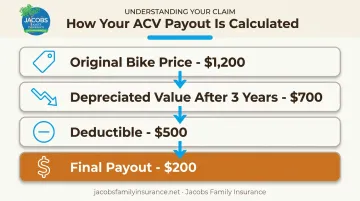
Here's a simplified example using ACV:
- Original bike price: $1,200
- Depreciated value after 3 years: $700
- Deductible: $500
- Payout: $200
That gap between original price and payout is why RCV coverage matters more for older bikes. If your bike's depreciated value sits close to (or below) your deductible, filing a claim might cost you more in time and premium impact than it's worth.
What Renters Insurance Doesn't Cover for Bikes
Standard coverage has real limits, and bikes hit several of them.
E-bikes are the biggest gray area, since coverage often depends on classification. Lemonade's guidance on e-bike insurance notes that pedal-assist Class 1 and Class 3 e-bikes may qualify for standard coverage, while throttle-powered Class 2 models, mopeds, and electric motorcycles typically don't. If you own an e-bike, don't assume; confirm the classification with your provider directly.
Other common exclusions include:
- Normal wear and tear: a worn chain or cracked frame from age isn't theft
- Mechanical failure: a blown motor or broken derailleur isn't a covered loss
- Racing or competitive use: some policies exclude damage sustained during organized races
- Negligence: if the bike wasn't locked or secured when stolen, insurers may deny the claim
That last point trips people up more than any other. An unlocked bike left on a porch overnight looks very different to an adjuster than one secured with a proper lock to something immovable. Documentation of how you typically store and secure your bike can matter here.
Protecting High-Value or Specialty Bikes with Extra Coverage
If your bike is worth more than your policy's sub-limit, whether it's a custom build, a racing bike, or a high-end e-bike, a scheduled personal property endorsement closes that gap.
Here's how it works: you itemize the bike on your policy with documentation like a receipt or appraisal, and the standard sub-limit no longer applies. Instead, the bike is insured for its actual scheduled value.
Who should consider this add-on:
- Owners of custom or racing bikes valued well above typical sub-limits
- Mountain bikers with specialty frames or components
- E-bike owners whose model costs several thousand dollars
Scheduling can also come with added perks beyond the higher limit:
- A lower or $0 deductible on the scheduled item
- Broader accidental damage protection that goes past theft alone
Given how active the cycling scene is around Santa Fe, Los Alamos, and Taos, this isn't a niche concern. A lot of local riders own gear that outpaces a standard policy's assumptions.
Working with a local agency like Jacobs Family Insurance, an Allstate Elite Agency serving Santa Fe and northern New Mexico, means you can sit down with someone who'll compare your bike's value against your current policy limits rather than guess.
One habit worth building: review your renters policy annually, especially after buying a new or higher-value bike. Coverage that fit last year's gear might not stretch far enough for this year's.
Filing a Claim for a Stolen Bike
If your bike is stolen, act quickly and document everything.
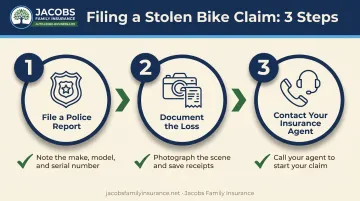
- File a police report immediately. Include the bike's make, model, color, and serial number, plus exactly where and when it was taken. This report becomes the backbone of your claim.
- Document the loss. Gather photos of the bike, your original purchase receipt, the serial number, and any appraisals if it's a higher-end model.
- Contact your Jacobs Family Insurance agent. Before filing, weigh the bike's depreciated value against your deductible. If the numbers are close, a claim may not make financial sense.
Having photos and serial numbers saved before theft happens (not scrambling to find them after) makes this whole process faster.
Tips to Prevent Bike Theft
The best claim is the one you never have to file.
- Use a quality U-lock or chain lock. Secure the frame and a wheel to something immovable, in a well-lit, high-traffic spot.
- Store indoors when possible. A garage, storage unit, or your apartment beats leaving a bike outside overnight.
- Register your bike. Services like Bike Index and 529 Garage log your serial number and photos, which helps with recovery and speeds up claims if theft does happen.
None of these guarantee your bike stays put, but they meaningfully reduce the odds and give you a paper trail if it doesn't.
Frequently Asked Questions
Can I claim a stolen bike on renters insurance?
Yes, most renters policies cover bike theft under personal property coverage. Your payout is still subject to the policy's sub-limits, deductible, and valuation method.
What are three things that renters insurance typically does not cover?
Common exclusions include damage to motor vehicles, business property beyond a small built-in limit, and flood or earthquake damage. These same principles carry over to bikes, where mechanical failure and racing damage are similarly excluded.
What happens if you rent a bike and it gets stolen?
A rented bike is usually the rental company's responsibility, covered by their own insurance or waiver, not your personal renters policy. That coverage only applies to bikes you own.
Does renters insurance cover e-bike theft?
It depends on the e-bike's classification. Pedal-assist models are more likely to qualify than throttle-powered ones, so confirm the specifics with your provider before assuming coverage.
How much will renters insurance pay for a stolen bike?
Payout depends on three factors: the bike's actual cash value, your policy's bicycle sub-limit, and your deductible. Older or heavily depreciated bikes often see smaller payouts than expected.
Does filing a bike theft claim raise my renters insurance premium?
It can affect your premium at renewal, though the impact varies by insurer and claims history. Speaking with your agent before filing helps you understand what to expect.
Not sure how your current renters policy handles bike coverage? Jacobs Family Insurance can review your policy and help you decide whether a scheduled endorsement makes sense for your ride. Call (505) 557-2067 or stop by the office at 1547 South St. Francis Drive, Santa Fe, to talk it through.