
Rents keep climbing, too. Zillow's June 2026 rent report puts the typical U.S. asking rent at $1,965, up 2.2% year over year. When you're paying that much monthly, protecting what's inside the unit matters even more. Add in the fact that many landlords now require proof of coverage before you sign a lease, and skipping renters insurance stops being a real option.
This guide breaks down exactly what HO-4 covers, what it excludes, how it stacks up against HO-3, HO-5, and HO-6 policies, and what it costs in 2026.
Key Takeaways
- HO-4 is the industry-standard form number for a renters insurance policy
- Covers personal property, liability, and loss of use—but not the structure
- Differs from HO-3 (homeowners) and HO-6 (condo) in who covers the structure
- Cost depends on your location, coverage limits, and optional add-ons
What Is HO-4 Insurance?
Insurers don't just call renters insurance "renters insurance" internally. They use HO-4, short for the ISO-standardized form HO 00 04, titled "Homeowners 4-Contents Broad Form." It's the same numbering system that gives us HO-3 for standard homeowners coverage.
HO-4 is built for anyone renting a house, apartment, condo, or even a single room. It intentionally skips coverage for the physical building because that's the landlord's or property owner's responsibility, not yours.
What it covers instead is everything you actually own and control:
- Your personal belongings, from furniture to electronics
- Your liability exposure if someone gets hurt in your rental
- Your ability to keep living somewhere if disaster strikes
Is Renters Insurance the Same as HO-4?
Yes. "Renters insurance" and "HO-4" describe the exact same policy. Agents and insurers use "HO-4" in paperwork and underwriting because it's the precise technical term, while "renters insurance" is the plain-language version consumers recognize. If your policy documents reference HO-4, that's simply your renters policy in industry shorthand.
Do You Need HO-4 Insurance?
No state requires renters insurance by law. Landlords increasingly do, though — many won't hand over keys without a declarations page proving active coverage. Beyond satisfying a lease clause, going without coverage means paying out of pocket for every stolen laptop, water-damaged mattress, or lawsuit from an injured guest.
A landlord's policy insures their building, not your belongings. If a pipe bursts and ruins your furniture, their insurer has no obligation to reimburse you. HO-4 exists specifically to fill that gap.
What Does HO-4 Renters Insurance Cover in 2026?
HO-4 is a named-peril policy. That means coverage only applies when a loss is caused by something specifically listed in the policy, not every possible disaster. Understanding that distinction matters more than almost anything else in this guide.
Personal Property Coverage
This is the core of an HO-4 policy. It protects your furniture, electronics, clothing, and other belongings against covered perils, whether the loss happens inside your rental or somewhere else entirely, like a laptop stolen from your car.
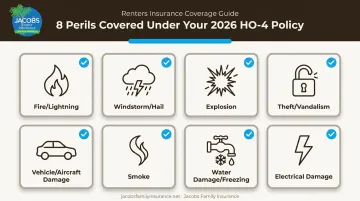
Standard 2026 policies typically list these named perils:
- Fire or lightning
- Windstorm or hail
- Explosion
- Theft and vandalism
- Damage from vehicles or aircraft
- Smoke
- Water damage or freezing from plumbing, HVAC systems, or appliance overflow
- Sudden electrical damage
Off-premises coverage is real, but it usually comes with a sublimit. Triple-I notes that a policy with $25,000 in personal property coverage might cap off-premises theft reimbursement at a smaller percentage of that total. If you own jewelry, art, or collectibles worth more than your standard limit allows, you'll likely need scheduled personal property coverage to insure those items at full value.
Personal Liability & Medical Payments Coverage
If a guest slips in your kitchen and needs stitches, liability coverage handles the medical costs and any legal fees if they sue. It also applies if you accidentally damage someone else's property, say, a small kitchen fire that spreads to a neighboring unit. Most HO-4 policies start liability limits around $100,000, though higher limits are available.
Loss of Use / Additional Living Expenses
When a covered peril makes your rental unlivable, this piece pays for the extra costs of living somewhere else temporarily. Think hotel bills, restaurant meals, even pet boarding: anything above your normal monthly expenses while repairs happen.
What HO-4 Insurance Doesn't Cover
Named-peril coverage means clear boundaries. Standard exclusions include:
- Flood damage: requires separate flood insurance
- Earthquake damage: needs its own endorsement or standalone policy
- Sinkholes, mudslides, and earth movement: excluded under every standard policy
- War and nuclear incidents: never covered regardless of cause
HO-4 also never covers the physical structure of your rental. That responsibility sits with your landlord. And it doesn't automatically cover a roommate's belongings unless they're specifically named on your policy — each unrelated adult in a shared rental generally needs their own coverage.
New Mexico-Specific Risks to Watch
Two regional risks deserve extra attention:
- Wildfire smoke damage: fire and smoke are typically covered as named perils, but smoke-related claims can get complicated depending on cause and extent
- Monsoon flooding: surface flooding from heavy monsoon rain is excluded, though damage from an internal plumbing failure is still covered
If you're renting anywhere in northern New Mexico, ask your agent to walk through exactly how your policy treats each scenario before you need to file a claim.
HO-4 vs. HO-3, HO-5, and HO-6: What's the Difference?
All the "HO" forms are standardized policy types. What separates them is the type of property they're written for and how broadly they cover perils.
- HO-3 is standard homeowners insurance, covering the dwelling on an open-peril basis (covered unless specifically excluded) plus named-peril coverage for belongings.
- HO-5 is comprehensive homeowners insurance, extending open-peril coverage to both the structure and personal belongings — broader than HO-3, and far broader than HO-4.
- HO-6 is condo insurance, adding "walls-in" coverage for drywall and flooring since condo owners partially own the building. Renters never need this coverage.
- HO-4 stays focused on belongings, liability, and loss of use, since renters have zero ownership stake in the structure.
| Form | Who It's For | Structure Coverage | Personal Property Basis |
|---|---|---|---|
| HO-3 | Homeowners | Open-peril for dwelling | Named-peril |
| HO-4 | Renters | None (landlord's responsibility) | Named-peril |
| HO-5 | Homeowners (upgraded) | Open-peril for dwelling | Open-peril |
| HO-6 | Condo owners | Limited "walls-in" coverage | Named-peril |
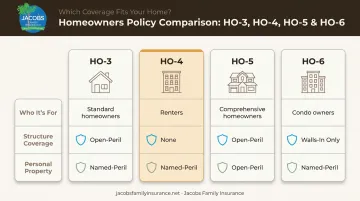
If you own the walls around you, you need HO-3, HO-5, or HO-6. If you're renting, HO-4 is the only form built for your situation.
How Much Does HO-4 Insurance Cost & How Much Coverage Do You Need in 2026?
Renters insurance remains one of the cheapest policies you'll ever buy. NerdWallet's 2026 analysis puts the national average around $151 per year, roughly $13 a month, for a sample policy with $30,000 in personal property and $100,000 in liability coverage.
What Drives Your Premium
- Personal property value — higher coverage limits mean higher premiums
- Location and ZIP code — local fire, theft, and storm risk all factor in
- Liability limits chosen — $100,000 is common, but higher limits cost more
- Deductible level — a higher deductible lowers your monthly premium
Estimating Your Coverage Need
Walk through your rental room by room and total up what it would cost to replace everything you own today, not what you originally paid. Most renters land somewhere between $20,000 and $100,000+ in coverage, depending on how much electronics, furniture, and valuables they've accumulated.
Worth considering as add-ons:
- Scheduled personal property coverage for jewelry, art, or collectibles above standard limits
- Flood or earthquake endorsements if you're in a higher-risk area
- A personal umbrella policy for extra liability protection beyond your base limit
Bundling helps too. Pairing an HO-4 policy with an auto policy typically triggers a multi-line discount that can offset much of what you'd pay for renters coverage on its own, making an already-affordable policy even cheaper.
At Jacobs Family Insurance, a family-owned Allstate Elite agency based in Santa Fe, we help renters across northern New Mexico compare coverage options. We run the numbers on bundling with auto insurance and land on limits that actually match what they own.

No call center, no generic quote form. Just a local agent who can walk you through your options. Reach out through our contact page or call the Santa Fe office for a free quote.
Frequently Asked Questions
How much is HO-4 renters insurance?
Renters insurance averages around $151 per year, or about $13 a month, though your actual cost depends on your location, coverage limits, and deductible.
Is renters insurance HO-4?
Yes. HO-4 is simply the technical industry term insurers use for a standard renters insurance policy.
What is the difference between HO-3 and HO-4?
HO-3 covers a homeowner's dwelling structure plus belongings. HO-4 only covers a renter's belongings and liability, since the landlord owns the structure.
Does HO-4 insurance cover theft away from home?
Generally, yes. Personal property coverage typically extends beyond your rental, covering items like a laptop stolen from your car, though off-premises theft often has its own lower limit.
Is HO-4 insurance required by law?
No. It's not legally mandated, but many landlords require it as a condition of the lease agreement.
Does HO-4 insurance cover roommates?
No, typically not. A standard policy only covers the named policyholder's belongings, so each roommate needs their own HO-4 policy.