Here's the reality: condos and single-family homes need different insurance forms entirely. Get the wrong one, and you could face serious coverage gaps after a fire, storm, or liability claim.
This guide breaks down condo insurance (HO-6) versus homeowners insurance (HO-3), so you know exactly which policy your property actually needs, not which one sounds familiar.
Key Takeaways
- HO-3 covers your entire home structure, from foundation to roof.
- HO-6 covers only your unit's interior, while the HOA's master policy handles the rest.
- Condo insurance runs cheaper nationally, averaging $539 annually versus $1,569 for homeowners, per 2022 NAIC data.
- Loss assessment coverage protects condo owners from shared HOA repair costs.
- Your property type—not price or preference—determines which policy you need.
Condo vs. Homeowners Insurance: Quick Comparison
Before diving into definitions, here's how these two policies stack up side by side.
| Coverage Area | Condo Insurance (HO-6) | Homeowners Insurance (HO-3) |
|---|---|---|
| Cost | Averages $539/year nationally | Averages $1,569/year nationally |
| Dwelling/Structure | Interior of unit only | Entire structure, inside and out |
| Personal Property | Belongings inside the unit | Belongings throughout the home |
| Liability | Covers claims tied to your unit | Covers claims tied to the whole property |
| Loss Assessment | Typically included, often limited | Not applicable |
Cost
According to the NAIC's 2022 Homeowners Report, the national average annual premium for HO-6 condo policies sits at $539, compared to $1,569 for HO-3 homeowners policies.
That gap isn't random: condo policies insure less physical structure, so there's simply less to cover. These are national benchmarks, not Santa Fe quotes, and your actual premium depends on your unit's location, size, and claims history.
Dwelling and Personal Property Coverage
An HO-3 policy protects the full structure: roof, walls, foundation, and attached garages. An HO-6 policy protects your unit's interior, meaning cabinets, flooring, and fixtures you're responsible for under your HOA's bylaws.
Both policies cover personal belongings and offer liability protection. The difference is scope, not category.
Loss Assessment Coverage
This is where condo owners face a unique exposure. If your HOA's master policy falls short after a covered loss, the association can bill unit owners directly. Loss assessment coverage helps absorb that hit, though many policies cap assessment-deductible coverage at just $1,000, according to state insurance regulators. Confirm your limit before assuming you're protected.
What is Homeowners Insurance (HO-3)?
HO-3 is the standard policy for anyone who owns a detached, single-family home. It's built around one simple principle: because you own the entire structure, your policy covers it in full.
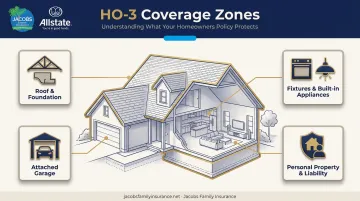
That includes:
- The roof, walls, and foundation
- Attached structures like garages
- Fixtures and built-in appliances
- Personal property and liability coverage
The core benefit is simplicity: one policy covers everything from the ground up. There's no coordination required with a homeowners association, no master policy to cross-reference, no guessing where your coverage ends and someone else's begins.
A few things matter when setting up your policy:
- Dwelling limits should reflect rebuild cost, not market value. Land value doesn't factor into what it costs to reconstruct your home after a total loss.
- Other structures coverage handles detached items like sheds or fences.
- Scheduled valuables can be added for jewelry, art, or collectibles that exceed standard limits.
Use Cases of Homeowners Insurance
HO-3 fits owners of detached single-family homes, townhomes without shared structural walls, and the rural or ranch properties common throughout New Mexico.
If you're financing a purchase, this matters at closing. Mortgage lenders across service areas like Rio Rancho, Las Cruces, and Albuquerque generally require proof of an acceptable property insurance policy, following Fannie Mae's property insurance requirements for financed one-to-four-unit homes.
Real-world scenario: A tree falls on a standalone home during a windstorm, tearing through the roof and damaging the attic below. The homeowner's HO-3 policy covers the structural repair, the roof replacement, and the interior water damage under one claim. No coordination with anyone else required.
What is Condo Insurance (HO-6)?
HO-6 covers what your HOA's master policy doesn't: the inside of your unit. That means personal belongings, interior finishes, liability, and loss of use if you're displaced during repairs.
The building's exterior, common hallways, and shared structural elements fall under the association's master policy instead. Your HO-6 policy fills that gap, so you're not paying for coverage you already have through your HOA dues, or going without coverage you actually need.
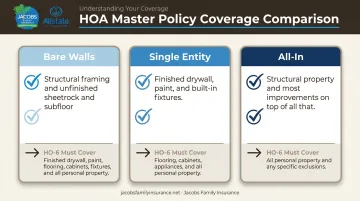
That gap depends heavily on which type of master policy your association carries:
- Bare walls – Covers common areas up to the unfinished sheetrock and subfloor. Everything inside, including your flooring and cabinets, falls on your HO-6 policy.
- Single entity – Extends coverage to bare-walls property plus original built-in fixtures, though renovations and upgrades remain your responsibility.
- All-in – Includes structural property, built-ins, and most owner improvements, leaving your HO-6 to handle deductibles and excluded items.
Use Cases of Condo Insurance
HO-6 is built for condo unit owners in HOA communities, a growing category in Santa Fe and Northern New Mexico's expanding condo and townhome developments.
Lenders treat this the same way they treat HO-3. Fannie Mae's guidelines require an individual unit policy whenever the master policy doesn't already cover the interior, meaning most condo buyers financing a purchase will need HO-6 in place before closing.
Real-world scenario: A kitchen fire breaks out in a condo unit, scorching the cabinets and damaging the ceiling. The HOA's master policy covers the structural ceiling repair. The owner's HO-6 policy covers the cabinets, appliances, and any personal belongings lost to smoke damage. Two policies, one claim, no gaps if both are sized correctly.
Which One Do You Actually Need?
Forget preference. This decision comes down to three questions:
- What does your deed say? A fee-simple detached home needs HO-3. A condo unit inside a shared building needs HO-6.
- Does an HOA master policy exist? If yes, you're a condo owner in the insurance sense, regardless of what the building looks like from the outside.
- What does that master policy actually cover? Bare walls, single entity, and all-in policies each leave different gaps for your HO-6 to fill.
There's no in-between here. If you own a detached home outright, HO-3 is the only appropriate form. If you own a unit governed by an association, you need HO-6, full stop.
One step buyers in Santa Fe and Northern New Mexico consistently skip: requesting the HOA's master policy declarations page before purchasing HO-6 coverage.
Master policy terms vary widely between associations, even within the same neighborhood, so guessing your dwelling coverage without that document leaves you exposed either way.
Coverage types vary widely by association. Don't assume your neighbor's condo policy matches yours just because the buildings look similar.
Rather than guessing at limits, talk to a local, licensed agent who can review your association's actual master policy alongside your personal coverage needs.
Jacobs Family Insurance, an Allstate Elite Agency serving Santa Fe and Northern New Mexico, can walk through your HOA's declarations page and build a personalized HO-6 or HO-3 quote.
Conclusion
Neither HO-3 nor HO-6 is "better." The right policy is determined by what you own, not what costs less or sounds more comprehensive. A detached homeowner needs full structural coverage. A condo owner needs interior coverage that coordinates with the association's master policy.
Getting this right protects more than paperwork. Proper dwelling limits and adequate loss assessment coverage stand between you and a costly surprise when something goes wrong. That's why we help Santa Fe and northern New Mexico homeowners match coverage to what they actually own.
Frequently Asked Questions
Is it cheaper to insure a condo or house?
Condo insurance is generally cheaper. NAIC data puts the national average HO-6 premium at $539 annually, compared to $1,569 for HO-3, largely because condo policies cover less physical structure.
Why are condos hard to insure?
Insurers often scrutinize aging buildings, deferred maintenance, and HOAs with weak reserve funds. Missing inspection records or a history of unresolved repairs can also make underwriters cautious.
Do I need homeowners insurance if I already have condo insurance?
No. Condo owners need HO-6, not HO-3. A standard homeowners policy isn't built for shared-building ownership and won't align with your HOA's master policy structure.
What does my HOA's master policy actually cover?
It depends on whether your association carries a bare walls, single entity, or all-in policy. Request your HOA's declarations page directly to confirm what's already insured before buying HO-6 coverage.
Is condo insurance the same as renters insurance?
No. Condo insurance (HO-6) covers owners responsible for part of the structure, while renters insurance (HO-4) only covers belongings and liability for tenants with no ownership stake in the building.
Can I get flood or earthquake coverage with a condo or homeowners policy?
Standard HO-3 and HO-6 policies exclude both perils. Flood coverage requires a flood insurance policy, often through the NFIP, while earthquake protection typically needs its own endorsement or standalone policy.