Many condo owners assume their HOA's master policy handles everything. It doesn't. The master policy typically stops at the building's structure and shared spaces, leaving your personal belongings, interior finishes, and temporary housing costs to your own policy.
This guide breaks down exactly what your HOA's master policy covers, what your personal HO6 policy covers, where the gaps hide, and how to close them before a fire forces you to find out the hard way.
Key Takeaways
- Condo fire coverage splits between two policies: the HOA master policy and your HO6 policy
- HO6 typically covers interior finishes, personal property, loss of use, and smoke damage
- HOA policies are labeled "bare-walls," "studs-in," or "all-in"—get this in writing
- Standard policies often exclude wildfire, flood, and earthquake damage in New Mexico's wildland areas
Understanding Condo Fire Insurance: HOA Master Policy vs. Your HO6 Policy
Unlike a single-family home, where one policy covers nearly everything, condo fire protection is split between two separate contracts working in tandem. Misunderstanding where one stops and the other starts is the single most common cause of condo insurance disputes after a fire.
What the HOA Master Policy Typically Covers
The master policy your HOA carries generally protects:
- Structural components: load-bearing walls, the roof, and building framing
- Common areas: hallways, elevators, stairwells, lobbies, and shared amenities
- Shared fire suppression systems: sprinklers and alarm systems serving the building [13][44]
Here's where it gets tricky. The extent of that coverage depends entirely on how the policy is structured:
- Bare-walls (studs-in): Restores your unit to a bare shell: unfinished walls, floors, and ceilings. Cabinets, flooring, and fixtures are not included [38]
- Single-entity (walls-in): Covers fixtures and built-ins installed by the original builder, but not upgrades or personal betterments you've added since [13]
- All-in: Extends into unit interiors, covering fixtures and installations within your walls, floors, and ceilings [13]
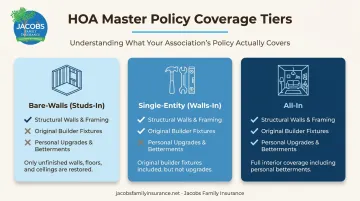
The label alone isn't enough. Ask your HOA board for the actual declaration and master-policy form in writing, because "studs-in" and "all-in" aren't standardized terms across every association [13][38].
What Your HO6 Condo Policy Typically Covers
Your HO6 policy fills whatever gap the master policy leaves behind, covering the things that make your unit livable and insurable as yours. At minimum, it typically includes:
- Personal property: furniture, electronics, and belongings damaged by fire or smoke
- Interior betterments and improvements: upgrades like custom cabinets or hardwood floors added since purchase
- Loss assessment: your share of a master-policy shortfall billed back by the HOA
- Loss of use: temporary housing while your unit is repaired
- Personal liability: protection if a guest is injured inside your unit
Your condo association's governing documents ultimately determine each party's obligations. Reviewing both the master policy and your HO6 together, rather than assuming one covers what the other doesn't, is the only way to know your actual exposure.
A 2025 survey from the CAI Foundation, covering 509 respondents including management companies representing more than 4,000 communities, found that only 53% of associations require unit owners to carry an HO6 policy at all [10].
That means nearly half of condo communities leave the decision entirely up to the owner, which is precisely how coverage gaps happen.
What Does Your HO6 Condo Fire Insurance Cover?
Your HO6 policy does the heavy lifting once a fire moves past the building's bones. Here's what it typically includes.
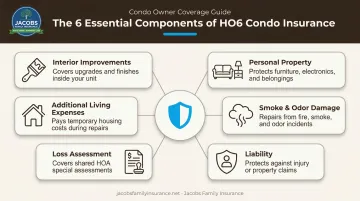
Interior structure and finishes. Drywall, cabinets, flooring, countertops, and fixtures damaged by fire, heat, or firefighting efforts are covered up to your policy limits. If your HOA carries a bare-walls policy, this coverage becomes essential rather than optional.
Personal property. Furniture, electronics, clothing, and appliances damaged or destroyed by fire fall under this coverage. Standard limits often fall short for high-value items such as jewelry, art, and collectibles usually need a scheduled rider to be fully protected.
Loss of use. Also called additional living expenses, this pays for:
- Temporary housing while your unit is uninhabitable
- Extra meal costs above your normal spending
- Related expenses tied directly to the displacement [27]
Smoke, soot, and odor damage. This is often the most disputed coverage category. Insurers sometimes argue lingering smoke odor is cosmetic rather than structural damage, which can delay or reduce a payout. Document odor and residue thoroughly if this happens to you.
Liability coverage. If your negligence, such as an unattended stove or a faulty appliance, starts a fire that damages a neighbor's unit, this coverage responds to claims and covers defense costs [11].
Loss assessment coverage. When a fire loss exceeds the master policy's limits or triggers a high deductible, your HOA may bill owners a special assessment. Loss assessment coverage can help pay your share, though it's not a substitute for adequate primary coverage [25].
Jacobs Family Insurance helps Santa Fe condo owners build HO6 coverage around six essential components: interior improvements, personal property, smoke and odor damage, liability, loss assessment, and additional living expenses, since master policies rarely cover all of them.
What Condo Fire Insurance Typically Does NOT Cover
Even a well-built HO6 policy has boundaries. Knowing them now saves confusion later.
- Flood damage: Excluded from standard homeowners and condo forms; requires a separate flood policy [12]
- Earthquake damage: : Damage caused deliberately isn't covered under any standard form
- Core building structure: Remains the HOA's responsibility regardless of your HO6 limits
- High-value belongings beyond standard limits: Jewelry, fine art, and collectibles typically need a scheduled endorsement
Mold is a gray area worth flagging. Damage from ongoing lack of maintenance isn't covered, and mold following a covered water loss (like firefighting runoff) may receive limited treatment depending on your specific policy language [16]. Don't assume you're covered. Verify the specifics with your policy documents.
Wildfire and Fire Risk for New Mexico Condo Owners
Standard condo fire coverage assumes a kitchen fire or an electrical short. It doesn't always account for wildfire pushing into a building's exterior or infiltrating through smoke and ember exposure, which is a distinct regional concern for New Mexico owners.
The numbers back this up. New Mexico recorded 823 wildfires burning 82,531 acres in 2024 alone, according to the National Interagency Fire Center's annual wildland fire report.
State forestry officials have identified 919 New Mexico communities at risk from wildland fire, including 448 classified as high-risk. Santa Fe County itself has 42 at-risk communities, 27 of them rated high-risk.
Many standard HO6 policies limit or exclude wildfire-related damage in these zones, or apply higher deductibles once a property sits inside a designated risk area. Confirming your specific coverage with a local agent matters more here than in most parts of the country.
This is where Jacobs Family Insurance's local footprint counts. As an Allstate Elite agency based in Santa Fe, the team reviews HOA master policies alongside personal HO6 coverage to flag regional gaps—things like:
- Extended replacement-cost endorsements to cover post-wildfire construction cost spikes
- Ordinance-or-law endorsements for rebuilding to current code
- Additional living expense limits realistic for New Mexico's often-extended evacuation timelines
Steps to Take If Your Condo Experiences a Fire
Acting quickly after a fire protects both your claim and your recovery timeline.
- Contact your HOA immediately to request a copy of the master policy and governing bylaws, so you know what's already covered
- File your HO6 claim as soon as possible. Don't wait to see what the master policy pays first
- Document everything with photos, videos, and a written inventory of damaged property before repairs start
- Track temporary living expenses, including receipts for hotels, meals, and any other displacement costs
- Request the fire department's incident report, which supports both your loss-of-use claim and any liability questions
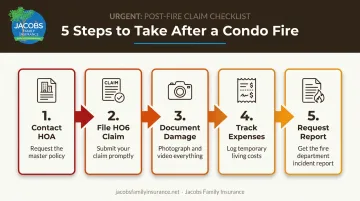
Skipping any of these steps can slow your claim or leave gaps in what your insurer is willing to reimburse.
Frequently Asked Questions
Is it necessary to buy fire insurance for a condo?
Yes. Your HOA's master policy covers structural components and common areas, but it doesn't cover your personal belongings or interior finishes. An HO6 policy fills that gap.
Is it okay not to have fire insurance for my condo if I have an existing mortgage or bank loan?
No. Most lenders require proof of condo insurance as a loan condition, and Fannie Mae now mandates unit-owner coverage whenever the master policy leaves interior gaps. Skipping it risks loan default.
What is the best insurance for a condo?
The best HO6 policy matches your actual personal property values, includes adequate loss-of-use and liability limits, and coordinates properly with your specific HOA master policy structure.
What are the four types of fire insurance?
Condo fire protection breaks into four categories: dwelling/interior coverage, personal property, loss of use, and liability. Loss assessment is often added as a fifth component for condo owners specifically.
Does condo fire insurance cover wildfire damage?
It depends on your insurer and region. New Mexico condo owners in high-risk zones should confirm wildfire coverage explicitly with their agent, since standard policies sometimes limit or exclude it.
How much fire insurance coverage do I need for my condo?
Inventory your belongings, estimate replacement costs, and confirm whether your HOA policy is bare-walls or all-in. That combination determines how much HO6 coverage you actually need.