That distinction isn't just insurance trivia. It affects what your policy pays for, how fast a claim gets approved, and whether your lender will even let you skip a coverage. Many drivers assume "full coverage" is one thing. It's actually two separate coverages doing very different jobs.
This guide breaks down what comprehensive and collision coverage each protect, when you actually need both, and how to pick deductibles that won't wreck your budget or your peace of mind.
Key Takeaways
- Collision coverage pays for crash damage with vehicles or objects, regardless of fault
- Comprehensive coverage handles non-crash damage: theft, weather, animals, vandalism
- Neither is legally required in New Mexico, but lenders and lessors typically require both
- Together, they're commonly called "full coverage," though that's not an official policy type
- The right deductible choice for each can raise or lower your monthly premium
Comprehensive vs. Collision: Quick Comparison
| Factor | Collision | Comprehensive |
|---|---|---|
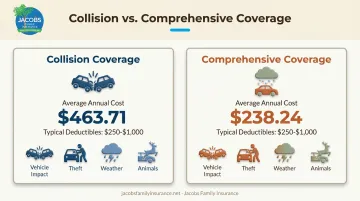
| Avg. annual cost | $463.71 nationally | $238.24 nationally |
| What it covers | Vehicle-to-vehicle or vehicle-to-object impacts, rollovers, potholes | Theft, vandalism, weather, fire, animal strikes, falling objects |
| Typical deductibles | $250–$1,000 common; some insurers offer wider ranges | $250–$1,000 common; some insurers waive it for glass repairs only |
| Legally required? | No, but lenders/lessors usually require it | No, but lenders/lessors usually require it |
| Payout basis | Vehicle's actual cash value minus deductible | Vehicle's actual cash value minus deductible |
Collision consistently costs more than comprehensive, and the reason comes down to risk. Collision covers repairs after accidents you cause, which insurers price higher due to frequency and repair costs. Comprehensive covers less predictable events like theft or hail, which occur less often per policyholder. These figures come from NAIC's 2022/2023 Auto Insurance Database Report.
On deductibles: NAIC's consumer guide lists $250, $500, and $1,000 as the most common choices. Some carriers advertise wider ranges. A few waive the deductible for windshield repairs under comprehensive, but a true $0 deductible across all comprehensive claims isn't standard. A local agent can walk you through the exact deductible options available on your policy.
What Is Collision Coverage?
Collision coverage pays to repair or replace your vehicle when it's damaged in an impact — with another car, a fence post, a guardrail, or the pavement itself. Fault doesn't matter here. If your car hits something, or something hits it, collision is the coverage that responds.
New Mexico's roads make this more than theoretical. Rural highways with sudden wildlife crossings, mountain switchbacks around Taos and Los Alamos, and icy winter stretches all raise the odds of an impact. Collision coverage also applies to:
- Single-vehicle rollovers, even with no other car involved
- Pothole damage — a real concern on many of the state's older rural roads
- Hitting a guardrail after sliding on ice
Where Collision Coverage Matters Most
Collision carries the most weight for:
- Financed or leased vehicles — lenders almost always require it
- Newer or higher-value cars where repair costs would otherwise come straight out of pocket
- High-traffic commuters on corridors like I-25 or I-40, where fender-benders and multi-car incidents are more common
These scenarios explain why the stakes are so high. According to NAIC data, the average incurred loss per collision claim reached $7,191 in 2022, up 17.6% from $6,113 the year before. That figure covers total losses and related claim costs, not just a body shop invoice — but it shows how quickly a single impact can outpace a modest emergency fund.

Consider a driver who slides off an icy road near Taos and clips a guardrail. No other vehicle is involved, no animal darted into the road — it's a straightforward collision claim, not comprehensive, because the operative event is impact.
What Is Comprehensive Coverage?
Comprehensive coverage handles damage from events outside your control that don't involve a crash. Think of it as protection against the world acting on your car while you're not driving it, or while something unpredictable happens around you.
For New Mexico drivers, that translates into some very specific, very regional risks:
- Hailstorms in Albuquerque and Santa Fe that pit hoods and shatter windshields
- Wildfire exposure across northern New Mexico, where parked or garaged vehicles can be damaged by smoke, embers, or evacuation-related incidents
- Deer and elk strikes on rural highways, especially in wooded or high-elevation corridors
Coverage has limits, too. What comprehensive doesn't cover matters just as much:
- Mechanical breakdowns or engine failure
- Normal wear and tear (tires, brakes, upholstery)
- Damage your car causes to someone else's property
Where Comprehensive Coverage Pays Off
Comprehensive earns its premium for:
- Rural and ranch property owners whose vehicles sit outdoors, exposed to weather and wildlife
- Drivers in hail-prone corridors, particularly central and eastern New Mexico
- Anyone commuting through wildlife corridors at dawn or dusk
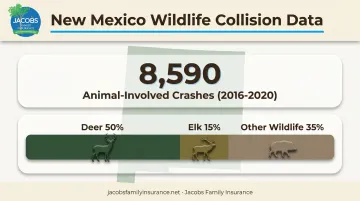
The wildlife numbers back this up. New Mexico recorded 8,590 reported animal-involved crashes between 2016 and 2020, according to a University of New Mexico traffic safety study. Deer accounted for 50% of those incidents, elk for 15%. That's a strong, state-specific case for comprehensive in rural and northern New Mexico.
New Mexico's numbers mirror a national pattern. According to State Farm's annual deer collision report, over 1.7 million animal-collision claims were filed across the U.S. between mid-2024 and mid-2025. The odds sit at roughly 1 in 139 nationally, and deer accounted for more than 1.1 million of those claims.
Picture a Santa Fe driver whose car sits in a driveway during a summer hailstorm. The hood and windshield take a beating. That's a textbook comprehensive claim — no impact with another object, just weather doing its damage.
Which Coverage Is Right for You?
Deciding between collision, comprehensive, or both comes down to a handful of practical questions:
- Is the vehicle financed or leased? Most lenders require both coverages until the loan or lease is paid off.
- What's the vehicle worth? If repair costs would exceed the car's actual cash value, some owners of older, paid-off vehicles choose to drop one or both coverages.
- What does your daily driving look like? Highway commuters face different risks than drivers who mostly stay in town.
- Where do you live and park? Rural, high-elevation, and wildlife-heavy areas raise the case for comprehensive specifically.
- Can you absorb a repair bill out of pocket? If not, keeping both coverages is usually the safer call.
Deductible Strategy
Matching deductibles across both coverages keeps budgeting simple. Choosing different deductibles can fine-tune your premium to your actual risk: a lower one for collision if you drive I-25 daily, and a higher one for comprehensive if you rarely encounter wildlife.
There's no universal "right" number. A $500 deductible costs more in premium but less if you file a claim. A $1,000 deductible does the opposite. The right choice depends on what you can comfortably pay without delaying a repair.
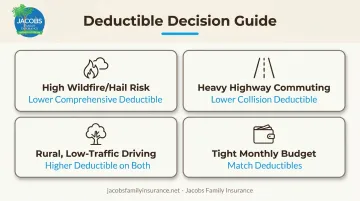
Regional risk varies widely: wildfire exposure in Los Alamos, hail in Santa Fe, elk on the road outside Taos. A quick way to sort out the right numbers:
- High wildfire or hail risk — lean toward a lower comprehensive deductible
- Heavy highway commuting — consider a lower collision deductible
- Rural, low-traffic driving — a higher deductible on both may save more in premiums
- Tight monthly budget — match deductibles for simpler planning
The team at Jacobs Family Insurance reviews coverage with drivers across the state regularly, factoring in exactly this kind of local terrain and risk.
Real-World Scenario: Weighing Coverage in Northern New Mexico
Imagine a driver in Española whose neighborhood just went through a hailstorm that damaged several vehicles on the same block. She's weighing whether to raise her comprehensive deductible to lower her premium, since her car escaped major damage this time.
A few miles north, a driver outside Santa Fe hits a deer on a dark highway stretch, a collision type common enough on New Mexico's rural roads that many local drivers carry comprehensive for this reason alone. His comprehensive coverage, with a moderate deductible, absorbs most of the repair cost.
Neither driver is wrong to reconsider their deductible, but the smarter move is matching that deductible to actual exposure rather than chasing the lowest possible premium. A rural driver logging miles through elk country has a different risk profile than someone parking in a covered garage downtown.
Ready to see how your coverage stacks up against your real risk? Contact Jacobs Family Insurance for a personalized policy review that accounts for your specific New Mexico location, driving habits, and budget. Reach the team at (505) 557-2067 or stop by 1547 South St. Francis Drive in Santa Fe.
Conclusion
Neither coverage is objectively "better." Collision protects you when your car hits something or gets hit, no matter who's at fault. Comprehensive protects you from the unpredictable stuff, including hail, theft, wildfire, and wildlife, that has nothing to do with driving at all. Most New Mexico drivers benefit from carrying both.
The real decision is how you configure them: which deductibles you choose, whether your vehicle's value justifies the premium, and how well your coverage matches where and how you actually drive. Get that combination right, and you're protected without overpaying. Get it wrong, and you might find out the hard way — with a repair bill you weren't ready for. Our Santa Fe team can walk through your specific vehicle, driving habits, and budget to help you land on the right combination.
Frequently Asked Questions
Is it better to choose a $500 or $1,000 deductible for comprehensive and collision coverage?
A $500 deductible lowers what you pay out of pocket per claim but raises your premium. A $1,000 deductible lowers your premium but costs more if you file a claim. Choose based on what you can comfortably afford to pay immediately.
What do comprehensive and collision coverage cover?
Collision covers damage from crashes, including collisions with other vehicles, objects, or rollovers. Comprehensive covers non-crash incidents like theft, weather damage, vandalism, and animal strikes.
Is it worth getting comprehensive and collision coverage?
It depends on your vehicle's value, loan status, and ability to pay for repairs out of pocket. Both matter more for financed or higher-value vehicles, and less for older, paid-off cars.
What is not covered by comprehensive coverage?
Comprehensive doesn't cover collision damage, mechanical failures, normal wear and tear, or damage and injuries you cause to other people or their property.
Is comprehensive and collision coverage required by law?
No state requires these coverages by law. However, lenders and leasing companies typically mandate both until the loan or lease is fully paid off.
What is considered "full coverage" car insurance?
"Full coverage" isn't an official insurance policy type. It generally refers to carrying liability, comprehensive, and collision coverage together on one policy.