

Everything inside — your furniture, your flooring, your liability if a guest gets hurt — falls to you. That's where an HO-6 condo insurance policy comes in.
According to a 2026 NerdWallet analysis, the average HO-6 policy costs $510 per year, or about $43 per month, nationally. Costs swing widely based on where you live, how much coverage you carry, and what your HOA's master policy actually includes.
This guide breaks down real pricing tiers, the factors that move your premium up or down, and how New Mexico condo owners can budget smart with help from a local agent.
Key Takeaways
- National HO-6 premiums average $510/year, while New Mexico owners typically pay less, around $405–$408/year.
- Coverage limits, deductible choice, location risk, and your HOA's master policy type drive most of the cost difference.
- Owners in lower-risk states like New Mexico generally pay less than those in coastal or storm-prone regions.
- Comparing identical quotes and working with a local insurance agent helps you avoid overpaying.
How Much Does Condo Insurance Cost? (Pricing Overview)
Condo insurance doesn't come with a single price tag. Your final premium depends on your personal property limit, liability limit, deductible, and ZIP code.
Before comparing coverage tiers, it helps to avoid the common mistakes that inflate costs or leave gaps:
- Assuming the HOA master policy covers your belongings or interior finishes (it usually doesn't)
- Underinsuring personal property, then facing a shortfall after a fire or theft claim
- Choosing the lowest liability limit available without weighing your actual exposure
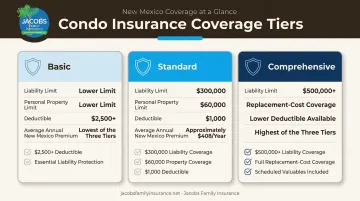
Insurers don't sell "Basic," "Standard," or "Comprehensive" as official product names, but coverage tends to cluster into three practical tiers based on the limits you select.
Basic Coverage
This tier keeps personal property and liability limits at the low end, often paired with a higher deductible ($2,500 or more) to keep premiums down.
Best for: Owners with modest belongings and an HOA with a robust "all-in" master policy that already covers interior fixtures.
Standard Coverage
Most New Mexico condo owners land here: $300,000 liability, a moderate personal property limit (around $60,000), and a $1,000 deductible. According to Insure.com's New Mexico condo insurance cost analysis, this combination runs roughly $408 per year, or $34 per month — with Santa Fe specifically averaging closer to $420/year.
Best for: Most owners with a fully furnished, typical-sized unit.
Comprehensive Coverage
This tier raises liability to $500,000 or higher, adds replacement-cost personal property coverage, schedules valuables like jewelry or art, and includes a loss assessment endorsement.
Best for: High-value units, owners with significant assets to protect, or condos where the HOA carries a "bare walls" master policy that leaves more of the interior on your shoulders.
Key Factors That Affect the Cost of Condo Insurance
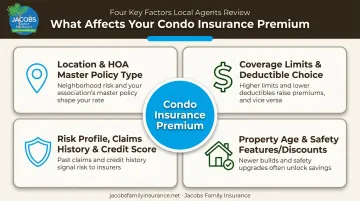
Four forces shape your premium: where you live, the coverage you choose, your HOA's master policy structure, and your personal risk profile.
Location and Master Policy Type
New Mexico sees frequent severe thunderstorms. Every county experiences damaging hail, high winds, and heavy rain each year, with eastern counties seeing golf-ball to baseball-size hail multiple times per season. Wildfire exposure is also a growing concern for Santa Fe-area condo communities.
Your HOA's master policy type matters just as much:
- All-in policies cover association property plus interior fixtures, so you mainly need to insure belongings.
- Bare walls policies exclude interior walls, plumbing, cabinets, and flooring, meaning your HO-6 needs to pick up much more.
- Single entity policies cover common areas and originally installed fixtures, leaving owner-added upgrades to your personal policy.
Coverage Choices and Risk Factors
Raising your personal property limit raises your premium proportionally. NerdWallet's national data shows the jump from $50,000 to $100,000 in personal property coverage pushes the average annual cost from $510 to $680.
Deductible choice works the opposite way. Bumping your deductible from $1,000 to $2,500 saves roughly 16% on average. That's a meaningful discount, but only smart if you have savings set aside to cover that out-of-pocket cost after a claim.
Beyond the coverage you select, insurers also weigh your risk profile. A history of prior claims, or a lapse in coverage, typically pushes rates higher. Insurers view continuous coverage and a clean claims record as signs of lower risk.
Credit-based insurance scores are another factor, though rules vary by state. According to NAIC, most insurers use these scores, but in most states a score alone can't be the sole reason to raise a rate or deny coverage. New Mexico permits restricted use of credit information. Insurers can't rely on it exclusively or penalize a missing score without other lawful underwriting factors.
Property Characteristics and Endorsements
Building age, unit size, and safety features all play into pricing. The Insurance Information Institute notes smoke detectors and burglar alarms can earn discounts of at least 5%, while monitored sprinkler or alarm systems may cut premiums 15% to 20% with qualifying insurers. Older buildings, especially those over 40 years old with original wiring or plumbing, can see higher rates due to increased risk.
These features aren't the only variables, though. Add-ons cost extra but close real gaps:
- Water backup coverage for sewer or drain backups
- Loss assessment increases beyond the standard $1,000–$2,000 limit
- Scheduled personal property for jewelry, art, or collectibles beyond standard sub-limits
Cost Breakdown of Condo Insurance
Condo insurance costs come from several sources, not a single premium. Your total protection combines what your HOA pays collectively with what you cover on your own individual policy.
- HOA master policy premium: Paid through your monthly or annual dues. Covers the building structure and common areas, shared among all owners.
- Personal HO-6 policy premium: Paid directly by you, annually or monthly. Covers personal property, interior finishes not covered by the master policy, liability, and loss of use.
- Loss assessment coverage: Usually a small add-on to your HO-6 policy. Helps cover your share if the HOA's master policy deductible or a shortfall gets passed down to unit owners.
- Optional endorsements: Flood, earthquake, water backup, or scheduled valuables. These are periodic add-ons that fill gaps standard HO-6 policies leave open.
Once you see each piece of the cost puzzle, it's worth checking whether you can shrink the total bill. Bundling opportunity: Pairing your condo policy with an auto policy through Jacobs Family Insurance, your local Allstate agency, typically produces multi-line discount savings across your whole insurance portfolio. A quick bundling analysis can show you the exact savings before you commit to anything.
How to Lower Your Condo Insurance Costs (and Get the Right Budget)
Getting the right price starts with matching coverage to what you actually need, not guessing.
- Request your HOA's master policy declarations page. This tells you exactly what the association covers, so you can right-size your HO-6 dwelling coverage instead of doubling up or leaving gaps.
- Raise your deductible strategically. If you have an emergency fund to cover it, a higher deductible can meaningfully cut your annual premium.
- Compare quotes with identical limits. Get multiple quotes using the same coverage limits and deductible across insurers for a true apples-to-apples comparison.
- Ask about every available discount. Bundling, safety devices, claims-free history, and autopay can all lower your premium. A local Jacobs Family Insurance agent often finds savings a DIY quote tool misses.
Conclusion
Condo insurance cost isn't a fixed number — it moves based on where you live, how much coverage you carry, your deductible, and what your HOA's master policy already handles. Understanding these pieces leads to a smarter budget, not just the cheapest sticker price.
If you own a condo in Santa Fe or Northern New Mexico, Jacobs Family Insurance can walk you through a personalized quote with no call center and no pressure.
As a local Allstate Elite agency with over 10 years serving the community, the team can review your HOA's master policy, right-size your coverage, and find bundling discounts you might otherwise miss.
Call (505) 557-2067, stop by 1547 South St. Francis Drive, or request a quote online to get started.
Frequently Asked Questions
How much is homeowners insurance on a $500,000 condo?
Cost depends far more on your coverage limits and location than your unit's market value. Base your personal property and liability limits on your actual belongings and financial exposure, not the price tag of your unit.
How much should I be paying for condo homeowners insurance?
Nationally, the average runs around $510/year according to industry data, while New Mexico owners typically pay closer to $405–$420/year. The right amount for you depends on your location, your HOA's master policy type, and the coverage limits you choose.
Is condo insurance required in New Mexico?
There's no state law mandating individual HO-6 coverage. However, most mortgage lenders and HOA governing documents require it, so check your loan terms and condo declaration.
What's the difference between an HO-3 and an HO-6 policy?
An HO-3 policy covers a full single-family home, including the structure itself. An HO-6 policy covers only the condo's interior, your personal belongings, and your personal liability.
How can I lower my condo insurance premium without losing coverage?
Raise your deductible if you can absorb the out-of-pocket cost, bundle with an auto policy, and match your HO-6 limits to what your HOA's master policy actually leaves uncovered.
What does the condo association's master policy cover versus my own policy?
The master policy covers the building structure, common areas, and shared association property. Your HO-6 policy covers your personal belongings, interior finishes, personal liability, and loss of use.