If you own a home in Santa Fe or Northern New Mexico, understanding your policy's three core protections — dwelling, personal property, and liability — matters more than you might expect. The region's adobe construction, wildfire exposure, and high-desert weather create risks that make a vague understanding of "I have insurance" genuinely dangerous.
This article breaks down each major coverage type in plain terms: what it protects, what it excludes, how to know if your limits are adequate, and where homeowners most commonly get burned by gaps they didn't know existed.
Key Takeaways
- A standard HO-3 policy bundles property and liability into six coverage categories (A through F)
- Dwelling coverage should reflect rebuild cost, not market value, and the gap between the two is often significant
- Actual cash value vs. replacement cost is the single biggest factor in what you'll receive after a personal property claim
- Liability coverage pays legal defense costs and settlements; standard limits range from $100,000 to $500,000
- In New Mexico, wildfires are typically covered, but floods and earthquakes require separate policies
What's Actually Included in a Standard Homeowners Policy?
A standard HO-3 policy — the most common homeowners form in the U.S., according to the NAIC's consumer guide — is organized into two sections and six coverage categories:
| Coverage | What It Protects |
|---|---|
| A — Dwelling | The physical structure of your home |
| B — Other Structures | Detached garages, sheds, fences |
| C — Personal Property | Furniture, electronics, clothing, belongings |
| D — Loss of Use | Temporary housing costs if home is uninhabitable |
| E — Personal Liability | Legal costs if someone is injured or you damage others' property |
| F — Medical Payments | Minor medical costs for guests injured on your property |
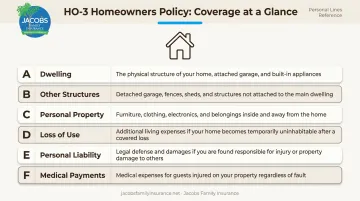
This article focuses on the three that affect most homeowners most directly: dwelling (A), personal property (C), and liability (E). Coverages B, D, and F are addressed where relevant.
One important note about those six categories: while mortgage lenders require homeowners insurance as a loan condition, no New Mexico state law mandates it for all homeowners. Understanding what each coverage does — and where the gaps are — is how you make sure you're protected, not just compliant.
Dwelling Coverage: Protecting the Structure of Your Home
Coverage A pays to repair or rebuild the physical structure of your home when damaged by a covered peril. That includes:
- Walls, roof, floors, and foundation
- Built-in appliances, plumbing, and electrical systems
- Attached structures like garages and covered patios
Covered perils on an HO-3 include fire, smoke, windstorm, vandalism, and accidental water damage. What it does not cover: floods, earthquakes, or damage from neglect (mold, pest infestation, normal wear).
For New Mexico homeowners, wildfire damage is typically covered under a standard HO-3 — but always confirm your specific policy language. Earthquakes, which do occur along the Rio Grande Rift fault system, require a separate endorsement and are not included in standard coverage.
How Much Dwelling Coverage Do You Actually Need?
Here's where most homeowners get it wrong: dwelling coverage should reflect rebuild cost, not market value.
Market value includes your land, location desirability, and real estate market conditions. Rebuild cost reflects what it would cost to reconstruct your home at current labor and material prices — and those two numbers can differ by tens of thousands of dollars.
The gap has widened sharply in recent years. According to the Insurance Information Institute, cumulative replacement costs increased 55% between 2020 and 2022 alone. Verisk data shows residential reconstruction costs rose 63.7% from October 2014 to October 2024.
If your policy limit was set more than two years ago, there's a real chance it no longer covers what a full rebuild would actually cost.
The 80% Rule: What It Means and Why It Matters
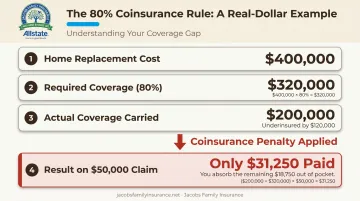
Most insurers require you to carry at least 80% of your home's replacement cost value to receive full reimbursement on a partial loss. Fall below that threshold and a penalty formula applies.
Here's a simplified example:
- Your home's replacement cost: $400,000
- Required coverage (80%): $320,000
- Your actual coverage: $200,000 (62.5% of required)
- You have a $50,000 loss
Instead of receiving $50,000 minus your deductible, your payout is reduced proportionally — you'd receive roughly $31,250 minus deductible. That's a meaningful gap on what seems like a routine claim.
Santa Fe and Northern New Mexico Homes
Adobe, pueblo-style, and custom-built homes common throughout Santa Fe typically carry higher-than-average rebuild costs per square foot due to specialized materials, skilled labor requirements, and regional construction practices. NAHB's 2024 data puts national custom-built home construction at roughly $166 per square foot — but Santa Fe's distinctive architecture and construction market can push that figure higher.
Standard online rebuild calculators often aren't built for regional nuances. A professional rebuild cost estimate — or a conversation with a local agent familiar with Santa Fe's construction market — gives you a more accurate baseline. Jacobs Family Insurance works with Santa Fe homeowners to review Coverage A limits against today's actual rebuild environment — particularly useful if you've renovated recently or haven't revisited your policy in a few years.
Coverage A focuses on the main structure, but your policy also protects what's around it. Coverage B (Other Structures) is automatically included at 10% of your dwelling limit — covering detached garages, sheds, and fencing — and can typically be increased if needed.
Personal Property Coverage: Protecting What's Inside Your Home
Coverage C protects your belongings — furniture, clothing, electronics, appliances, décor — if they're damaged or stolen due to a covered peril. Coverage often extends beyond your home: a laptop stolen from a hotel room may qualify, for example.
The default Coverage C limit is typically 50–70% of your dwelling coverage limit, according to the III. If your home is insured for $400,000, your personal property coverage might default to $200,000–$280,000. For many households, that's enough — but households with significant assets, art, jewelry, or specialized equipment should verify this math actually works for them.
Actual Cash Value vs. Replacement Cost — Why It Matters
This distinction has more impact on your claims experience than almost any other policy detail.
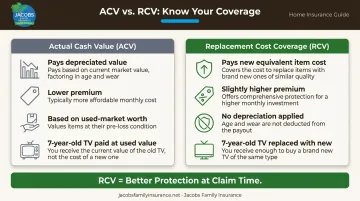
Actual Cash Value (ACV) pays the depreciated value of your item at the time of loss. A 7-year-old TV isn't worth what a new TV costs — so ACV pays what a 7-year-old TV is worth on the used market.
Replacement Cost Coverage (RCV) pays what it would actually cost to buy a comparable new item today. Your 7-year-old TV gets replaced with a new equivalent model.
Replacement cost coverage costs slightly more in premium, but the difference in a real claim is substantial. Ask your agent which valuation method applies to your current policy — and whether upgrading makes sense.
Sub-Limits and High-Value Items
Standard HO-3 policies apply sub-limits to specific categories regardless of your total Coverage C limit. Per the ISO HO-3 sample form:
- Cash/money: $200
- Jewelry, watches, and precious stones (theft): $1,500
- Firearms and related equipment (theft): $2,500
- Silverware and goldware (theft): $2,500
If you own jewelry, collectibles, fine art, or high-end equipment that exceeds these caps, a Scheduled Personal Property endorsement (personal articles floater) allows you to list specific items at their appraised value — with broader protection and often no deductible on covered losses.
Jacobs Family Insurance works with homeowners across Santa Fe and northern New Mexico to schedule high-value items — jewelry, fine art, collectibles — that standard sub-limits leave underprotected. If you're unsure whether your current policy covers what you actually own, that's worth a direct conversation with your agent.
Create a home inventory — a documented list of your belongings with photos and estimated values. Store it somewhere outside your home (cloud storage works well). It makes the claims process significantly smoother and helps you avoid underestimating your coverage needs.
Liability and Other Protective Coverages in Your Policy
Personal Liability Coverage (Coverage E)
Coverage E kicks in when you or a family member are legally held responsible for bodily injury or property damage to someone else. It pays:
- Legal defense costs
- Court-ordered settlements
- Damages up to your policy limit
Concrete scenarios where this matters:
- A guest slips on your icy walkway and sues
- Your dog bites a neighbor's child
- You accidentally damage a neighbor's fence or vehicle
Dog-bite claims alone cost U.S. homeowners insurers $1.862 billion across 28,450 claims in 2025, averaging $65,450 per claim, according to the Insurance Information Institute. A single incident can quickly exceed a modest liability limit.
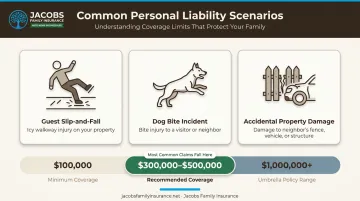
Standard policies offer $100,000–$500,000 in Coverage E. The III recommends considering $300,000–$500,000 as a baseline. Homeowners with pools, trampolines, dogs, or significant personal assets should consider higher limits — or an umbrella policy.
An umbrella policy extends liability coverage beyond your homeowners limit, starting at $1 million. Insurers generally require $300,000 in underlying homeowners liability before issuing a $1 million umbrella.
Loss of Use / Additional Living Expenses (Coverage D)
Liability protection matters, but what happens if your home itself becomes unlivable? That's where Coverage D steps in. If a covered loss makes your home temporarily uninhabitable, it pays for additional living expenses above your normal cost of living — hotel stays, restaurant meals, temporary rentals. The typical cap is 20% of your dwelling limit, and you'll need to keep receipts for reimbursement.
Medical Payments to Others (Coverage F)
Coverage F pays reasonable medical expenses for someone accidentally injured on your property — regardless of fault and without covering household members. Limits are modest ($1,000–$5,000), but the coverage earns its keep: it can resolve minor accidents before they escalate into full liability claims.
Common Misconceptions and Coverage Gaps to Watch For
A few patterns come up repeatedly when homeowners review their policies:
Market value ≠ rebuild cost. Many homeowners set their dwelling limit based on purchase price or Zillow estimates. Neither reflects what it costs to rebuild. With construction costs rising sharply over the past several years, policies set even three or four years ago may be materially underinsured today.
Floods and earthquakes aren't covered by a standard HO-3 policy. Both are explicit exclusions. In New Mexico, flash flooding in arroyos is a documented seasonal risk, and the Rio Grande Rift presents genuine earthquake exposure. Flood insurance is available separately through the National Flood Insurance Program (NFIP); earthquake coverage typically requires a separate endorsement.
Personal property sub-limits catch people off guard. Homeowners often assume their belongings are "fully covered" up to their Coverage C limit. They're not — specific categories have hard caps that apply before you reach the overall limit. High-value jewelry, firearms, collectibles, and business equipment used at home all have limitations that a quick policy review would reveal.
A 2023 Policygenius survey found only 33% of homeowners were "very sure" their dwelling coverage limits were adequate, and 56% hadn't reviewed their policy in the prior year. None of these gaps are hard to fix. The challenge is identifying them before you file a claim. A policy review with a local agent is the most direct way to catch them.
Frequently Asked Questions
What is the difference between dwelling coverage and personal property coverage?
Dwelling coverage (Coverage A) protects the physical structure — walls, roof, built-in systems, and attached structures. Personal property coverage (Coverage C) protects the contents inside your home. They're separate coverage limits within the same policy, and each can be underinsured independently.
What should my home insurance dwelling coverage be?
Your dwelling coverage should reflect the full cost to rebuild your home at today's construction prices — not its market value or what you paid for it. Most insurers recommend insuring to at least 80–100% of replacement cost. A local agent or professional appraisal gives you the most accurate number for Santa Fe's construction market.
What should my personal liability be on my homeowners insurance?
Standard policies offer $100,000–$500,000 in liability coverage. Homeowners with dogs, pools, trampolines, or significant assets should carry $300,000–$500,000 at minimum — or supplement with an umbrella policy for coverage starting at $1 million.
Why would someone purchase a dwelling policy instead of a homeowners policy?
A dwelling-only policy is designed for rental properties, vacation homes, or properties the owner doesn't occupy. It covers the structure but generally excludes the broader personal property and comprehensive liability protections that a full HO-3 homeowners policy provides.
Does homeowners insurance cover wildfires or floods in New Mexico?
Wildfire damage is typically covered under a standard HO-3 policy — an important protection given Santa Fe County's documented wildfire exposure. Flood damage is excluded and requires separate coverage through the NFIP. Earthquake damage also requires a separate endorsement and is not included in standard policies.
What is the difference between actual cash value and replacement cost coverage?
Actual cash value pays the depreciated worth of your item at the time of loss — what a used version is worth, not what a new one costs. Replacement cost coverage pays what it would cost to buy a comparable new item today. It runs slightly more in premium but delivers meaningfully better protection when you file a claim.
Jacobs Family Insurance is a local, family-owned Allstate Elite Agency serving Santa Fe and Northern New Mexico for over 10 years. For a free quote or policy review, visit jacobsfamilyinsurance.net or call (505) 557-2067, Monday–Friday, 9 AM–5 PM.