Most New Mexico drivers know they're required to carry this coverage. Far fewer understand what it actually pays for, how the limits work, or what happens when the damage bill exceeds their policy cap. This guide covers all of it: what PD liability is, what it covers, how it works in a real claim, and how to pick a limit that actually protects you.
Key Takeaways
- PD liability pays to repair or replace other people's property — vehicles, fences, buildings — when you're at fault
- Does not cover your own car, your own property, or your own medical bills
- New Mexico requires a minimum $10,000 PD liability limit per accident under the 25/50/10 framework
- If damages exceed your limit, you pay the difference out of pocket
- Raising your PD limit above the state minimum usually adds very little to your premium
What Is Property Damage Liability Coverage?
Property damage liability is the part of your auto policy that pays to repair or replace someone else's property when you cause an accident. Not your property — theirs.
It's one half of what insurers call liability coverage. The other half is bodily injury (BI) liability, which covers medical costs and related damages for people you injure. The two work together but serve different purposes: BI covers injured people, PD covers damaged property.
How It Fits Into Your Auto Policy
Liability coverage is legally required in New Mexico — it's not optional like collision or comprehensive. Under New Mexico's MVD requirements, every registered vehicle must carry at minimum 25/50/10 coverage:
- $25,000 bodily injury per person
- $50,000 bodily injury per accident
- $10,000 property damage per accident
The $10,000 is the PD liability floor — the least coverage you can legally carry.
PD liability is also separate from personal liability coverage on a homeowners or renters policy. Personal liability covers everyday incidents at home — PD liability applies only when you cause property damage while driving.
What Property Damage Liability Covers — and What It Doesn't
Property Typically Covered
When you're at fault, PD liability can pay to repair or replace a wide range of property types:
- Another person's vehicle (parts and labor)
- Fences, mailboxes, and gates
- Light poles, guardrails, and utility poles
- Road signs and public infrastructure
- Buildings — including homes, storefronts, or commercial structures
- Trees and landscaping features
PD liability may also cover legal fees and court costs if the property owner files a lawsuit against you over the accident. In other words, it functions as both a repair bill coverage and a legal defense resource.
What PD Liability Won't Pay For
PD liability does not cover:
- Damage to your own car — that requires collision coverage
- Your own personal property inside or outside your vehicle
- Your medical expenses — that's what MedPay handles
- Your lost wages after an accident
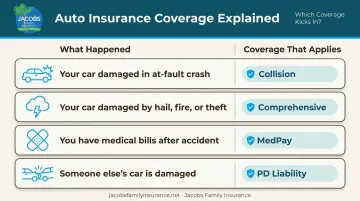
Here's how the gaps get filled:
| What Happened | Coverage That Applies |
|---|---|
| Your car is damaged in an at-fault crash | Collision coverage |
| Your car is damaged by hail, fire, or theft | Comprehensive coverage |
| You have medical bills after an accident | MedPay (or PIP in some states) |
| Someone else's car is damaged | PD liability |
How Property Damage Liability Works When You're at Fault
PD liability pays on a per-accident basis — not per vehicle or per object damaged. Say you rear-end a car at a stoplight, pushing it into the vehicle ahead. Now you've damaged two cars in one accident. Both repair bills come out of a single PD limit. If your limit is $10,000 and the combined damage is $18,000, your insurer pays $10,000 — and you owe the remaining $8,000 out of your own pocket.
That scenario is more common than it sounds. According to the Insurance Information Institute, the average property damage liability claim in 2024 was $6,770 — and a multi-vehicle or high-damage incident can easily push well past $10,000.
Understanding Coverage Limits and the Split-Limit Format
The three-number format — 25/50/10 — shows up on your declarations page and breaks down like this:
- Per-person bodily injury (25): Maximum paid per injured person — $25,000
- Per-accident bodily injury (50): Total cap for all bodily injury in one accident — $50,000
- Property damage (10): Maximum paid for all property damage in one accident — $10,000
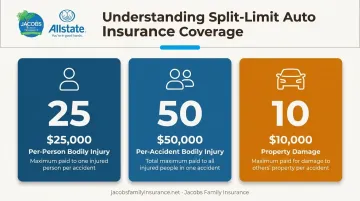
The third number is your PD coverage. It's the maximum your insurer will pay for all property damage in a single accident, regardless of how many vehicles or objects are involved.
Some policies use a combined single limit (CSL) instead. Rather than three separate caps, a CSL pools bodily injury and property damage into one total — for example, $300,000 covering all liability damages from one accident. CSL policies offer more flexibility because the full amount can shift toward whichever type of damage is larger, but they tend to cost more than comparable split-limit policies.
How Much Property Damage Liability Coverage Do You Need?
New Mexico's Minimum — and Why It May Not Be Enough
New Mexico's legal floor is $10,000 PD per accident. That covers compliance — not a realistic accident.
Consider the numbers: new vehicles averaged $50,080 in September 2025, and average used car listing prices sit around $25,730. A single total-loss claim on a newer vehicle will exhaust a $10,000 PD limit before the paperwork is done.
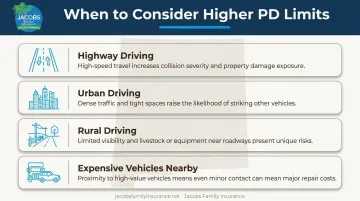
Factors That Point Toward Higher Limits
Ask yourself where and how you drive:
- Highway driving on I-25 or I-40, where speeds are higher and multi-vehicle accidents are more likely
- Urban driving in Santa Fe's commercial corridors or Albuquerque, where vehicle density is higher
- Rural driving on state highways where guardrails, utility poles, and fencing can add to accident costs
- Expensive vehicles in your area — damaging a newer truck or SUV is a common scenario in New Mexico
Moving from $10,000 to $25,000 or $50,000 in PD coverage typically adds a modest amount to your premium. The NAIC notes that higher liability limits are often available "without much increase" in premium — though the exact difference depends on your driving record, vehicle, and insurer. Getting a side-by-side quote is the only way to see your actual cost difference.
Adding an Umbrella Policy
For drivers who want protection beyond their auto policy limits, an umbrella policy provides an additional layer of liability coverage — typically in $1 million increments — that kicks in after your underlying auto limits are exhausted.
One important detail: umbrella policies generally require substantially higher underlying auto limits than New Mexico's state minimum before they'll attach. A local agent can help you determine whether your current auto limits qualify.
Jacobs Family Insurance, a family-owned Allstate Elite agency serving Santa Fe and communities across New Mexico, can review your current policy and help you assess whether your PD limit fits your actual driving exposure — with no obligation.
Common Misconceptions About PD Liability
"My insurance will cover my own car if I'm at fault."
No. PD liability only covers other people's property. If you cause an accident and your car is damaged, collision coverage pays for your repairs — not PD liability.
"Full coverage means I have enough liability."
"Full coverage" isn't a defined insurance term. It typically refers to a policy that includes collision and comprehensive, which cover your own vehicle — completely separate from liability limits. A driver can have both and still carry only $10,000 in PD liability, leaving them exposed in any serious at-fault accident.
"The state minimum is enough."
State minimums are legal compliance floors, not financial safety benchmarks. New Mexico set $10,000 as the minimum to keep drivers legally on the road, not to protect them against realistic damage costs. Modern vehicle repairs regularly exceed $4,700, and a total loss can run $25,000 to $50,000. The minimum limit can be exhausted by one moderate accident.
These misconceptions share a common thread: confusing legal compliance with actual financial protection. If any of the three applied to your current policy, it's worth reviewing your PD liability limits before you need to use them.
Frequently Asked Questions
What does property damage liability coverage cover?
PD liability pays to repair or replace another person's vehicle, structures, fences, utility poles, road signs, and similar property damaged in an accident you caused. It may also cover related legal fees if the property owner sues you.
What is not covered by property damage liability coverage?
PD liability does not cover your own car, your personal property, your medical bills, or your lost wages. Each of those gaps has its own coverage:
- Collision covers your vehicle after an at-fault accident
- MedPay handles your medical costs
- Comprehensive covers non-collision damage to your car
How much property damage liability coverage do I need in New Mexico?
New Mexico's minimum is $10,000 per accident. Given current vehicle values and repair costs, most agents recommend carrying limits above the state minimum. A local agent at Jacobs Family Insurance can help you choose a limit that fits your driving habits and financial exposure.
What happens if the damage I cause exceeds my coverage limit?
Your insurer pays up to your policy limit and you are personally responsible for the remaining balance. That's why carrying higher limits than the legal minimum is worth the modest premium difference.
Is property damage liability the same as full coverage?
No. "Full coverage" is an informal term that typically refers to collision and comprehensive (coverages for your own vehicle). Liability coverage is a separate component, and having collision or comprehensive does not guarantee sufficient PD liability limits.
Does property damage liability cover damage to my own car?
No. PD liability only covers damage to other people's property. Damage to your own vehicle in an at-fault accident is covered under collision insurance, not PD liability.