
Renters are burglarized more often than most people realize. In fact, renter households experienced 120.6 property victimizations per 1,000 households in 2023, compared to just 81.2 per 1,000 for homeowners, according to Bureau of Justice Statistics data. If you rent your home, you're statistically more exposed to theft than your neighbor who owns.
Yet most renters have no idea what their policy actually pays out. What counts as "theft"? Is there a cap on jewelry? Does it matter if the door was locked?
This guide breaks down what renters insurance covers for theft, what it doesn't, and how to avoid a denied claim. We'll also share how Jacobs Family Insurance helps Santa Fe and northern New Mexico renters choose the right protection.
Key Takeaways
- Personal property coverage pays for stolen items in or outside your home, minus your deductible.
- Overall policy limits and item sublimits (jewelry, cash, electronics) both apply.
- Your car is never covered, but items stolen from inside it usually are
- Missing documentation, like a police report, is a leading cause of claim denial
- A local agent can match coverage limits and endorsements to what you own.
What Does Renters Insurance Cover for Theft?
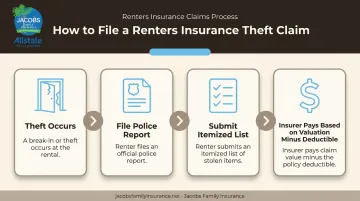
Standard renters insurance includes personal property coverage, and theft (whether it's a burglary or a robbery) is one of the core perils nearly every policy insures against. If someone steals your belongings, this is the coverage that reimburses you.
Here's a typical scenario: A renter comes home to find their door pried open. Their TV, laptop, and a stack of clothing are gone.
They file a police report, call their insurer, and submit an itemized list of what's missing. Assuming theft is a covered peril on the policy (it almost always is), the insurer pays out based on the policy's valuation method, minus the deductible.
Actual Cash Value vs. Replacement Cost
This is where payouts get confusing. Insurers settle claims one of two ways:
| Valuation Method | How It Pays |
|---|---|
| Actual Cash Value (ACV) | Depreciated value of the stolen item — that five-year-old laptop won't fetch what you paid for it. |
| Replacement Cost Value (RCV) | Cost to buy a new equivalent item today, no depreciation subtracted. |
RCV coverage typically costs more to add to a policy, but it pays out meaningfully more after a real loss. Knowing which one your policy uses matters before you ever file a claim.
Coverage applies whether the thief forced their way in or walked through an unlocked door, as long as the theft is documented as a genuine crime. Insurers care about proof, not the point of entry.
Renters insurance also includes liability protection, which covers injuries or damage you're responsible for. That's separate from property theft coverage. Don't confuse the two when reviewing your policy.
Coverage amounts, deductibles, and included perils vary by provider and plan. Your Declarations Page spells out your actual limits, so read it before a theft occurs, not after.
Theft Coverage Beyond Your Home
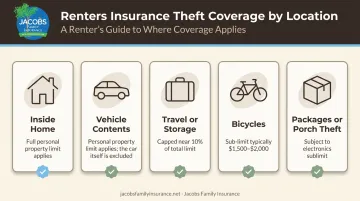
Here's something many renters don't realize: theft coverage under most policies extends worldwide, not just within your rental's four walls. Your belongings are generally protected wherever you take them, subject to your policy's terms and limits.
Does Renters Insurance Cover Car Break-Ins?
The vehicle itself is never covered by renters insurance. Auto theft, damage to the car, all of that falls under a separate auto or comprehensive policy.
However, personal items stolen from inside your car are typically covered under your renters policy, up to your personal property limit, minus the deductible. Think laptops, sports gear, or bags left on a seat.
This distinction matters more than you might think. Vehicle break-ins account for a substantial share of theft nationally. The FBI recorded 1,027,221 thefts from motor vehicles in 2024, out of roughly 4.3 million total larceny-thefts, meaning nearly a quarter of all reported larceny-theft involves vehicle contents.
Theft While Traveling or in Storage
Renters insurance often protects belongings stolen from hotels, storage units, or while you're on vacation. For example, a suitcase stolen from a hotel room during a family trip typically falls under this off-premises provision. Many insurers cap this "off-premises" protection at a percentage of your total personal property limit, commonly around 10%.
If you have $40,000 in personal property coverage, that might mean roughly $4,000 in protection for items stolen away from your rental. Check your Declarations Page for your specific off-premises limit before assuming full coverage applies.
Does Renters Insurance Cover Bike Theft?
Bikes are typically covered personal property, including when stolen away from home. A locked bike stolen from a rack outside your building still counts as theft. But most policies apply a sub-limit to bicycles and other sports equipment, often $1,500 to $2,000.
If you own an e-bike or a high-value bicycle, that sub-limit may fall well short of replacement cost. E-bikes especially often retail above that threshold. In those cases, a separate rider or bicycle-specific policy fills the gap.
Does Renters Insurance Cover Package Theft?
Porch piracy is covered as well, up to the item's value and your policy's relevant sublimit. Here's the catch: if a stolen laptop is worth more than your policy's computer or electronics sublimit, you'll only recover up to that cap, not the item's full value.
Also worth noting: a $30 package might fall below your deductible entirely, meaning no payout even though theft is a covered peril.
Special Limits for High-Value Items
Most renters policies cap payouts for high-risk categories regardless of what the item is actually worth. This catches people off guard.
Common category limits include:
- Jewelry: Often capped around $1,000 to $2,500 for theft, well below an engagement ring's real value
- Cash: Usually limited to just a few hundred dollars, no matter your total coverage limit
- Firearms: Subject to special theft sublimits that vary by insurer
- Collectibles: Stamps, coins, and similar items often fall under a separate category limit
Electronics deserve their own mention. Laptops and smartphones often have specific per-item tech coverage limits that are distinct from your general personal property limit. That stolen MacBook might exceed the "computer" sublimit even if your overall coverage looks generous on paper.
Closing the Gap With Scheduled Coverage
A scheduled personal property endorsement, sometimes called a valuable items floater, extends coverage beyond these standard sublimits. You appraise the item, add it to your policy by name, and it's protected closer to its actual worth, often without a deductible.
If you own jewelry, firearms, or collectibles worth more than your policy's built-in limits, this is the fix. Jacobs Family Insurance works with renters throughout Santa Fe and northern New Mexico to review sublimits line by line and add endorsements where the gap matters most.
Understanding Coverage Limits, Deductibles & Cost
Personal property limits typically range from $20,000 to $100,000 or more, and the right number depends entirely on what you own, not a generic recommendation. A home inventory (room by room, with photos and receipts) is the fastest way to land on an accurate figure.
How much does coverage cost? According to NerdWallet's 2026 rate analysis, a sample policy with $30,000 in personal property coverage and a $500 deductible averages $151 per year nationally and $168 per year in New Mexico. Higher limits, like $100,000 or beyond, raise that premium, though not as dramatically as many renters expect.
How a Theft Claim Payout Actually Works
Say you carry a $500 deductible and $50,000 in personal property coverage under a replacement cost value (RCV) policy. A thief steals:
- A laptop (replacement cost: $1,200)
- A bike ($600)
- Clothing valued at $400
Total loss: $2,200.
Your insurer subtracts your $500 deductible from that total, leaving a $1,700 payout, assuming nothing exceeds a category sublimit. Choosing a higher deductible (say, $1,000 instead of $500) can lower your premium by a meaningful margin, but it also means you absorb more of the loss before coverage kicks in.
What to Do If You're a Victim of Theft (And Why Claims Get Denied)
Acting fast and documenting everything gives you the best shot at a smooth claim.
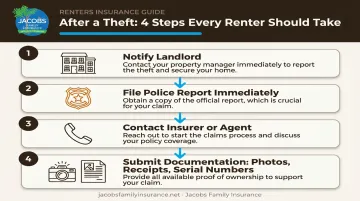
- Notify your landlord if the break-in involves shared entry points or building security
- File a police report immediately and get the report number
- Contact your insurer or agent as soon as possible, most policies have reporting deadlines
- Submit documentation, including photos, receipts, serial numbers, and an itemized list of what's missing
A home inventory completed before a loss makes this process dramatically easier. Photos, serial numbers, and receipts gathered in advance can cut days off your claim timeline.
Even fast, well-documented claims get denied sometimes. The most common reasons include:
- No police report was filed
- The loss occurred under an excluded circumstance (like a lapsed policy)
- The stolen item exceeds a category sublimit with no supporting endorsement
- Documentation is too thin to establish ownership or value
Jacobs Family Insurance offers personal-property inventory guidance to Santa Fe-area renters before a policy is even purchased, so there's no scrambling for proof after the fact. And when theft does happen, you'll reach a local agent who already knows your policy and your Santa Fe address.
Frequently Asked Questions
What does renters insurance cover for theft?
Personal property coverage reimburses stolen belongings both inside and outside your home, up to your policy limits and minus your deductible. Theft is a standard covered peril on nearly every renters policy.
How much does $300,000 in renters insurance cost?
Cost depends on your coverage limit, location, and provider, with national averages of $151-$171 per year for $30,000 limits. For $300,000 in coverage, request a personalized quote since premiums scale with your total insured value.
Can insurance deny a claim for theft?
Yes. Common denial reasons include a missing police report, an excluded circumstance, a lapsed policy, or a loss that exceeds an item-specific sublimit without proper documentation.
Does renters insurance cover theft from a car?
The car itself isn't covered under renters insurance. Personal belongings stolen from inside it, like electronics or bags, typically are covered up to your personal property limit.
Does renters insurance cover stolen packages?
Yes, up to the item's value and your policy's relevant sublimit. A stolen laptop, for example, may be capped by your electronics sublimit rather than your full policy limit.
How much renters insurance coverage do I need?
Start with a home inventory to estimate your belongings' total value, then match your coverage limit to that number. A local agent, like Jacobs Family Insurance, can help you choose limits that fit your actual risk.