The good news? A condo insurance policy, known as an HO-6 policy, can include an add-on called loss assessment coverage built specifically to help pay bills like this one. This article breaks down how special assessments happen, what loss assessment coverage actually pays for, and how New Mexico condo owners can figure out the right amount of protection.
Key Takeaways
- Special assessments bill you when your HOA's master policy or reserves fall short of a claim's true cost.
- Standard HO-6 policies include only a small loss assessment limit — you can increase it.
- Coverage applies to fire, wind, hail, and liability, not capital improvements or flood damage.
- A local agent's review of your HOA's master policy quickly reveals coverage gaps.
What Is a Special Assessment? (And Why Condo Owners Get Hit With Them)
A special assessment is a one-time or installment charge your condo association levies on unit owners when shared expenses exceed what monthly dues and reserve funds can cover.
The Community Associations Institute defines it broadly: a special assessment is used when reserves or insurance are insufficient for a specific project or unexpected expense.
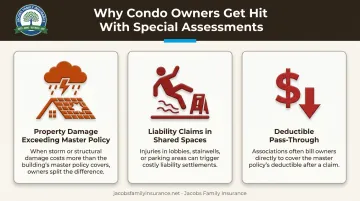
Three situations trigger most assessments:
- Property damage exceeding the master policy limit: a fire, storm, or burst pipe damages a roof, elevator, or lobby, and repair costs blow past what the HOA's insurance pays out.
- Liability claims in shared spaces: someone slips on ice in the parking lot, and the resulting judgment exceeds the association's liability coverage.
- Deductible pass-through: HOA deductibles can run into tens of thousands of dollars, split among owners instead of paid from reserves.
How the Bill Gets Divided
Assessments aren't always split evenly by unit count. In New Mexico, common expenses are allocated based on the percentages written into your condominium declaration, not automatically by headcount. New Mexico statute 47-7B-7 also allows exceptions: expenses that benefit only certain units, or damage caused by one owner's negligence, can be assessed against just that unit.
Amounts vary widely depending on the repair and building. A single roof replacement might mean a few hundred dollars per owner in a large complex, or several thousand in a smaller one. Ask your HOA for its reserve study — it's the clearest signal of whether a big-ticket assessment might be coming.
What Is Condo Insurance for Special Assessments? (Understanding Loss Assessment Coverage)
Loss assessment coverage is an optional endorsement added to an HO-6 condo policy. It reimburses your share of a covered special assessment, up to whatever limit you've purchased. Most standard HO-6 policies include a modest built-in limit automatically, and owners can typically increase that limit through an endorsement , often up to $100,000 depending on the insurer.
A Quick Example
Say a fire causes $550,000 in damage to a shared building, but the HOA's master policy only covers $500,000. The association divides the $50,000 shortfall among 50 unit owners , or $1,000 each. If you're carrying loss assessment coverage, your policy reimburses that $1,000 (or your full share, up to your limit), rather than leaving you to pay it out of pocket.
This coverage only responds to assessments tied to a covered peril. Allstate's guidance on loss assessment coverage confirms it can help with fire, wind, hail, vandalism, and association liability claims — plus your share of the HOA's insurance deductible, when that deductible relates to a covered claim.
| Trigger | Typically covered? |
|---|---|
| Fire or wind damage to common areas | Yes |
| Liability judgment from a common-area injury | Yes |
| HOA master policy deductible (covered claim) | Often, up to your limit |
| Planned capital improvements (new roof, landscaping) | No |
| Flood or earthquake damage | No, unless separately insured |
What's generally excluded:
- Capital improvement projects funded because reserves ran low — new elevators, repaving, amenity upgrades.
- Uninsured perils like flood or earthquake, unless you've added that coverage separately.
- Assessments tied to mismanagement rather than an actual insured loss.
Does Condo Insurance Automatically Cover Special Assessments?
Not fully. Base HO-6 policies include only a limited loss assessment amount by default. If your building has an aging roof, an elevator, a pool, or other high-value common areas, that default limit may not stretch far enough. Owners in older buildings or smaller associations should seriously consider increasing it.
How Much Loss Assessment Coverage Do You Need — and What Does It Cost?
The right coverage limit depends on three things:
- Your HOA's master policy limit — how much of a major loss it actually covers.
- The master policy deductible — a larger deductible means a bigger potential bill passed to owners.
- How many units share the cost — fewer units sharing an assessment means each owner's share is larger.
Before choosing a limit, ask your HOA for two documents: the master policy declarations page and the most recent reserve study. Together, they show you what's insured, what isn't, and whether the association is saving enough to avoid a surprise bill.
Buildings with fewer units, more amenities (pools, elevators, clubhouses), or older infrastructure typically warrant higher loss assessment limits, because there are fewer owners to absorb a shortfall.
On cost: loss assessment endorsements typically add only a small amount to your annual premium — the exact cost depends on the insurer and the limit you choose. Given that an assessment itself can run into the thousands, the endorsement is often inexpensive protection relative to the risk it covers.
A local agent can help you spot these gaps before they turn into a costly surprise. Jacobs Family Insurance, an Allstate Elite Agency in Santa Fe, includes loss assessment as a core piece of the HO-6 condo policies it writes for owners across Santa Fe, Los Alamos, Española, Taos, and the rest of Northern New Mexico. The policy also covers personal property, interior improvements, personal liability, and additional living expenses.

Protecting Yourself Before a Special Assessment Hits
A little homework now can save you a painful surprise later.
- Review meeting minutes and reserve reports every year. Chronic underfunding is usually visible months, sometimes years, before an assessment lands.
- Ask about upcoming capital projects such as roof replacements, repaving, or elevator overhauls — then find out if reserves will actually cover them.
- Get your master policy reviewed by a local agent who can compare your HOA's coverage limits and deductible against your own HO-6 loss assessment limit, and flag where the two don't line up.
If any of these checks turn up a gap, that's exactly where a second set of eyes helps. Jacobs Family Insurance has served Santa Fe and Northern New Mexico condo owners for more than a decade as a family-owned Allstate Elite Agency.
Reach the team at (505) 557-2067 or visit the office at 1547 South St. Francis Drive, Santa Fe, NM 87505, Monday through Friday. The team will walk through your HOA's master policy and tailor your loss assessment limit to your building's actual risk.
Frequently Asked Questions
Does condo insurance cover special assessments?
Standard HO-6 policies include a small built-in loss assessment limit, but it often isn't enough for larger bills. Owners can purchase a higher optional limit to close that gap.
Is condo assessment insurance worth it?
Yes, for most owners. The endorsement typically adds a modest amount to your annual premium, while an actual assessment can run into the thousands.
What should condo owners know before a special assessment hits?
Review your HOA's master policy and reserve study, and confirm your own loss assessment limit ahead of time. Waiting until after an assessment lands is too late to adjust coverage.
How much does loss assessment coverage typically cost?
Cost varies by insurer and the limit you choose, but it's usually a low-cost addition to your HO-6 premium. A licensed agent at Jacobs Family Insurance can give you an exact quote for your policy.
Does loss assessment coverage cover my HOA's insurance deductible?
Often, yes. If the association passes its master policy deductible to owners after a covered claim, loss assessment coverage can typically help pay it, up to your limit.
What happens if I don't have loss assessment coverage and get hit with an assessment?
You're personally responsible for the full amount out of pocket. Any amount above your purchased limit also falls to you, even with coverage in place.