
Many condo owners assume their HOA's master policy has them covered. Then a claim happens, and they discover a gap they never knew existed. The truth is that HO6 condo insurance and the HOA's master policy work together. They don't overlap, and they definitely aren't interchangeable.
This guide breaks down exactly what condo insurance covers, what it excludes, and how New Mexico condo owners can close the gaps between their personal policy and their association's coverage.
Key Takeaways
- HO6 covers personal belongings, interior structure, liability, and additional living expenses.
- Master policies cover buildings and common areas; HO6 covers your interior and contents.
- Flood, earthquake, and pest damage need separate coverage; HO6 excludes them by default.
- Liability coverage, not the small "Damage to Property of Others" provision, pays for major damage to a neighbor's unit.
What Does Condo Insurance (HO6) Actually Cover?
An HO6 policy is built around four core coverage areas. Each one has its own limit, and each responds to a different type of loss.
Personal Property and Belongings
Your furniture, electronics, jewelry, and clothing are protected against fire, smoke, theft, vandalism, and lightning. Because HO6 only insures the interior and contents rather than an entire structure, it typically costs less than a standard homeowners policy.
That said, standard limits often fall short for high-value items. Fine jewelry, art, and collectibles usually need a scheduled endorsement or floater policy to be covered at their real value.
Personal Liability and Damage to Others' Property
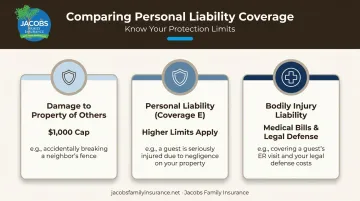
This is where most condo owners get confused. If your negligence causes serious damage to a neighbor's unit (say, that overflowing bathtub or a fire that started in your kitchen), the claim is generally paid through Personal Liability (Coverage E), not the smaller Damage to Property of Others provision.
Here's the distinction that matters:
- Damage to Property of Others is a limited courtesy coverage, often capped around $1,000, meant for minor, no-fault situations (think: you accidentally scratch a neighbor's door while moving furniture).
- Personal Liability carries much higher limits and applies when your negligence causes real financial harm to another owner's unit or to the building itself.
- Bodily Injury Liability falls under Coverage E too, paying a guest's medical bills and your legal defense costs if they're hurt in your unit and decide to sue.
Loss of Use / Additional Living Expenses
If a covered loss makes your unit unlivable during repairs, HO6 insurance typically pays for a hotel, temporary rental, and related costs like extra meals, up to your policy's limit. For example, if a kitchen fire forces you out for six weeks, this coverage helps offset the cost of staying elsewhere while your unit is restored.
Master Policy vs. Your HO6 Policy: Who Pays for What?
The HOA's master policy generally covers:
- The building's structure, roof, and exterior walls
- Common areas like elevators, pools, and hallways
- The association's liability exposure
Your HO6 policy picks up the interior, your belongings, and your personal liability. But where exactly the master policy stops depends heavily on which type your association carries.
Bare Walls vs. All-In Master Policies
- Bare walls (or walls-out) policies cover only the original structure and common areas. Damage repairs restore your unit to bare walls, floors, and ceilings, leaving you to cover the rest.
- All-in (or all-inclusive) policies go further, covering built-in fixtures, cabinets, and installations. This narrows the gap your HO6 must fill, though belongings and liability remain your responsibility.
Knowing which type your HOA carries changes how much interior coverage you actually need on your own policy.
Loss Assessment Coverage
If your association gets hit with a large claim or the master policy's deductible exceeds what reserves can cover, owners are often billed a share of the difference. Loss assessment coverage on your HO6 reimburses you for that bill, up to your selected limit.
For example, if a liability loss exceeds the association's coverage by $50,000 and that shortfall is split across 50 owners, each owner might be assessed $1,000. Loss assessment coverage exists precisely for moments like this.
Under New Mexico's Condominium Act, associations must maintain property and liability insurance on common elements, and that association policy is treated as primary when it overlaps with an individual owner's coverage. But the statute itself doesn't mandate individual HO6 coverage — that requirement typically comes from your HOA's bylaws or your mortgage lender instead.
Before you assume you're covered, pull out your association's bylaws, master deed, and declaration. These documents spell out exactly where the association's responsibility ends and yours begins.
What Does Condo Insurance Typically NOT Cover?
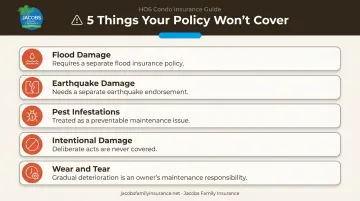
HO6 policies exclude several categories of damage, mostly because insurers consider them preventable or outside the scope of "sudden and accidental" loss:
- Flood damage: requires a separate flood insurance policy
- Earthquake damage: requires separate earthquake coverage
- Pest infestations — termites and similar damage are considered a maintenance issue, not an accident
- Intentional damage caused by the policyholder
- Wear and tear or damage from lack of maintenance
If you're in a flood zone or a seismic-risk area, standard HO6 coverage won't protect you from those specific perils. Talk to a Jacobs Family Insurance agent about adding flood or earthquake coverage separately, since it's not automatically bundled in.
Does Condo Insurance Cover Water Damage?
Water damage is one of the most common condo claims, and coverage hinges entirely on how the water got there.
- Covered: A burst pipe, an overflowing appliance, or a sudden failure in your plumbing or HVAC system
- Not covered: Gradual leaks that developed over weeks, or damage tied to deferred maintenance
Allstate's condo insurance guidance confirms this split: sudden, accidental discharge is generally covered, while slow leaks and maintenance-related deterioration generally aren't.
When water travels from a neighboring unit into yours, things get more complicated. Liability rules determine who's financially responsible.
Some condo declarations also include a "waiver of subrogation" clause, which limits an insurer's ability to chase down a negligent neighbor for reimbursement after paying your claim, even if that neighbor caused the damage.
If water damage hits your unit:
- Document everything immediately — photos, videos, and a written timeline
- Report the claim to your own insurer right away
- Notify your HOA so they can determine whether the master policy responds too
Filing with both sides quickly helps sort out who pays first and avoids delays in getting repairs started.
Is Condo Insurance Required, and How Much Coverage Do You Need?
Mortgage lenders frequently require HO6 coverage, particularly when the master policy doesn't fully protect unit interiors or carries a high per-unit deductible. Many HOAs mandate it in their bylaws too, even for owners who own their unit outright.
This isn't a rare requirement. A 2025 survey by the Community Associations Institute found that 53% of surveyed condominium communities already required individual owners to carry HO6 insurance, and nearly 29% reported insurers imposing high or per-unit deductibles at renewal — a trend that shifts more financial exposure onto individual owners.
Beyond whether it's required, your ideal coverage amount depends on:
- The total value of your personal belongings
- The liability limits you want if something serious happens
- Your association's master policy type (bare walls vs. all-in)
- Your potential loss assessment exposure
Since these variables shift from one condo building to the next, a one-size-fits-all policy rarely fits well.
That's the kind of review Jacobs Family Insurance handles regularly. As a local Allstate Elite agency serving Santa Fe and Northern New Mexico for more than 10 years, the team helps condo owners look at both sides of the equation. That means reviewing what the HOA's master policy actually covers and what your personal HO6 policy needs to fill in.

If you're not sure whether your current coverage lines up with your association's policy type, a free coverage review is a straightforward way to find out.
Frequently Asked Questions
Does condo insurance cover damage to a neighbor's property?
Yes, typically through your Personal Liability coverage (Coverage E), not the smaller "Damage to Property of Others" provision. Liability coverage carries much higher limits designed for serious, negligence-based damage claims.
What protections does condo insurance provide for condo owners?
HO6 policies cover personal belongings, interior structure and improvements, personal liability, and additional living expenses if your unit becomes uninhabitable. Each coverage area has its own separate limit.
What does condo insurance typically not cover?
Standard exclusions include flood damage, earthquake damage, pest infestations, and intentional damage caused by the policyholder. Wear and tear from lack of maintenance is excluded as well.
Does condo insurance cover water damage caused by a neighbor?
It depends on whether the water was sudden and accidental or the result of a slow leak. Liability and subrogation rules, including any waiver clauses in your condo declaration, determine who ultimately pays.
Is condo insurance required if I don't have a mortgage?
It's not always legally required, but many HOAs mandate it through their bylaws regardless of mortgage status. Skipping it leaves you exposed to significant out-of-pocket costs after a covered loss.
What's the difference between a master policy and an HO6 policy?
The master policy, held by your HOA, covers the building's structure and common areas. Your HO6 policy covers your unit's interior, personal belongings, and personal liability.