Choosing the wrong coverage, or skipping it entirely, can leave you paying out of pocket after a break-in, a kitchen fire, or a guest's slip-and-fall lawsuit. That gap is more common than you'd think. Only 57% of renters carry renters insurance, compared to 88% of homeowners who carry homeowners coverage, according to a Triple-I consumer poll reported by Investopedia.
This guide breaks down what each policy covers, what it costs, and how to know which one fits your life right now.
Key Takeaways
- Renters insurance covers belongings and liability; it never covers the building structure itself.
- Homeowners insurance covers the dwelling, belongings, and liability; lenders usually require it.
- Expect to pay far less for renters coverage since there's no structure to insure.
- New Mexico's wildfire risk, rural land, and older adobe construction can shift premiums for both policy types.
- Your need for renters, homeowners, or neither depends on your ownership status.
Renters vs. Homeowners Insurance: Quick Comparison
Before diving into the details, here's how the two policies stack up side by side.
| Factor | Renters Insurance | Homeowners Insurance |
|---|---|---|
| Cost | Lower: insures belongings and liability only | Higher: insures dwelling, structure, and broader liability |
| Coverage scope | Personal belongings, liability, loss of use | Dwelling, other structures, belongings, liability, loss of use |
| Who insures the building | Landlord's policy (not the tenant) | The homeowner insures the entire structure |
| Legal/lender requirement | Not required by law, often required by lease | Almost always required by mortgage lenders |
The biggest misconception among tenants? Assuming the landlord's policy has them covered. It doesn't. A landlord's insurance protects the building, not what's inside a tenant's unit. If a pipe bursts and ruins your furniture, that's on your policy, not theirs, according to the National Association of Insurance Commissioners.
What Is Renters Insurance?
Renters insurance protects tenants who have no ownership stake in the building they live in. Whether you're leasing a downtown Santa Fe apartment, a rental house in Española, or a condo in Albuquerque, the structure itself is the landlord's financial responsibility. Your belongings and personal liability are yours.
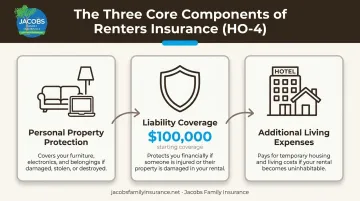
A standard renters policy (often called an HO-4) breaks down into three core pieces:
- Personal property protection: covers furniture, electronics, clothing, and other belongings against theft, fire, and other named perils
- Liability coverage: pays out if someone is injured in your rental and sues you, typically starting around $100,000 in coverage
- Additional living expenses: pays for a hotel or temporary rental if your unit becomes uninhabitable after a covered loss
One detail worth checking before you buy: does your policy pay actual cash value or replacement cost? Actual cash value factors in depreciation, so a five-year-old laptop pays out at its current worth, not what you paid for it. Replacement cost pays to buy a comparable new item, which usually costs a bit more in premium but pays off far more after a real claim.
Who Needs Renters Insurance
Plenty of landlords across Santa Fe and the rest of New Mexico now require proof of renters insurance as a lease condition, similar to requiring a security deposit. Even where it's not mandatory, skipping it is a gamble few tenants can afford.
Consider these common scenarios:
- Apartment fire: your unit and everything in it is damaged, and your policy pays for temporary housing plus replacement of your belongings
- Burglary: stolen electronics, jewelry, or bikes get replaced instead of coming out of your savings
- Guest injury: a friend slips on your stairs and needs medical care; liability coverage handles the claim
The affordability makes this an easy call. Renters insurance runs about $23 a month nationally, and closer to $21 a month here in New Mexico, based on ValuePenguin's 2026 rate analysis. That's less than most people spend on streaming subscriptions, for coverage that can save thousands after a single incident.
At Jacobs Family Insurance, bundling a renters policy with an auto policy often knocks the premium down even further through a multi-line discount.
What Is Homeowners Insurance?
Homeowners insurance is the broader, more comprehensive policy required once you own the property you live in. It protects the physical structure along with everything inside it, plus your liability if someone gets hurt on your land.
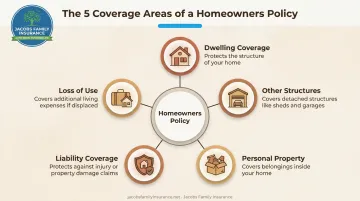
A standard policy typically includes five coverage areas:
- Dwelling coverage — pays to repair or rebuild the home itself after a covered loss
- Other structures — covers detached garages, sheds, fences, and similar structures
- Personal property — covers your belongings, similar to a renters policy
- Liability coverage — protects you financially if someone is injured on your property
- Loss of use — covers temporary housing if your home becomes unlivable
New Mexico adds some regional wrinkles. A high-value adobe-style home in Santa Fe may need higher dwelling limits to reflect true rebuild costs, since traditional adobe construction can be pricier to repair than standard framing. Rural and ranch properties outside city limits often need added endorsements for outbuildings, fencing, or land-based structures that a standard policy doesn't automatically cover.
Local, experienced guidance, like what Jacobs Family Insurance provides through its Allstate-backed policies, helps match coverage limits to the property, not a generic template.
Who Needs Homeowners Insurance
If you have a mortgage, your lender will require proof of homeowners insurance before your loan can close, according to the Consumer Financial Protection Bureau. No policy, no keys.
Real-world claims that show why this matters in New Mexico:
- Wildfire damage — rising nonrenewals in wildfire-exposed areas across the state, particularly in northern New Mexico
- Wind and hail claims — common across the state's exposed high-desert terrain
- Liability after a guest injury — a visitor is hurt on your property and files a claim against you personally
Homeowners insurance costs more than renters coverage because it insures the entire structure. NerdWallet's 2026 benchmark puts the national average at $2,490 per year, with New Mexico running higher at roughly $2,800 per year, based on a $400,000 dwelling limit and $1,000 deductible, according to NerdWallet's home insurance data.
Wildfire exposure, home age, and construction type can all push that number up or down.
Renters vs. Homeowners Insurance: Which Is Right for You?
The decision usually isn't complicated once you look at four factors:
- Ownership status — do you own the structure or just rent the space?
- Value of your belongings — higher-value items may need scheduled coverage regardless of which policy you carry
- Liability exposure — how much foot traffic, guests, or risk does your property see?
- Contractual requirements — does your lease or mortgage mandate a specific coverage type?
If you rent, renters insurance is a low-cost, non-negotiable purchase. If you own your home or you're closing on one soon, homeowners insurance is required and non-optional in most cases. The only gray area comes during a transition.
Real-World Scenario: Moving From Renting to Owning
Picture a longtime Santa Fe renter who finally closes on their first home. Up until closing day, they've carried a renters policy covering their furniture and liability. The trigger point comes fast: the mortgage lender won't fund the loan without proof of an active homeowners policy in place.
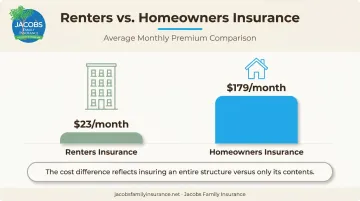
That switch usually brings a real jump in premium. Renters coverage averages roughly $23 a month nationally, while homeowners coverage runs closer to $179 a month, according to ValuePenguin's national rate comparison. That gap reflects the added cost of insuring an entire structure rather than just its contents.
Some buyers briefly juggle both policies, keeping renters coverage active on a current unit while a new homeowners policy takes effect on the property being purchased. Timing this transition correctly avoids paying twice or, worse, having a coverage gap on closing day.
Getting the timing right often calls for local, personalized guidance. Jacobs Family Insurance, a family-owned Allstate Elite agency, walks New Mexico buyers through switching, timing, and bundling opportunities at each stage, whether you're still renting, closing next month, or settled into your new home.
Conclusion
Neither renters insurance nor homeowners insurance is inherently "better." The right choice depends entirely on whether you own or rent. Renters insurance delivers affordable protection for belongings and liability, while homeowners insurance covers the structure, belongings, and liability together.
Getting this right protects you from out-of-pocket repair costs, a lawsuit, or being displaced with nowhere to turn. If you're unsure which policy fits your situation, or you're transitioning from renting to owning, our team at Jacobs Family Insurance can help.
We know New Mexico's property landscape, from Santa Fe adobes to rural ranch land, and can match your coverage to your actual risk.
Frequently Asked Questions
Is renters insurance more expensive than homeowners insurance?
No, renters insurance is typically much cheaper because it only covers personal belongings and liability, not the physical structure. Homeowners insurance costs more since it insures the entire building.
How much does renters insurance typically cost?
Renters insurance averages about $23 per month nationally and roughly $21 per month in New Mexico. Costs vary based on coverage limits, deductible, location, and claims history.
How much does homeowners insurance typically cost?
Homeowners insurance averages $2,490 per year nationally and around $2,800 per year in New Mexico, largely due to wildfire exposure. Home size, age, rebuild cost, and coverage limits all affect the final price.
Do I need both renters insurance and homeowners insurance?
Usually only one, based on whether you rent or own. The exception is a short transition period, like closing on a home while still finishing out a lease, when carrying both briefly makes sense.
Does homeowners insurance cover a tenant's personal belongings if I rent out part of my home?
No, a homeowners policy protects the owner's structure and belongings, not a tenant's possessions. Any tenant living in a rented space needs their own renters policy for their belongings and liability.
Can I easily switch from a renters policy to a homeowners policy?
Yes, though timing matters. You'll typically secure homeowners coverage before your closing date, then cancel your renters policy once you've moved out. Working with a local agent helps make sure there's no gap in between.