That gap catches riders off guard every year. Liability insurance, which most states require, only pays for damage or injuries you cause to someone else. It won't touch your own repair bill.
This post breaks down what collision coverage actually covers and excludes, how it compares to comprehensive and liability, whether it's worth the added premium, and how New Mexico riders can choose the right mix of protection.
Key Takeaways
- Collision coverage repairs or replaces your motorcycle after a crash, regardless of fault
- It excludes theft, weather damage, fire, vandalism, and your own medical bills
- New Mexico doesn't mandate collision coverage, but lenders often require it on financed bikes
- Premiums vary by bike value, riding history, and location—compare against repair costs
- A local licensed agent can help you find the right coverage mix at a competitive price
What Is Motorcycle Collision Insurance & How Does It Work?
Collision coverage pays to repair or replace your motorcycle after it's damaged in a crash, up to the bike's insured value, minus your deductible. It applies whether you hit a car, a stationary object, or simply lose control and go down on your own.
Insurers typically value your bike one of two ways:
- Actual cash value (ACV): Replacement cost minus depreciation based on age, mileage, and wear. This is the standard method for most policies.
- Replacement cost: No depreciation subtracted. This option often makes more sense for classic, exotic, or heavily customized motorcycles worth more than their depreciated value suggests.
How the deductible works: Say your bike suffers $6,000 in damage and you carry a $500 deductible. Your insurer pays $5,500; you cover the rest. Most riders choose deductibles between $250 and $1,000, though some policies allow a range from $0 to $2,000.
What legally counts as a collision? It's broader than most riders think:
- Striking another vehicle
- Hitting a stationary object, like a guardrail or parked car
- Spilling or overturning the motorcycle on your own, even without another vehicle involved
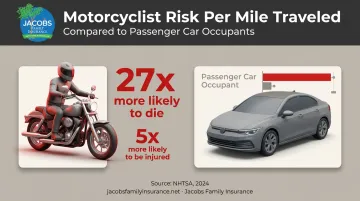
This coverage matters more for motorcyclists than car drivers. According to NHTSA's 2024 data, motorcyclists are almost 27 times more likely to die and nearly 5 times more likely to be injured than passenger-car occupants, per vehicle mile traveled. Higher crash exposure means physical damage to your bike is a real possibility, not just a hypothetical.
When Lienholders Require Collision Coverage
If you're financing or leasing your motorcycle, your lender almost certainly requires collision and comprehensive coverage until the loan is paid off. This protects the lender's financial interest in the bike, not just your own investment.
Once the loan is satisfied, that requirement disappears, and the decision to keep collision coverage becomes yours alone. At that point, compare your bike's actual cash value to your annual premium and deductible. If a repair would routinely cost more than you'd want to pay out of pocket, keeping the coverage still makes sense, especially for newer or higher-value motorcycles.
What Does Motorcycle Collision Insurance NOT Cover?
Collision coverage is narrowly focused on impact damage. It leaves several gaps that surprise riders after a claim gets denied.
Here's what falls outside collision coverage:
- Theft, vandalism, fire, or flood: these require comprehensive coverage instead
- Your own medical bills or injuries: you'll need medical payments coverage or personal injury protection (PIP), depending on your state
- Damage or injuries you cause to others: that's liability coverage's job, not collision's
- Mechanical breakdown or normal wear and tear: these typically need separate coverage or aren't insurable at all
- Riding gear and apparel: often requires its own endorsement or separate policy
Custom parts deserve special attention. Many policies only cover factory-standard components, or they cap custom-parts coverage at a modest amount.
If you've added aftermarket exhaust, upgraded chrome, or custom paint, ask about a custom-parts endorsement. Coverage limits vary by insurer, so confirm exactly what's included before assuming your customization is protected.
Collision vs. Comprehensive vs. Liability: Know the Difference
These three coverages solve different problems, and confusing them is one of the most common mistakes riders make.
| Coverage | What it pays for |
|---|---|
| Liability | Injuries or property damage you cause to others |
| Collision | Repairs to your own bike after hitting a vehicle or object |
| Comprehensive | Non-collision losses like theft, fire, vandalism, or weather |
Most riders who want full protection carry all three together, sometimes called "full coverage." It's an informal industry term, not a specific product, but it generally signals liability plus collision plus comprehensive.
Three add-ons worth asking about:
- Guest passenger liability, which covers injuries to a passenger if you're at fault
- Uninsured/underinsured motorist coverage, which steps in when the at-fault driver has no insurance or not enough to cover your losses
- Custom parts and equipment coverage, which extends protection to aftermarket parts, chrome, and accessories beyond factory specs
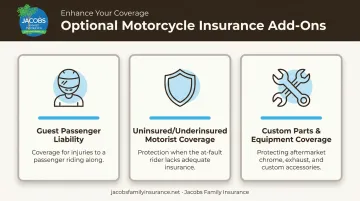
Neither of the three core coverages addresses these situations on their own, so they're worth discussing during a policy review.
Is Motorcycle Collision Insurance Worth It?
Collision coverage isn't legally required in most states, including New Mexico. The state's Office of the Superintendent of Insurance sets minimum liability limits at 25/50/10, meaning $25,000 bodily injury per person, $50,000 per accident, and $10,000 in property damage. None of that touches your own bike's repair costs.
So the real question is whether it makes financial sense for you. Collision coverage tends to be worth adding if:
- Your motorcycle is financed or leased
- You ride a newer or higher-value bike
- You spend a lot of time on rural highways or unpredictable roads
- You've had prior at-fault accidents
The upside is real financial protection. Industry loss data from the Highway Loss Data Institute (HLDI) shows an average motorcycle collision claim runs $8,583 for recent model-year bikes, per its 2022 loss fact sheet. That's a steep number to cover out of pocket if your bike gets totaled in a single incident.
The downside is added premium cost, which may not make sense for an older, lower-value motorcycle. If your bike is worth $2,500 and a total loss claim would only pay out a fraction of that after depreciation, liability-only or liability-plus-comprehensive might be the more practical choice.
A simple gut check: if your bike's value outweighs a few years of collision premiums plus your deductible, adding the coverage makes sense. If it doesn't, you might be paying more in premiums than you'd ever recover.
Cost Factors & Choosing the Right Coverage
Insurers price motorcycle collision coverage based on several variables specific to you and your bike:
- Rider profile: age, riding experience, and driving record
- Bike details: make, model, engine size, and current value
- Usage: how often and how far you ride
- Storage: garaged versus street-parked, and your ZIP code
- Regional risk: local weather patterns, road conditions, and theft rates
New Mexico's mix of rural highways, sudden weather shifts, and long stretches without cell service adds its own layer of risk that a local agent can factor into your quote.
Discounts can lower your premium. Ask your agent about:
- Complete a motorcycle safety course
- Bundle your policy with an existing auto or home policy
- Qualify for mature rider discounts
- Join a motorcycle club or riding organization
At Jacobs Family Insurance, bundling your motorcycle policy with an existing auto or home policy can lower your overall rates. As a Santa Fe-based Allstate Elite Agency, the team assesses New Mexico-specific riding risks and compares coverage options to find you a personalized, competitive rate.

You can reach a licensed agent by calling (505) 557-2067, visiting the office at 1547 South St. Francis Drive, Santa Fe, NM 87505, or requesting a free quote online, with no pressure or obligation.
Frequently Asked Questions
Should I get motorcycle collision insurance?
It depends on whether your bike is financed, its current value, and how much financial risk you're willing to absorb after a crash. Higher-value or financed motorcycles usually justify the added cost.
What type of motorcycle insurance is best?
Most riders benefit from combining liability, collision, comprehensive, and uninsured motorist coverage. The right mix depends on your bike's value and how you ride.
What does motorcycle collision insurance not cover?
It excludes theft, fire, weather damage, vandalism, your own injuries, and damage you cause to others. Those situations require comprehensive, medical payments, or liability coverage instead.
How much does motorcycle collision insurance cost?
Cost varies widely based on your riding history, bike value, and location. Getting a personalized quote from a local New Mexico agency, like Jacobs Family Insurance, is the most accurate way to find your number.
Is motorcycle collision insurance required by law?
It's generally optional under state law, including in New Mexico. However, lenders typically require it on financed or leased motorcycles until the loan is paid off.
What's the difference between collision and comprehensive motorcycle coverage?
Collision covers impact-related damage, like hitting a vehicle or object. Comprehensive covers non-collision losses, such as theft, fire, or weather damage.