
This scenario plays out more often than most condo owners realize. A condo insurance policy, known as an HO-6 policy, fills the exact gap that catches owners off guard. It protects personal belongings, interior finishes, and liability exposure the association's master policy doesn't touch.
This guide covers what condo insurance is, what it does and doesn't cover, how much it typically costs, and how Jacobs Family Insurance helps New Mexico condo owners find the right Allstate policy for their situation.
Key Takeaways
- Master policies typically cover the building exterior and common areas, not unit interiors.
- Coverage needs vary by master policy type: bare walls, single entity, or all-in.
- Condo insurance costs $490 per year on average, though rates vary by state.
- A local Allstate agent at Jacobs Family Insurance helps close coverage gaps affordably.
What Is Condo Insurance (HO-6 Insurance)?
An HO-6 policy is built specifically for condominium and co-op unit owners. It covers the "walls-in" portion of the home, meaning everything from the paint on your walls to the furniture in your living room, plus your personal liability if someone gets hurt in your unit.
Here's the part that trips people up: your HO-6 policy and your condo association's master policy work together, but they're not interchangeable. One insures the shared building structure, while the other insures your individual space and belongings.
Knowing where one ends and the other begins is essential before you buy coverage. Guess wrong, and you're either paying for overlap or leaving a gap exposed.
Types of Condo Association Master Policies
Not all master policies are created equal. New Mexico's Office of the Superintendent of Insurance advises condo owners to review their master policy closely, since it may only insure common areas or bare walls, leaving far more exposed than owners expect.
| Master policy type | What the HOA covers | What's left to you |
|---|---|---|
| Bare walls | The building's structural shell and shared property | Sinks, cabinets, appliances, flooring, wallpaper, and all personal belongings |
| Single entity | Original fixtures and equipment inside units | Personal property and any upgrades or improvements you've made |
| All-in / all-inclusive | Structural improvements, including owner-added upgrades | Primarily personal belongings and liability exposure |
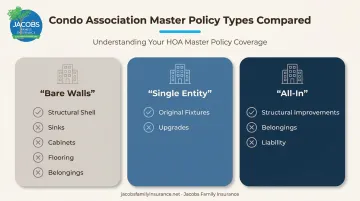
Bare walls policies are the most basic and put the most responsibility on you. Single entity is the most common arrangement. All-in is the most comprehensive on the association's side, but it still won't touch your furniture or electronics.
Before choosing coverage limits, request a copy of your HOA's master policy or governing bylaws. That document tells you exactly where the association's responsibility stops.
Is Condo Insurance Required?
Mortgage lenders typically require an HO-6 policy as a condition of financing. Freddie Mac guidelines specifically require it when the association's master policy doesn't cover unit interiors or carries a per-unit deductible. Many condo associations mandate coverage regardless of financing status, since it protects the community's overall risk profile.
Own your unit outright with no mortgage? You're not off the hook from a practical standpoint. Without coverage, a kitchen fire or a burglary comes entirely out of pocket. Condo insurance remains one of the more affordable ways to protect against loss, theft, and liability claims.
What Does Condo Insurance Cover?
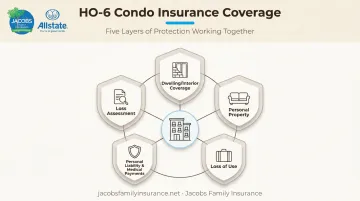
A standard HO-6 policy is built around several core coverage types, each designed to protect what the master policy leaves out. Together, they form a layered defense around your unit and your finances.
Dwelling Coverage (Interior/Walls-In Coverage)
This covers damage to your unit's interior structure, things like drywall, flooring, built-in cabinets, and fixtures, depending on what your master policy excludes. If your HOA carries a bare walls policy, this coverage becomes especially important since you're responsible for nearly everything inside your four walls.
Personal Property Coverage
This protects your belongings, furniture, electronics, clothing, kitchen equipment, against named perils such as fire, theft, and windstorm. Two payout structures exist:
- Actual cash value (ACV): Pays what your items are worth today, after depreciation
- Replacement cost: Pays what it costs to buy new, comparable items, no depreciation deducted
A five-year-old couch destroyed in a fire won't fetch its original price under ACV. Replacement cost coverage closes that gap.
Loss of Use / Additional Living Expenses Coverage
If a covered event makes your unit unlivable, this coverage pays for temporary housing, meals, and related costs while repairs happen. Say a kitchen fire forces you into a hotel for three weeks. This coverage picks up the tab for lodging and reasonable extra expenses during that stretch.
Personal Liability and Guest Medical Payments Coverage
Personal liability protects you if someone sues over an injury or property damage you're legally responsible for, think a guest slipping on a wet floor. Guest medical payments coverage kicks in for accidental injuries on your property regardless of fault, covering reasonable medical expenses without a lawsuit.
Most insurers offer liability limits ranging from $100,000 to $500,000, with $300,000 being a common middle-ground choice.
Loss Assessment Coverage
Here's a coverage type many owners overlook. If a claim, say major storm damage to the building, exceeds the master policy's limits, the HOA can assess unit owners for their share of the shortfall.
Loss assessment coverage picks up that bill. Standard policies often include a modest limit, sometimes cited around $1,000, but that figure varies by insurer and shouldn't be assumed without checking your actual policy.
These five coverages work together as a safety net. None of them duplicate the master policy; each one picks up exactly where the association's protection stops.
What Condo Insurance Doesn't Cover
No HO-6 policy covers everything. Standard exclusions include:
- Flooding: requires separate flood insurance
- Earthquakes: requires a separate endorsement or policy
- Normal wear and tear: deterioration isn't a covered "loss"
- Pest infestations: termites, rodents, and similar issues
- Intentional damage: deliberate acts aren't covered, ever
Anything the master policy covers — damage to shared hallways, the building's roof, or exterior siding — is also excluded from your individual HO-6 policy. That's the association's claim to file, not yours.
New Mexico owners in flood-prone river corridors or areas near active fault zones should check their exposure directly. FEMA's Map Service Center provides address-level flood hazard data, and USGS maintains seismicity maps for the state. If your area carries either risk, a standalone flood or earthquake policy closes the gap your HO-6 won't.
How Much Condo Insurance Do You Need, and What Does It Cost?
Coverage needs depend on a handful of factors:
- Your master policy's scope: bare walls arrangements demand more personal dwelling coverage than all-in policies
- The value of your belongings: walk through your unit and estimate replacement cost, not just what you paid
- Upgrades you've made: new countertops or custom flooring may not be the HOA's responsibility to replace
- Your liability exposure: frequent guests or a home office may warrant higher limits
On cost, the national average for condo insurance runs about $490 per year, based on a benchmark profile with $70,000 dwelling coverage, $50,000 personal property, and $300,000 liability. That's national data, though. New Mexico rates vary based on your specific building, location, and coverage choices.
Rates are also shaped by:
- Building age and construction
- Location and regional risk factors
- Coverage limits and deductible selection
- Your personal claims history
Before buying, compare quotes from multiple insurers and check each carrier's financial strength rating through AM Best or S&P. A cheap premium doesn't help if the insurer struggles to pay claims.
For a personalized read on your situation, Jacobs Family Insurance, an Allstate Elite agency based in Santa Fe, can review your HOA's master policy alongside your coverage needs and quote a policy built for New Mexico condo communities specifically.
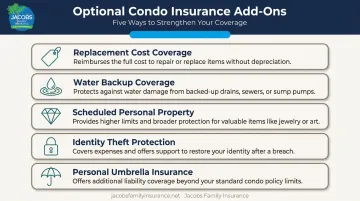
Optional Add-On Coverages for Condo Owners
A handful of endorsements fill gaps that standard HO-6 policies leave open:
- Replacement cost coverage — reimburses belongings at today's prices instead of depreciated value, worth it for anyone with newer furniture or electronics
- Water backup coverage — covers damage from sewer or drain backups, a common exclusion in standard policies
- Scheduled personal property — adds dedicated coverage for valuables like jewelry, art, or collectibles beyond standard policy sublimits
- Identity theft protection — helps offset costs tied to identity restoration after fraud
- Personal umbrella insurance — extends liability protection well beyond your HO-6's cap, ideal when your standard limit tops out at $500,000
Jacobs Family Insurance's local agents can help you decide which of these fit your unit and lifestyle. Call (505) 557-2067 or stop by the Santa Fe office at 1547 South St. Francis Drive.
Frequently Asked Questions
What is the best insurance for condo owners?
The "best" policy depends on your HOA's master policy gaps and your personal belongings' value. Pairing Allstate's condo coverage options with guidance from a local agent, like the team at Jacobs Family Insurance, helps you land on the right fit.
What isn't covered by house insurance?
Standard exclusions include flooding, earthquakes, normal wear and tear, and intentional damage. Separate policies or endorsements can cover some of these gaps, particularly flood and earthquake risk.
What's the difference between an HO-3 and an HO-6 policy?
HO-3 covers single-family homes, including the physical structure itself. HO-6 covers only the interior and personal belongings of a condo unit, since the structure is typically insured through the HOA's master policy.
Is condo insurance required?
Mortgage lenders and many HOAs require it as a condition of financing or association membership. Owners without a mortgage may still want coverage for protection against loss, theft, and liability claims.
How much does condo insurance typically cost?
The national average runs about $490 per year, though location, coverage limits, and deductible choice all affect your final premium.
What is loss assessment coverage and do I need it?
It covers your share of HOA-assessed costs when a claim exceeds the master policy's limits. Increasing this coverage is smart if your association carries a high deductible or limited master policy coverage.