Many homeowners search for "wildfire insurance" expecting to find a standalone policy they can buy. That product doesn't exist. Wildfire protection is already built into the homeowners, renters, auto, and business coverage most New Mexicans carry, but only if the limits and endorsements are set up correctly.
This guide breaks down what wildfire coverage really includes, whether it's worth carrying at current New Mexico premiums, and how to keep coverage in place if you live in a high-risk zip code.
Key Takeaways
- No standalone wildfire insurance exists; fire peril coverage applies
- Nearly 70% of New Mexico homes sit inside wildland-urban interface zones
- Dwelling, ALE, and business interruption coverage each respond differently to wildfire loss
- Underinsurance is common nationwide—many wildfire survivors lack rebuild funds
- Reviewing dwelling limits locally is essential as rebuild costs rise
What Is Wildfire Insurance?
Here's the short version: there's no such thing as a dedicated wildfire insurance policy sold on the market. What people mean when they search that phrase is fire peril coverage, and it's baked into the property and casualty policies most households and businesses already own.
Fire, including wildfire, has been a covered peril under standard insurance forms for decades. Insurers build their policies around state-regulated fire coverage requirements, then layer in additional protections for smoke, ash, and evacuation costs.
Wildfire protection typically comes bundled into these policy types:
- Homeowners insurance (HO-3)
- Renters insurance (HO-4)
- Condo insurance (HO-6)
- Comprehensive auto coverage
- Business owner's policies (BOP)
You'll also hear the terms "hazard insurance" and "fire insurance" used interchangeably with wildfire coverage. That's because it's a named peril within these broader policies, not a separate product with its own name on the declarations page.
Why This Matters More in New Mexico
New Mexico has an unusually high concentration of homes sitting where development meets wildland fuel. According to a U.S. Forest Service analysis of wildland-urban interface areas, roughly 628,000 of the state's 901,000 houses, about 69.7%, sit inside the WUI.
This represents the majority of the state's housing stock, not a rural footnote. If you own property in Los Alamos, Taos, Silver City, or almost anywhere off the interstate corridor, your fire peril coverage does the heaviest lifting on your policy.
What Does Wildfire Insurance Actually Cover?
Fire peril coverage touches nearly every part of a standard policy, but each piece works differently. Knowing the distinctions helps you spot gaps before a fire does.
Your Home, Structures, and Belongings
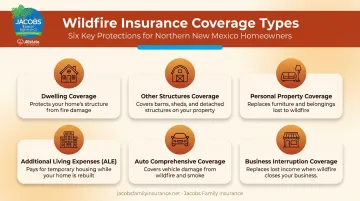
Dwelling coverage pays to rebuild or repair your home's structure after fire damage. Construction costs have climbed quickly in recent years, so an extended or guaranteed replacement cost rider can help close the gap if your dwelling limit falls behind actual rebuild pricing.
Other structures coverage protects detached garages, barns, sheds, and fences, which matters for ranch and rural property owners across Los Alamos, Taos, and Silver City. Standard policies often cap this at 10% of the dwelling limit, which rarely covers a working barn or a mile of perimeter fencing.
Personal property coverage reimburses furniture, electronics, and belongings lost to fire or smoke. There's a meaningful difference between actual cash value, which pays depreciated value rather than today's replacement price, and replacement cost, which pays what it actually costs to buy a new equivalent.
High-value items like jewelry, art, and firearms often need scheduled endorsements since standard limits cap out fast.
Living Expenses, Auto, and Business Coverage
Loss of use / additional living expenses (ALE) reimburses hotel stays, meals, and temporary housing if a wildfire forces evacuation or displaces your family during rebuilding. New Mexico evacuations have stretched for weeks at a time, so realistic ALE limits are worth double-checking.
Auto comprehensive coverage is the only part of a car insurance policy that responds to fire, smoke, or ash damage. Liability and collision coverage won't help if wildfire scorches your vehicle in the driveway.
A business owner's policy covers property damage from fire, while business interruption or income coverage helps small New Mexico businesses recover lost revenue during a forced closure. For a Santa Fe shop owner evacuated for two weeks, that income coverage often matters as much as the property claim itself. A local agent can help confirm these limits actually match your risk.
Is Wildfire Insurance Worth It in New Mexico?
Yes, and the numbers back that up. If you own property inside a wildland-urban interface community, adequate fire peril coverage determines whether you rebuild or start over from nothing.
New Mexico's fire activity has stayed high in recent years:
| Year | NM Wildfires | Acres Burned |
|---|---|---|
| 2023 | 1,019 | 212,378 |
| 2024 | 823 | 82,531 |
| 2025 | 907 | 179,388 |
Source: National Interagency Fire Center annual reports
The Underinsurance Problem
Having a policy isn't the same as having enough policy. After Colorado's Marshall Fire, United Policyholders' survivor survey found 79% of respondents lacked sufficient insurance to repair or replace their homes. An earlier state review found two-thirds of total-loss claims were underinsured.
That gap shows up fast. Homeowners insurance replacement costs jumped 55% between 2020 and 2022 industry-wide, driven by inflation, supply-chain disruption, and rising material prices. A dwelling limit set five years ago may not stretch far enough today.
Weighing the Cost
New Mexico's average homeowners premium runs around $1,151 a year. Compare that against the cost of rebuilding a home from a total loss, which easily runs into six figures once labor, materials, and code-upgrade requirements are factored in. The math isn't close.
Local risk drivers pushing this urgency higher:
- Ongoing drought conditions across northern and central New Mexico
- Expanding development into wildland-urban interface zones
- A high concentration of rural and ranch properties in areas like Ruidoso and Española
An annual policy review catches problems before a fire does. Jacobs Family Insurance, a Santa Fe-based Allstate Elite agency, helps neighbors confirm their dwelling limits and endorsements keep pace with local rebuild costs instead of lagging years behind.
How to Get Wildfire Coverage in High-Risk New Mexico Areas
Insurers increasingly use wildfire risk scoring models that weigh building materials, surrounding vegetation, and exact location. In high-risk zip codes, this can lead to nonrenewal or declined applications, though insurers must give advance written notice before dropping coverage.
If standard coverage gets denied, New Mexico has a backstop. The New Mexico FAIR Plan offers basic fire protection as a last resort when the voluntary market says no.
A few things worth knowing about the FAIR Plan:
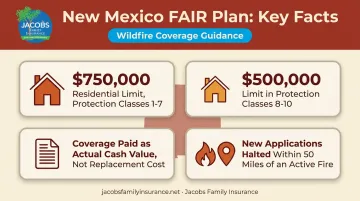
- Residential limits run up to $750,000 in Protection Classes 1-7, and $500,000 in Classes 8-10
- Coverage is generally actual cash value, not replacement cost
- The FAIR Plan halts new applications within 50 miles of an active fire
Navigating a nonrenewal notice or a FAIR Plan application isn't something to figure out alone. Working with a local agency that knows the FAIR Plan process and nonrenewal timelines beats a call-center runaround every time. That's the kind of neighborly guidance Jacobs Family Insurance provides across Santa Fe and northern New Mexico.
Reducing Wildfire Risk (and Insurance Costs)
Mitigation work protects your home and can strengthen your standing with insurers, even if a discount isn't guaranteed.
Create defensible space:
- Clear brush, dead vegetation, and flammable debris in a buffer zone around the home
- Focus especially on the first 5 feet next to the structure, then extend outward
Harden the home:
- Install fire-resistant roofing materials
- Add ember-resistant vents with fine metal mesh
- Choose noncombustible siding where possible
Prepare for a future claim:
- Ask your agent whether completed mitigation work qualifies for any available discounts
- Keep an updated home inventory with photos or video, stored somewhere off-property
Small upgrades add up. A hardened roof and cleared perimeter won't stop every ember, but they buy your home a fighting chance and give your insurer confidence you've done the work.
Filing a Wildfire Insurance Claim
Speed and documentation matter once a wildfire has passed through your property.
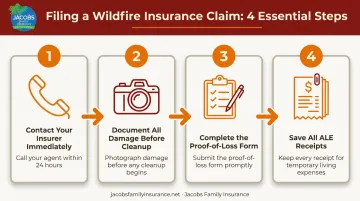
- Contact your insurance professional immediately and get your claim number and filing instructions
- Document everything before cleanup begins with photos or video of all damage, inside and out
- Complete the proof-of-loss form your insurer requires, listing damaged items with approximate purchase dates and replacement costs
- Save every receipt tied to hotel stays, meals, or other extra costs so your Additional Living Expenses (ALE) reimbursement gets processed accurately
Filing deadlines vary by state and carrier, so don't wait to make that first call.
New Mexico regulators can extend emergency filing deadlines during major wildfire disasters, but that relief isn't guaranteed. Get ahead of the timeline instead of hoping for an extension.
Frequently Asked Questions
Is there such a thing as wildfire insurance?
No standalone wildfire policy exists on the market. Protection comes through homeowners, renters, condo, auto, and business insurance as part of standard fire peril coverage.
Is it worth it to have fire insurance?
Yes, especially in wildfire-prone areas like New Mexico. Rebuilding a home from total loss easily costs six figures, far more than the cost of an adequate annual premium.
Does homeowners insurance cover wildfire damage in New Mexico?
Standard New Mexico homeowners policies include fire and wildfire as covered perils, subject to your specific policy limits and deductibles. Confirming those limits match current rebuild costs is the key step most people skip.
What happens if my insurer drops my policy because of wildfire risk?
Insurers must provide advance written notice before nonrenewal. Contact an agent promptly to explore alternative coverage, including the New Mexico FAIR Plan if standard markets decline you.
Does auto insurance cover wildfire damage to my car?
Only the optional comprehensive portion of an auto policy covers fire, smoke, and ash damage. Liability and collision coverage do not respond to wildfire losses.
How much does wildfire risk add to my insurance premium?
Premiums vary based on location, home value, building materials, and completed risk mitigation. A personalized quote from a local agent gives you the most accurate picture for your specific property.
Ready to check whether your dwelling limits and endorsements match today's wildfire risk? Reach out to Jacobs Family Insurance at (505) 557-2067 or visit the office at 1547 South St. Francis Drive, Santa Fe, for a free wildfire coverage review.