Introduction
Many New Mexico residents run two vehicles: a car for weekday commutes and a motorcycle for weekend rides along the Turquoise Trail or the High Road to Taos. By default, that means two separate insurance policies, two insurers, two billing cycles, and two sets of renewal deadlines to track.
Most policyholders manage this without complaint — until they realize bundling both vehicles under one policy is an option.
This article breaks down the practical benefits of bundling car and motorcycle insurance: what the savings actually look like using New Mexico-specific cost data, how consolidated management works day-to-day, and what happens when both vehicles get caught in the same hailstorm.
Key Takeaways
- Bundling means purchasing both policies through one insurer — not merging them into a single policy
- Multi-policy discounts can reduce premiums meaningfully, with GEICO publishing up to 10% on motorcycle coverage for customers who also insure a car with them
- One insurer means one login, one renewal reminder, and one claims contact
- Adding a home or renters policy to the mix may layer additional savings on top
- Always compare the bundled rate against separate quotes to confirm the savings before committing
What Is Car and Motorcycle Insurance Bundling?
Bundling means purchasing your car insurance and motorcycle insurance through the same company, so both policies are linked under one account.
What bundling does not do is merge your two policies into one. Each vehicle still carries its own coverage limits, deductibles, exclusions, and endorsements. Your declarations pages remain separate. Bundling changes how you manage and pay for those policies, not what they actually cover.
It's essentially a loyalty arrangement. Insurers benefit from reduced administrative overhead and stronger customer retention when you consolidate policies with them. In exchange, they pass a portion of that benefit back to you in the form of a lower premium on one or both policies.
Once you've bundled car and motorcycle coverage, adding a renters or homeowners policy to the same insurer may unlock additional multi-policy savings on top of what you're already receiving — though the exact stacking mechanics vary by carrier. As the Insurance Information Institute notes, there's no guaranteed universal discount range, which is why comparing bundled and separate quotes is always worth the effort.
Key Benefits of Bundling Car and Motorcycle Insurance
Premium Savings Through Multi-Policy Discounts
Every major insurer — Allstate, Progressive, State Farm, GEICO — advertises multi-policy discounts for bundling auto and motorcycle coverage. The discount gets applied directly to your premium, reducing what you pay on one or both policies.
GEICO is the only major carrier that publicly posts a specific percentage: up to 10% on motorcycle insurance when you also insure your car with them. Allstate and Progressive advertise multi-policy savings without publishing a fixed percentage — the actual amount depends on your coverage levels, driving record, bike type, and location.
To put real numbers behind this, here's what a 10% discount could mean for a typical New Mexico household, using NAIC's 2023 New Mexico auto expenditure data and Progressive's New Mexico motorcycle benchmark:
| Combined Annual Premium | 10% Savings | 5-Year Value |
|---|---|---|
| NM avg. auto ($1,081.61) + liability-only motorcycle ($243.73) | ~$133/year | ~$663 |
| NM avg. auto + full-coverage motorcycle (~$1,776/year) | ~$178/year | ~$888 |
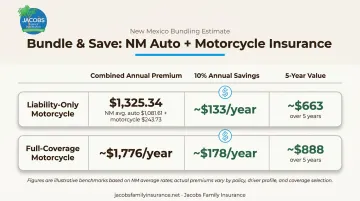
These are illustrative examples based on published benchmarks, not guaranteed discounts. Your actual savings depend on your carrier's filed rates and your specific policy profile.
One additional financial benefit worth asking about: some insurers allow policyholders to pay only one deductible when both vehicles are damaged in the same covered incident. Allstate's motorcycle policy page confirms an optional First Accident Waiver feature, though availability and terms vary by state. Before assuming this applies to your bundle, ask your agent directly.
Simplified Policy Management and Billing
Two insurers means two renewal dates to track, two billing accounts to monitor, and two separate customer service relationships to maintain. When a question comes up — or a claim needs to be filed — you're managing twice the administrative friction.
Bundling collapses that into one:
- One login to review both policies
- One renewal reminder each year
- One payment to track per billing cycle
- One agent who knows your full coverage picture
For seasonal riders in New Mexico who store their motorcycle during winter months, this is especially useful. Working with a single agent makes it easier to adjust motorcycle coverage during off-season periods without losing track of where each policy stands or inadvertently letting one lapse while focused on the other.
GEICO notes that bundling lets customers manage multiple coverages in one place through their app. State Farm similarly highlights that bundled policies simplify management and may stack discounts. The core convenience is consistent across carriers, even if the specific tools differ.
A Smoother Claims Experience
Simpler billing is one thing — but where bundling can really matter is at claim time.
When both your car and motorcycle are damaged in the same event — a hailstorm, a flash flood, a vandalism incident — dealing with two separate insurers simultaneously means two claims representatives, conflicting damage assessments, and overlapping timelines to track.
With a bundled policy, one insurer handles both vehicles. One call, one representative, one coordinated resolution.
For context on why claims speed matters: J.D. Power's 2025 Auto Claims Satisfaction Study found an industry average satisfaction score of 700 out of 1,000, with average repair cycle times of 19.3 days — down from 22.3 days the prior year. Faster resolution correlates directly with higher satisfaction. Navigating two separate claims processes simultaneously pushes that timeline in the wrong direction.
New Mexico's weather makes this more than hypothetical. NWS Albuquerque reports that hail with flash flooding becomes a genuine hazard for central and northern New Mexico from June through September, with potential for extensive vehicle damage.
Santa Fe County alone recorded more than 500 high-wind events in NOAA's database between 2021 and 2025. When conditions damage both vehicles overnight, having both policies under one roof removes a significant logistical burden.
What Happens When You Skip Bundling
The most direct cost of skipping bundling is this: you forgo the multi-policy discount every year you keep separate policies.
Using the NAIC and Progressive New Mexico benchmarks, a household missing out on a 10% discount on a combined $1,325 annual premium loses roughly:
- $133/year
- $398 over three years
- $663 over five years
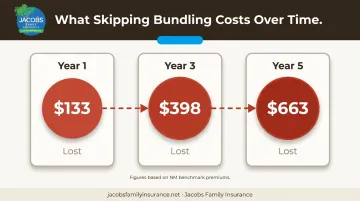
Those numbers grow if your motorcycle carries full coverage rather than liability-only.
Beyond the missed savings, separate policies add administrative friction. Two renewal notices, two billing cycles, two carriers to contact when your situation changes — and twice the chances for something to slip.
New Mexico law requires minimum auto liability coverage of $25,000/$50,000/$10,000. A missed renewal or failed payment can create real legal exposure. No data proves that two insurers statistically cause more lapses, but fewer accounts to track means fewer opportunities for a payment to fail or a notice to get buried. That's a practical reason to consolidate, independent of the discount.
How to Get the Most Out of Your Bundle
Bundling works best when you approach it as a comparison exercise, not just a convenience decision.
Before requesting a bundled quote, gather:
- Your current premiums and deductibles for both vehicles
- Both policy renewal dates
- Your VINs and driver's license number
- Documentation of any completed motorcycle safety courses
When reviewing a bundled quote, check:
- That coverage limits and deductibles on both policies still meet your actual needs — a lower premium that sacrifices adequate protection isn't a good deal
- Whether the bundled rate from one insurer beats the combined cost of two separate policies elsewhere
- What additional discounts might apply on top of the multi-policy savings (safe driver, loyalty, motorcycle safety course completion)

Allstate confirms that riders who have voluntarily completed a motorcycle safe driving program within the past 36 months may qualify for an additional discount. The Motorcycle Safety Foundation's Basic RiderCourse is one qualifying program — worth completing on its own merits, and worth documenting when you request a quote.
Tracking down all these discounts on your own takes time — and it's easy to miss one. Policyholders in Santa Fe and northern New Mexico can work directly with Jacobs Family Insurance — an Allstate Elite Agency — to compare bundled auto and motorcycle rates, review current coverage, and flag every applicable discount. A single local agent who reviews both policies together can spot coverage gaps, catch overlapping deductibles, and keep you ahead of renewal deadlines. Call (505) 428-4735 to request a personalized bundled quote.
Conclusion
Bundling car and motorcycle insurance delivers three compounding advantages: lower premiums through multi-policy discounts, simplified day-to-day management, and a more coordinated claims experience when you actually need one.
That said, bundling requires periodic attention to stay worthwhile. Review your policies at each renewal, keep your agent informed of changes — new vehicles, seasonal storage, updated coverage needs — and verify the bundle still beats the alternative. A quick annual check is usually all it takes.
If you're based in Santa Fe or anywhere in northern New Mexico, Jacobs Family Insurance can walk you through your bundling options and make sure your car and motorcycle coverage are working together the right way.
Frequently Asked Questions
Is it cheaper to bundle car and motorcycle insurance?
Typically, yes. Multi-policy discounts reduce premiums when both vehicles are insured with the same carrier — some insurers advertise up to 10% off motorcycle coverage for existing auto customers. The exact savings depend on your insurer, driving record, and coverage levels, so compare the bundled rate against separate quotes before deciding.
How do you bundle auto and motorcycle insurance?
Contact your current insurer or a new one and ask to add a motorcycle policy to your existing auto policy (or vice versa). Provide vehicle information for both and request a bundled quote. Compare it against what you currently pay separately before committing.
Does bundling affect the coverage on each policy?
No. Bundling doesn't merge the two policies or change their individual terms. Each vehicle still has its own limits, deductibles, and exclusions. Bundling only changes how you manage and pay for them — and may unlock a discount.
Can I bundle car and motorcycle insurance with other policies?
Yes. Most insurers allow you to add home or renters coverage to the same bundle, which can add more multi-policy discounts on top of your auto-motorcycle savings — though how those combine varies by carrier.
Do I pay one deductible if both vehicles are damaged in the same incident?
Some insurers offer a single or reduced deductible when both bundled vehicles are damaged in the same covered event. This varies by carrier and state, so ask your agent whether it applies to your specific policy combination.
What discounts are available when bundling in New Mexico?
Bundling through Allstate can unlock multi-policy discounts alongside other savings such as safe driver, loyalty, and motorcycle safety course discounts. A local agent at Jacobs Family Insurance can identify which discounts apply to your specific situation — call (505) 428-4735 to find out.