

Introduction
Condo ownership comes with two overlapping insurance policies — your individual HO-6 policy and your association's master policy — and both carry separate deductibles that can affect the same claim. What most owners don't realize is that these deductibles don't cancel each other out. They stack.
The pressure has intensified in recent years. A 2025 survey by the Foundation for Community Association Research found that 93% of community associations experienced premium increases at their most recent renewal, and 29% reported insurers forced higher or per-unit deductibles. That cost doesn't stay with the association — it gets passed down.
Most condo owners don't know which deductible applies in a given situation, who's legally on the hook for paying it, or whether their HO-6 policy actually covers the gap. When a real claim hits, that uncertainty has a dollar amount attached to it. This guide walks through exactly how both deductibles work — and where the gaps tend to appear.
Key Takeaways
- A condo insurance deductible applies to both your HO-6 policy and your association's master policy
- Your association's master policy type (bare walls, single entity, or all-in) determines how much personal coverage you need
- Single-unit damage? You typically owe the full master policy deductible. Multi-unit damage? It's split proportionally
- Loss assessment coverage bridges this gap — but it's not automatically included in every HO-6 policy
- Review your association's Certificate of Insurance every year to catch coverage gaps before a claim
What Is a Condo Insurance Deductible?
A deductible is the fixed dollar amount you pay out-of-pocket before insurance covers the rest of a covered loss. For condo owners, though, that straightforward definition gets complicated fast — because you're managing two separate policies at once.
Two Deductibles, One Claim
Your HO-6 policy has its own deductible. So does your association's master policy. When damage touches both policies, both deductibles can come into play — and the master policy deductible is usually the bigger number.
Master policy deductibles have grown substantially. According to Associa, typical association deductibles now run $10,000 to $25,000 per occurrence for all-other-perils coverage, with wind and hail coverage often structured as a percentage of total insured value. Fannie Mae caps eligible master property insurance deductibles at 5% of the total master coverage amount — which on a $5 million policy, for example, equals $250,000.
Understanding that exposure is exactly why reviewing your HO-6 coverage limits matters before a loss occurs.
Per-Occurrence vs. Per-Unit Deductibles
Master policies typically use one of these structures:
- Per-occurrence — one deductible applies to each covered incident regardless of how many units are affected
- Per-unit — a separate deductible applies for each unit involved in a loss
- Per-building — the deductible is applied at the building level rather than per claim
HO-6 policies generally use a straightforward per-claim deductible applied to each separate covered incident.
What a Deductible Is Not
A few misconceptions worth clearing up:
- It's not a premium — your deductible is what you pay at claim time, not what you pay monthly
- It's not a penalty — filing a claim doesn't mean your deductible gets larger
- It's not covered by HOA dues — paying your monthly assessment does not fund the master policy deductible
The deductible-premium trade-off is why associations often carry high deductibles: a higher deductible means lower annual premiums for the association. Those savings flow to the association's budget — but the deductible risk lands squarely on you as the unit owner.
The Three Types of Condo Master Policy Coverage
Your association's master policy type determines what gets covered after a loss — and how much you'll owe out of pocket. Knowing which type applies to your building before a claim happens can save you from a costly surprise.
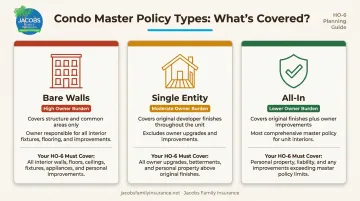
Bare Walls Coverage
Bare walls (sometimes called "walls out") covers the building structure only — the studs, concrete, and subfloor — plus common areas. Everything inside your unit is your responsibility:
- Interior finishes (flooring, drywall, paint)
- Cabinets and countertops
- Fixtures and built-ins
- Appliances
Owners in bare-walls communities carry the heaviest burden on their HO-6 policy and need the most interior coverage.
Single Entity Coverage
Single entity coverage (also called "walls in") covers the original interior finishes the developer originally installed — including cabinets, fixtures, and floor coverings. The catch: upgrades aren't included.
If you replaced builder-grade laminate countertops with quartz, the master policy after a covered loss pays only to restore the original laminate. Your HO-6 policy needs to cover the difference in value for any improvements you've made.
All-In Coverage
All-in coverage is the most owner-friendly option. It covers both the original finishes and any improvements or upgrades you've added to the unit. A kitchen renovation, new flooring, upgraded bathrooms — all covered by the master policy after a covered loss.
That said, all-in coverage doesn't eliminate your obligation to pay the master policy deductible when a loss affects your unit — even the broadest policy passes that cost to you.
How to Identify Your Association's Coverage Type
- Request the Certificate of Insurance — issued at each policy renewal, it specifies the coverage type and current deductible amount
- Review governing documents — the CC&Rs or bylaws often define the association's insurance responsibilities
- Contact your HOA president or property manager if the documents are unclear
Make a note of the deductible amount on the certificate. That number directly affects how much loss assessment coverage you need on your HO-6 policy.
Who Pays the Master Policy Deductible?
Responsibility depends on where the damage occurred and how many units were affected. Governing documents often address this — but many don't, leaving room for disputes.
Single-Unit Damage
When a covered loss affects only your unit and originates within your unit — a burst pipe, an appliance malfunction — you typically owe the entire master policy deductible, even if the master policy pays the repair costs above that amount.
This is the scenario that surprises most owners. The association's insurer pays the contractor. You pay the deductible directly to the association.
Multi-Unit Damage
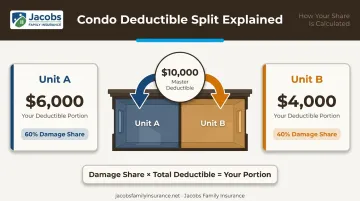
When one incident damages multiple units, the master policy deductible is split proportionally based on each unit's share of the total loss.
Example: A roof leak damages two units — Unit A sustains $60,000 in damage, Unit B sustains $40,000. The master policy deductible is $10,000.
| Unit | Damage | Share of Loss | Deductible Owed |
|---|---|---|---|
| Unit A | $60,000 | 60% | $6,000 |
| Unit B | $40,000 | 40% | $4,000 |
Common Area Damage
When only common areas are damaged — the lobby, pool, hallways — the deductible is treated as a common expense. It comes from association reserves or gets spread across all unit owners through a special assessment.
Special Assessments When Damage Exceeds Coverage Limits
The deductible isn't always the only out-of-pocket exposure. When total damage costs exceed the master policy's coverage limits, the association levies a special assessment against all unit owners to cover the shortfall. These can be substantial — one Dockside at Ventura condo owner faced an assessment of over $128,000 following Hurricane Ian repairs, with the association taking on a loan exceeding $18 million.
Loss assessment coverage on your HO-6 policy is specifically designed to cover your share of these assessments. It also covers your portion of the master policy deductible when the triggering loss is a peril your HO-6 also covers. This coverage is not automatically included at adequate limits on every HO-6 policy, so verifying your current limits is worth a quick call to your agent.
How Your HO-6 Policy Bridges the Gap
The HO-6 policy is your individual layer of protection. It covers what the master policy doesn't — and it handles your share of what the master policy leaves behind.
Core HO-6 Coverages
- Personal property — furniture, clothing, electronics, and other belongings
- Interior improvements — fixtures, flooring, and finishes not covered by the master policy
- Personal liability — if a guest is injured inside your unit
- Additional living expenses — hotel and housing costs if your unit becomes uninhabitable
- Loss assessment coverage — your share of special assessments and master policy deductibles
The Loss Assessment Coverage Problem
Standard ISO HO-6 policies include a base loss assessment limit of just $1,000. Given that master policy deductibles now commonly run $10,000 to $25,000, that base limit covers a fraction of a real exposure. A supplemental endorsement — ISO form HO 04 35 — is available to increase that limit, but you have to request it.
According to Fannie Mae's lending guidelines, loss assessment coverage should be sufficient to cover assessments in excess of 5% of the master property insurance coverage amount divided by the number of units. For most unit owners, the default $1,000 falls far short.
Jacobs Family Insurance works with Santa Fe and New Mexico condo owners to review existing HO-6 policies and confirm that loss assessment limits actually align with the association's current master policy deductible — not whatever was in place three years ago.
The Risk of Carrying No HO-6 Policy
Reviewing and updating your HO-6 matters — but so does having one in the first place. Some condo owners skip HO-6 coverage assuming the master policy handles everything. It doesn't. Without an HO-6 policy, you're personally exposed to:
- The full master policy deductible on single-unit claims
- Your share of any special assessment
- Damage to all personal property
- Any liability claim arising inside your unit
Choosing the Right Deductible Amount for Your Condo
The Trade-Off in Practical Terms
A higher HO-6 deductible lowers your annual premium, but the savings only help if you can cover that amount when a claim actually occurs. The right deductible is the highest figure you could pay out of pocket without straining your finances.
Common HO-6 deductible options break down like this:
| Deductible | Premium Impact | Out-of-Pocket Exposure |
|---|---|---|
| $500 | Higher premium | Lowest — most first-dollar protection |
| $1,000 | Moderate | Balanced trade-off for most owners |
| $2,500 | Lower premium | Higher — only works with savings to cover it |
Which amount makes sense depends on your cash reserves and how much premium savings you'd realistically recoup before your next claim.
For master policies, the picture is different. Deductibles of $10,000 or more are now standard in many markets.
Aligning Loss Assessment Coverage with the Master Deductible
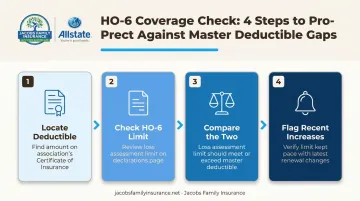
Walk through these four steps to make sure your HO-6 coverage keeps pace with your association's master policy:
- Locate the deductible on your association's Certificate of Insurance
- Check the loss assessment limit on your HO-6 policy declarations page
- Compare the two — your loss assessment limit should meet or exceed the master policy deductible
- Flag any recent increases — if the association raised its deductible at the last renewal, your coverage limit may now be inadequate
If your association carries a $15,000 master policy deductible and your HO-6 loss assessment limit is $1,000, you have a $14,000 gap. Increasing that limit typically costs very little annually — but the protection it provides is substantial.
Conclusion
Condo insurance deductibles don't work like standard homeowners coverage because there's no single policy. Two policies, two deductibles, and one claim can mean significant out-of-pocket costs if you haven't checked the details in advance.
Before that claim happens, take three concrete steps:
- Read your association's governing documents and Certificate of Insurance — identify the master policy coverage type and current deductible amount
- Review your HO-6 policy — confirm loss assessment coverage is present and that the limit matches the master deductible
- Talk to a local agent — close any gaps before you need the coverage
Jacobs Family Insurance helps Santa Fe and New Mexico condo owners navigate both policies and close coverage gaps. A local, family-owned Allstate Elite agency, they've spent more than 10 years serving northern New Mexico. They can review your HO-6 policy and confirm your coverage aligns with your association's current deductible structure. Contact them at (505) 557-2067 or visit the office at 1547 South St. Francis Drive, Santa Fe.
Frequently Asked Questions
What is condo insurance deductible coverage?
Condo insurance deductible coverage is the portion of a covered loss you pay before insurance kicks in. In condo settings, this applies separately to your HO-6 policy and the association's master policy. Which deductible applies depends on which policy is triggered and what your governing documents specify.
Is a $2,000 or $5,000 deductible considered high for condo insurance?
For an individual HO-6 policy, $2,000 is moderate and $5,000 is on the higher end, though neither is unusual. Master policy deductibles are a different story: $10,000 to $25,000 per occurrence is now common. What feels high at the unit level may be modest compared to what your association actually carries.
Who is responsible for paying the condo association's master policy deductible?
On single-unit claims, the affected unit owner typically owes the full master policy deductible. In multi-unit or common area losses, the cost is split proportionally or absorbed by the association through reserves or a special assessment.
What is loss assessment coverage in condo insurance?
Loss assessment coverage is an HO-6 endorsement that pays your share of a special assessment or master policy deductible after a covered loss. The default limit on most standard policies is just $1,000, well below what most master policy deductibles now require.
What is the difference between bare walls, single entity, and all-in master policy coverage?
Bare walls covers only the building shell and common areas. Single entity adds original interior finishes as installed by the developer. All-in covers both original finishes and owner-made improvements, making it the most comprehensive option for unit owners.
Does my HO-6 policy automatically cover the master policy deductible?
No. Standard HO-6 policies include only a limited base loss assessment amount, typically $1,000. To match your association's actual master policy deductible, you'll need to confirm and increase that limit via endorsement. This is not automatic and requires a deliberate policy review.