New Mexico currently ranks sixth among Western states for wildfire exposure, with nearly 118,000 homes and $37.1 billion in reconstruction value at risk, according to Cotality's 2025 Wildfire Risk Report. If you own a home in Santa Fe, Taos, Ruidoso, or anywhere in between, understanding exactly what your policy covers — and where it falls short — matters before fire season arrives.
Key Takeaways
- Wildfire is a covered peril under most standard homeowners policies, including structure, belongings, other structures, and temporary living costs
- Fires from arson, neglect, or intentional acts are excluded and will result in claim denial
- High-risk zone homeowners may face higher premiums, wildfire-specific deductibles, or non-renewal
- New Mexico's FAIR Plan provides last-resort basic fire coverage, with a maximum residential limit of $750,000
- Many homeowners are underinsured, with rebuilding costs after regional fires often exceeding policy limits
What Does Homeowners Insurance Typically Cover for Wildfire Damage?
Wildfire is one of the most consistently covered perils in a standard homeowners policy. Under an HO-3 policy — the most common form — your home is insured against all perils except those specifically excluded, and wildfire is not excluded. You typically don't need a separate wildfire endorsement.
Dwelling Coverage (Coverage A)
This pays to repair or rebuild your home's physical structure after wildfire damage, up to your coverage limit.
One important caveat: after a major regional fire, construction costs surge. Labor and materials become scarce, contractor demand spikes, and your pre-fire coverage limit can fall well short of what rebuilding actually costs. Extended replacement cost coverage addresses this by paying a percentage above your stated limit (commonly 20–50%) to account for post-disaster price increases. Ask your agent whether this endorsement is already on your policy.
Other Structures Coverage (Coverage B)
Detached garages, sheds, fences, and similar structures are covered here — typically at 10% of your dwelling limit by default. If you have a large workshop, guest casita, or extensive fencing, that default may not be enough. This limit can usually be adjusted.
Personal Property Coverage (Coverage C)
Furniture, electronics, clothing, and appliances destroyed in a wildfire fall under personal property coverage — commonly set at 50–70% of your dwelling coverage, according to the Insurance Information Institute.
The key distinction here is how losses are paid:
- Actual Cash Value (ACV): Pays the depreciated value of your belongings at the time of loss
- Replacement Cost Value (RCV): Pays what it actually costs to replace items with new equivalents
For wildfire recovery, RCV is the better option. A five-year-old couch is worth far less under ACV than what you'd pay to replace it today.
Loss of Use Coverage (Coverage D)
If wildfire forces you out of your home — whether from direct damage or mandatory evacuation — this coverage pays for hotel stays, meals, and other living expenses while your home is repaired or rebuilt. Standard limits are typically 20% of dwelling coverage.
Displacement after a major wildfire can stretch for many months. A United Policyholders survey of Northern California wildfire survivors found 80% had not settled the dwelling portion of their claim roughly a year after the fires. That timeline is worth weighing against your current loss of use limit — if it's set at the standard 20%, it may not cover a full year of alternative living costs.
What Types of Fire Damage Are NOT Covered?
Wildfire coverage is broad, but several specific scenarios will get a claim denied. Understanding where coverage stops is just as important as knowing where it starts.
Intentional Acts and Arson
Any fire deliberately set by a policyholder is excluded under standard HO-3 language. Insurers may investigate fire cause before approving a claim, and fraudulent claims carry criminal consequences, not just civil liability.
Neglect and Poor Maintenance
If an insurer can show your negligence allowed fire to spread or worsen (ignoring known electrical hazards, failing to maintain the property), they can deny or reduce your claim. The HO-3 policy form defines neglect as failure to use all reasonable means to protect property during and after a loss.
Landscaping, Trees, and Certain Exclusions
Most standard policies offer limited or no coverage for:
- Trees, shrubs, and plants destroyed by wildfire
- Nuclear hazards (explicitly excluded in HO-3 language)
- Government-ordered demolitions in some circumstances
If landscaping matters to you, particularly on a xeriscaped New Mexico property, review your policy's specific language on this point.
The Underinsurance Problem
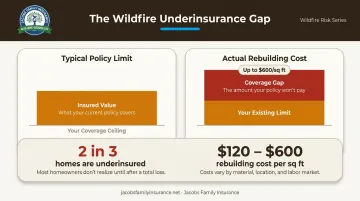
Underinsurance quietly creates the same outcome as a denial. United Policyholders estimates roughly two-thirds of homes are underinsured for wildfire total-loss rebuilding costs. Rebuilding estimates for Western homes range from $120 per square foot for tract construction to $600 per square foot for mountain properties.
If your dwelling limit was set years ago and hasn't been updated to reflect current construction costs, that shortfall surfaces at the worst possible moment — after a total loss.
Getting Homeowners Insurance in High Wildfire Risk Areas
As wildfire seasons grow longer and more destructive, some carriers have begun pulling back from high-risk zones. This trend has been most dramatic in California, but it's increasingly relevant across fire-prone Western states — including New Mexico.
A 2025 U.S. Treasury report found that nonrenewal rates in the highest-risk ZIP codes were roughly 80% higher than in the lowest-risk areas. Policyholders in those zones paid an average of $2,321 in premiums — about 82% more than homeowners in lower-risk areas.
Higher Premiums and Wildfire-Specific Deductibles
Homeowners in designated high-risk fire zones should expect:
- Significantly higher premiums than neighbors in lower-risk areas
- Wildfire-specific percentage deductibles — tied to your home's insured value rather than a flat dollar amount, which can mean thousands out of pocket before coverage kicks in
- Stricter underwriting criteria based on proximity to wildland areas, roofing materials, and defensible space
The FAIR Plan: Last-Resort Coverage
If private insurers won't cover your home, New Mexico's FAIR Plan (formally the New Mexico Property Insurance Program) provides basic fire coverage. Key facts:
- Maximum residential coverage: $750,000
- Coverage is generally based on actual cash value, not replacement cost
- Typically does not include liability or loss of use coverage
- All insurers licensed in New Mexico are required to participate in the program
Think of the FAIR Plan as a last resort: premiums run higher than standard market policies, and the coverage gaps — no liability, no loss of use — are significant.
Surplus Lines Carriers
If both standard market and FAIR Plan options fall short, surplus lines (non-admitted) carriers can legally cover risks that standard insurers won't. These come with trade-offs:
- Generally higher premiums and deductibles than standard policies
- Not covered by New Mexico's state guaranty fund if the carrier becomes insolvent
- Require careful vetting — check the carrier's financial ratings and licensing status before signing
Steps to Take After Wildfire Damages Your Home
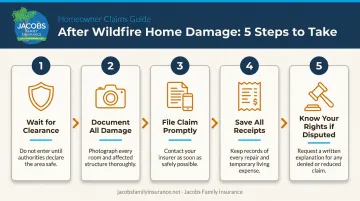
The steps you take in the first 48 hours after a wildfire loss directly shape how your claim is handled — and how much you recover.
Wait for clearance before re-entering. Don't go back into a damaged home until authorities confirm it's safe. Structural instability and air quality hazards are real risks.
Document everything before touching anything. Photograph and video every area of damage — structure, belongings, other structures — before any cleanup begins. Keep damaged items on-site until an adjuster has inspected them.
File your claim promptly. Most HO-3 policies require prompt notice after a loss. Call your insurer or agent as soon as possible to open a claim and request an adjuster visit. Track every communication in writing.
Keep all receipts for temporary expenses. Hotel stays, meals, and other displacement costs should be documented carefully — your loss of use reimbursement depends on it.
Know your rights if a claim is disputed. If your claim is denied or the payout seems low, you have options:
- Request a second appraisal or independent inspection
- File a formal appeal with your insurer
- Submit a complaint to the New Mexico Office of Superintendent of Insurance at osi.state.nm.us
The OSI can investigate your complaint and intervene with your insurer, though it cannot order a carrier to pay a specific amount. That said, a formal complaint often prompts insurers to take a second look — so don't walk away from a denial without pushing back.
How to Make Sure Your New Mexico Home Has the Right Wildfire Coverage
New Mexico's terrain, dry climate, and expanding wildland-urban interface create real and growing risk for homeowners from Santa Fe to Taos to Ruidoso. Getting coverage right requires more than buying a policy — it requires actively managing it.
Review Your Policy Limits Before Fire Season
Every year before wildfire season, check:
- Dwelling coverage limit — Does it reflect current local construction costs? A limit set three years ago may already be insufficient.
- ACV vs. RCV — Is your personal property covered at replacement cost or depreciated value?
- Loss of use limits — Could you actually afford extended displacement on your current Coverage D?
Reduce Your Risk Profile With Home Hardening
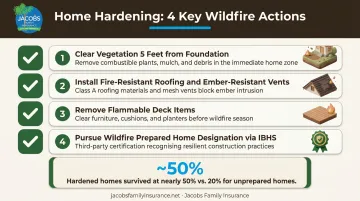
Proactive mitigation can improve your insurability and may support better coverage terms. Research from California's Department of Insurance found that homes with key hardening features and defensible space survived wildfires at nearly 50%, compared to around 20% for unprepared homes. These findings shape the national standards that IBHS and state forestry agencies — including New Mexico's — use to guide homeowners today.
Practical steps for New Mexico homeowners:
- Clear dead vegetation and combustible debris at least 5 feet from your home's foundation (per New Mexico State Forestry guidance)
- Install fire-resistant roofing materials and ember-resistant vents
- Remove flammable items from decks and porches
- Pursue a Wildfire Prepared Home designation through IBHS — some insurers recognize this three-year certification when evaluating coverage eligibility and terms
Work With a Local Agent Who Knows New Mexico
Navigating wildfire coverage options in New Mexico — from policy limits and deductible structures to defensible space requirements and FAIR Plan eligibility — is complex. Generic national advice doesn't account for the specific risks of high-elevation Northern New Mexico communities.
Jacobs Family Insurance in Santa Fe is an Allstate Elite Agency that has served Northern New Mexico homeowners since 2016. Their agents live and work in the communities they cover, so wildfire coverage reviews are grounded in local knowledge — not scripted call-center advice. Whether your concern is current policy limits or coverage for a home in a high-risk zone, they're a straightforward first call.
You can reach them at (505) 557-2067, Monday through Friday, 9 AM to 5 PM, or visit at 1547 South St. Francis Drive in Santa Fe.
Frequently Asked Questions
Does homeowners insurance cover wildfires?
Yes. Wildfire is a standard covered peril under most homeowners insurance policies, including coverage for your home's structure, detached structures, personal belongings, and temporary living expenses while your home is uninhabitable. If you're in a high-risk area, confirm with your agent that your policy limits reflect current rebuilding costs.
Which types of fires are not covered by homeowners insurance?
Fires caused by intentional acts (including arson by the policyholder), neglect, or failure to maintain the property are not covered. Nuclear hazards are also excluded, and most standard policies limit or exclude coverage for trees, shrubs, and landscaping.
What should I do if I lose everything in a house fire?
Confirm the property is safe before re-entering, then document all damage with photos and video before any cleanup begins. Contact your insurer promptly to file a claim and activate your loss of use coverage for temporary housing and meals.
How much does homeowners insurance cost for a $500,000 house in a high-risk area?
Costs vary widely by risk zone, property characteristics, and insurer. Across wildfire-prone states, premiums have risen sharply in recent years — a trend that applies to high-risk areas in New Mexico as well. Speak with a local agent for a quote tied to your specific property and location.