Introduction
You just bought an ATV for weekend trail rides outside Santa Fe. You assume your homeowners policy has you covered if something goes wrong.
That assumption gets a lot of New Mexico homeowners into trouble.
ATV accidents cause serious injuries every year. According to the Consumer Product Safety Commission, an estimated 57,700 emergency-department-treated injuries involved 4-wheel ATVs annually between 2019 and 2023. Many riders never check their policy until after an accident happens, and by then, it's too late to fix a coverage gap.
This guide breaks down exactly when homeowners insurance applies to ATV accidents, where it falls short, and what New Mexico riders should do to protect themselves properly.
Key Takeaways
- Homeowners liability may apply to ATV accidents on your property, but never covers the ATV itself
- Coverage generally stops once your ATV crosses your property line onto trails or roads
- A standalone ATV policy fills coverage gaps, including theft and off-property liability
- Rural areas like Taos, Farmington, and Silver City see heavy ATV use, making coverage essential
Does Homeowners Insurance Cover ATV Accidents?
Here's the short version: homeowners insurance liability coverage can extend to ATV accidents, but only under narrow conditions. If your ATV causes an injury or property damage while being used on your insured property, your homeowners liability coverage may respond. What it will never do is pay to repair or replace the ATV itself.
That distinction trips up a lot of owners. Liability protects other people. It doesn't protect your machine.
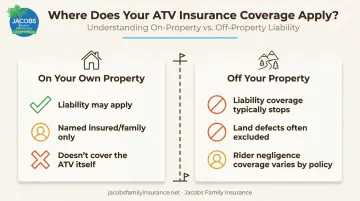
On Your Own Property
Homeowners liability coverage is built around the concept of "insured premises." If an accident happens on the land listed on your policy declarations page, your liability protection generally kicks in for injuries or damage caused to others.
But there are catches:
- Some policies only cover accidents caused by the named insured or immediate family members, not friends, neighbors, or other riders
- Coverage typically applies to injuries or damage caused by the ATV, not damage to the ATV
- Limits vary widely by insurer, so a policy that looks protective on paper may leave real gaps
Off Your Property
The moment your ATV leaves your property line, standard homeowners liability coverage usually stops working. Ride onto a public trail, a neighbor's ranch, or a state-managed area, and you're likely on your own.
Some policies draw a line between land defects causing an injury, which are often excluded, and rider negligence causing an injury, which may still be covered depending on policy wording.
This distinction depends entirely on your specific policy language. There's no universal rule here, which is exactly why pulling out your declarations page, or calling your agent, matters more than guessing.
What Homeowners Insurance Doesn't Cover
Beyond the on-property/off-property divide, homeowners insurance has hard limits when it comes to ATVs. Understanding these gaps upfront saves a lot of frustration later.
Three key gaps trip up most ATV owners:
- Physical damage: Crashes, rollovers, and fire damage to the ATV aren't covered. That protection only comes from collision and comprehensive coverage in a dedicated recreational vehicle policy.
- Theft: If someone steals your ATV from your garage or property, homeowners insurance typically won't reimburse you — a real risk for ATVs stored in barns or outbuildings on rural properties.
- Liability limits: Many homeowners policies start around $100,000 in liability protection. Serious ATV accidents involving head trauma or long-term disability can quickly exceed that limit, making $300,000 or $500,000 a safer target for most owners.
Put together, these three gaps explain why so many ATV owners end up underinsured without realizing it until an accident forces the question.
Steps to Take After an ATV Accident
Immediate action after an ATV accident matters for two reasons: protecting whoever's hurt, and protecting your ability to file a clean insurance claim later.
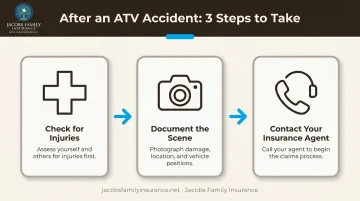
Check for Injuries First
Check everyone involved before anything else. ATV injuries frequently involve the head and extremities, and a nationwide analysis found an estimated 67,957 pediatric ATV-related head injuries occurred between 2012 and 2021, with over 7,600 in 2021 alone.
Call for medical evaluation even if no one appears hurt. Internal injuries and concussions don't always show obvious symptoms right away, and delaying care can make things worse.
Document the Scene
Once everyone's safety is addressed, start documenting:
- Photograph the ATV, terrain, and any visible injuries
- Collect contact information from any witnesses
- File a police report, especially for serious accidents or anything happening on a public trail or roadway
This documentation becomes essential if a claim gets filed, whether by you or another party involved.
Contact Your Insurance Agent
Notify your insurer even if you don't plan to file a claim yourself. The other party involved might file one, and an agent at Jacobs Family Insurance needs to know what happened regardless of who's at fault.
Your agent will also need to know which type of policy applies (homeowners or a standalone ATV policy), since that determines how the claim gets processed and what's actually covered.
Do You Need a Separate ATV Insurance Policy?
Given everything homeowners insurance leaves out, most ATV owners genuinely need a standalone policy. Homeowners coverage typically leaves these gaps:
- Excludes physical damage to the ATV itself
- Skips liability protection once you leave your property
- Leaves theft protection completely uncovered
That's a lot of exposure to carry unprotected.
A dedicated ATV or recreational vehicle policy typically includes:
- Liability coverage for bodily injury or property damage you cause to others
- Collision coverage for damage from hitting another vehicle or object
- Comprehensive coverage for theft, fire, vandalism, and weather-related damage
- Medical payments coverage for injuries you or your passengers sustain while riding
The biggest advantage: this protection follows you anywhere you ride, not just on your own land. For New Mexico riders with access to extensive public and private off-road terrain, that portability is the whole point.
At Jacobs Family Insurance, we're a local Allstate Elite agency that can review your existing homeowners policy alongside your ATV use to pinpoint exactly where the gaps sit.
Bundling homeowners and recreational vehicle coverage often adds multi-line discounts across your entire portfolio, so closing these gaps doesn't have to cost more. Reach out to our team, and we'll walk through your coverage options in person, not through a call center.
New Mexico Considerations for ATV Owners
New Mexico's rural and ranch-heavy landscape makes ATV ownership common across our service areas, including Taos, Farmington, and Silver City. Off-roading is part of how people manage land, work property, and spend weekends across the state.
A few state-specific rules matter for ATV owners:
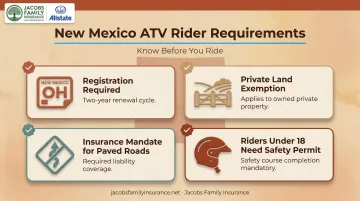
- Registration is generally required. Per the New Mexico Motor Vehicle Division, operating an off-highway vehicle without registration is prohibited unless an exemption applies. Registration stickers use an "OH" prefix and expire every two years.
- Private land exemption exists. ATVs used exclusively on privately held land may be exempt from standard registration fees, provided applicable taxes are paid.
- Insurance mandates apply in specific situations. New Mexico doesn't broadly require liability insurance for off-highway use. However, coverage under the Mandatory Financial Responsibility Act becomes mandatory if a local authority permits ATV operation on a paved road or highway.
- Riders under 18 need a safety permit and must wear approved head and eye protection.
These rules shift depending on where and how you ride. At Jacobs Family Insurance, our agents understand New Mexico's requirements and can match your coverage to real-world riding habits, not a generic template.
Frequently Asked Questions
What to do after an ATV accident?
Check everyone involved for injuries first, even if no one looks hurt. Document the scene with photos and witness information, then contact your insurance agent promptly regardless of who's at fault.
What does insurance cover on an ATV?
A standalone ATV policy can cover liability, collision, and comprehensive damage to the vehicle itself. Homeowners insurance, by contrast, may only offer limited liability protection while the ATV is on your own property.
Does homeowners insurance cover ATV accidents that happen on someone else's property?
Coverage becomes unlikely once your ATV leaves your own insured property. However, the other property owner's homeowners policy might come into play depending on the circumstances.
Is ATV insurance required in New Mexico?
Requirements depend on where and how you ride, particularly around registration and specific road-use permissions. Confirm your specific situation with a licensed local agent to stay compliant.
Will homeowners insurance cover a stolen ATV?
No. Theft of an ATV is typically excluded from homeowners policies entirely. Protecting against theft requires a dedicated recreational vehicle policy with comprehensive coverage.
What's the difference between ATV insurance and homeowners insurance for off-road vehicles?
Homeowners insurance offers narrow liability protection limited to your own property. ATV insurance offers broader, portable protection for both the vehicle and the rider, wherever you actually ride.
Ready to close your coverage gaps? Contact Jacobs Family Insurance at (505) 557-2067 for a free policy review tailored to how you use your ATV.