A guest slips on your icy front walk. Your dog nips a jogger on the trail. Your kid's bike knocks over a neighbor's fence post. These moments happen fast, and they can turn into lawsuits that threaten your savings just as much as a house fire threatens your roof.
Many New Mexico homeowners don't realize this protection already lives inside their policy, under a section called Coverage E. Jacobs Family Insurance, a Santa Fe-based Allstate Elite agency, has spent more than 10 years helping local families understand exactly what this coverage does and where it stops.
This guide covers what Coverage E means, real scenarios where it applies, how much protection is enough, what's excluded, and how it works differently on a DP3 rental property policy.
Key Takeaways
- Coverage E pays medical costs, legal fees, and judgments for injuries or property damage you cause.
- Limits typically run $100,000–$500,000+; higher-net-worth owners often add an umbrella policy.
- Coverage E excludes intentional acts, business activities, auto accidents, and damage to your own property.
- DP3 rental policies rarely include liability automatically; you'll need to add it separately.
What Is Coverage E in Homeowners Insurance?
Coverage E is the personal liability section built into Section II of a standard HO-3 homeowners policy. It protects your finances if you're found legally responsible for injuring someone or damaging their property, whether that happens on your porch or three states away.
Unlike optional endorsements you have to request separately, Coverage E typically comes bundled automatically with a set liability limit. Most policies start homeowners off around $100,000 of protection, though your declarations page will show your actual number.
What Costs Does Coverage E Help Pay For?
Coverage E generally steps in for four situations:
- Medical expenses for a third party injured because of your negligence
- Repair costs for property you damaged, whether that's a fence, a parked car, or a neighbor's window
- Legal defense fees, even if a lawsuit against you turns out to be groundless or false
- Court judgments or settlements, up to your policy's liability limit
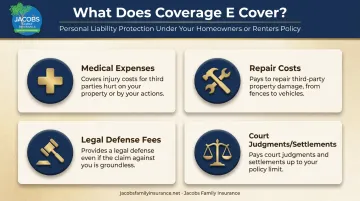
That legal defense piece catches people off guard. Your insurer covers the cost of defending you in court even when the claim never actually holds up.
Understanding Section II: Coverage E and F
Homeowners policies split into two halves. Section I (Coverages A through D) covers your dwelling, other structures, personal belongings, and loss of use, essentially your own stuff. Section II (Coverages E and F) covers what happens to other people because of you.
Coverage E and Coverage F work together but serve very different purposes:
| Criteria | Coverage E | Coverage F |
|---|---|---|
| Requires proof of fault | Yes | No |
| Typical limit | $100,000–$500,000+ | $1,000–$5,000 |
| What it covers | Injury/damage to others, legal defense, judgments | Small medical bills for others, regardless of blame |
Coverage F pays out quickly for minor injuries with no fault investigation needed. Coverage E handles the larger, costlier claims where liability has to be established first, often requiring witness statements, police reports, or an attorney before a settlement is reached.
Real-Life Scenarios: When Coverage E Protects New Mexico Homeowners
Coverage E isn't theoretical. It shows up in ordinary accidents that happen to homeowners across Santa Fe, Taos, and the rest of northern New Mexico.
Common triggers include:
- Icy walkways and wet patios. A guest slips on your front steps during a winter gathering and breaks a wrist. New Mexico's freeze-thaw winters make this one of the most common claims agents see.
- Dog bites. Dogs are common on rural and ranch properties statewide, and claims are climbing fast. Dog-related injury claims rose more than 25% in 2025, reaching roughly 28,450 claims at an average cost of $65,450 each — nearly double a decade ago, according to Triple-I's analysis of 2025 industry data.
- Kids being kids. A stray baseball through a neighbor's window or a bike crashing through a flowerbed can result in a repair bill Coverage E typically pays.
- Wind-driven property damage. Northern New Mexico's high wind events can knock a tree, fence panel, or outbuilding onto a neighbor's land. If negligence on your part contributed, such as a dead tree you never removed, Coverage E can respond.
Liability Doesn't Stop at Your Property Line
A lot of homeowners miss this part: Coverage E travels with you. If your dog bites someone during a walk downtown, or your child breaks something at a friend's house during a sleepover, your homeowners policy can still respond. The trigger is your legal responsibility, not your street address.
How Much Personal Liability Coverage Do You Need?
Most homeowners policies default to $100,000 in Coverage E protection. That number made sense decades ago. It doesn't always hold up today.
Common Limit Tiers
- $100,000 – the standard starting point, often too thin for homeowners with real assets to protect
- $300,000 – a more realistic middle ground for many families
- $500,000 or more – appropriate for higher-net-worth households or those with elevated risk factors
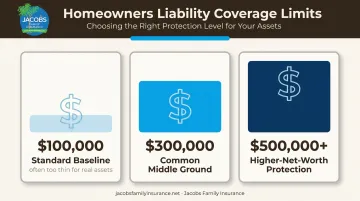
Allstate recommends homeowners consider $300,000 or $500,000 in liability protection rather than settling for the $100,000 baseline, particularly once medical costs and legal fees from a serious claim enter the picture.
The right number depends on what you actually have to lose. Your limit should roughly match your net worth: home equity, savings, investments, and future income a court could pursue in a judgment.
When an Umbrella Policy Makes Sense
Once your homeowners liability limit isn't enough, an umbrella policy picks up where Coverage E stops. It adds a large block of protection, often $1 million or more, above your existing home and auto limits.
Insurers commonly require at least $300,000 in underlying homeowners liability before issuing $1 million in umbrella coverage, according to the Insurance Information Institute. An umbrella policy is worth a serious look if you have:
- A swimming pool or trampoline
- Dogs, especially larger breeds
- A rental unit or guest house on your property
- Significant savings or investments to protect
New Mexico's Rural Liability Exposures
Ranch and rural properties across northern New Mexico carry their own set of risks. Livestock wandering onto a neighbor's land, ATV and UTV riders on shared trails, and outbuildings scattered across acreage all raise the odds of a liability claim compared to a typical in-town lot.
These exposures rarely fit into a generic, one-size-fits-all policy. That's where a local agency earns its keep.
Jacobs Family Insurance, an Allstate Elite agency based in Santa Fe, reviews your specific property, animals, and lifestyle risk factors before recommending a Coverage E limit and umbrella policy if warranted. Skip the guesswork of a distant call center and talk with a local agent who knows New Mexico ranch risk.
What Coverage E Does Not Cover
Coverage E has real limits. Knowing them now beats finding out during a claim.
- Intentional acts. If you injure someone or damage their property on purpose, Coverage E won't pay. It's built for accidents, not deliberate harm.
- Business activities. Claims tied to a home-based business typically fall outside your homeowners liability. A separate policy, such as a Business Owners Policy (BOP), fills that gap.
- Auto accidents. Your car insurance, not Coverage E, handles liability from a vehicle accident.
- Damage to your own property. Coverage E only pays for damage you cause to someone else, not repairs to your own home, which fall under Coverages A through C instead.
- Injuries to you or household family members. Coverage E protects against claims from outside your household, not injuries within it.
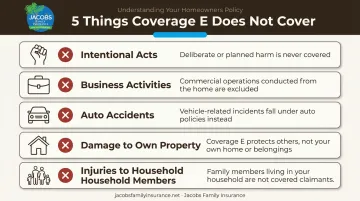
If you run a home-based business, rent out part of your property, or aren't sure where your liability protection ends, talk to your agent now. A quick conversation can prevent a costly coverage gap later.
Coverage E on a DP3 Policy: What Rental Property Owners Should Know
Own a rental property in Santa Fe or elsewhere in northern New Mexico? It's likely insured under a DP3 (dwelling fire, special form) policy rather than a standard HO-3. That distinction matters more than most landlords realize.
A DP3 is built mainly to cover the structure itself. Unlike an HO-3, it doesn't automatically bundle in personal liability the same way.
That gap has real consequences: a tenant who slips on icy front steps, or a visitor injured on the property, could expose you to a lawsuit with no Coverage E cushion behind you.
Landlords typically need to take one of two paths:
- Add Coverage E as an endorsement to the existing DP3 policy
- Purchase a separate landlord liability policy to run alongside it
Either approach closes the gap, but only if it's in place before an incident, not after.
If you own rental property in New Mexico, review your DP3 policy with your agent and confirm exactly what liability protection exists today.
Jacobs Family Insurance works with rental property owners throughout Santa Fe and northern New Mexico to check for this specific gap and add a landlord liability endorsement where one is missing.
Frequently Asked Questions
What is Section 2 Coverage E and F?
Section 2 of a homeowners policy covers liability protection: Coverage E for legal responsibility and Coverage F for no-fault medical payments to others. Section 1, by contrast, covers damage to your own home and belongings.
What is Coverage E on a DP3?
DP3 policies, often used for rental properties, don't automatically include Coverage E the way HO-3 policies do. It usually needs to be added as an endorsement or purchased as a separate liability policy.
Is Coverage E included in most homeowners insurance policies?
Yes. Coverage E is standard in most HO-3 homeowners policies, providing personal liability protection for injuries or property damage you cause to others.
How much personal liability coverage do homeowners usually have?
Limits typically range from $100,000 to $500,000 or more, depending on the homeowner's assets, lifestyle risk factors, and whether they carry an umbrella policy on top.
Does Coverage E apply only at your home?
No. Coverage E can extend beyond your property, covering certain liability incidents that happen elsewhere, such as your dog or child causing injury or damage away from home.
What's the difference between Coverage E and an umbrella policy?
An umbrella policy adds liability protection above and beyond your homeowners Coverage E limit. It kicks in once a serious claim exceeds what your homeowners policy will pay.