This is what a loss assessment looks like in practice. Many condo owners don't know this kind of charge is even possible until one lands in their mailbox. The HOA's master policy covers shared structures and common areas, but when a claim exceeds that policy's limits — or the association can't cover its own deductible — individual unit owners pay the difference.
This article explains how those coverage gaps form, what triggers an assessment, what loss assessment coverage actually pays for, and how New Mexico condo owners can make sure they're protected.
Key Takeaways
- Loss assessment coverage fills the gap between what the HOA master policy pays and what unit owners owe after a major claim.
- Most standard condo policies include only $1,000 in default loss assessment coverage — far less than a real-world assessment typically costs.
- Triggers include property damage, liability judgments, or the HOA's inability to cover its own deductible.
- Coverage generally does not cover flood damage, earthquake damage, planned upgrades, or routine maintenance.
- Reviewing your condo association's master policy is the essential first step in choosing the right coverage amount.
The HOA Master Policy and Why Coverage Gaps Happen
When you buy a condo, the association purchases a master insurance policy covering shared structures and common areas — the roof, exterior walls, hallways, elevators, pools, and other amenities. Your HOA dues fund a portion of that coverage.
That policy has defined limits and a deductible — and the deductible can be substantial. Fannie Mae's underwriting guidelines allow deductibles up to 5% of the total insured value, meaning a building insured at $2 million could carry a $100,000 deductible.
Where the Gap Opens
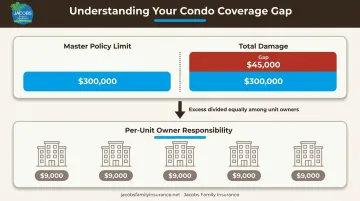
When a loss exceeds the master policy's limits — or the association doesn't have enough reserve funds to cover the deductible — the association charges each unit owner a proportional special assessment to cover the shortfall.
This differs from your regular HOA dues, which cover routine operating expenses. A loss assessment is a separate, unexpected charge tied to a specific insured event — and owners often receive little warning before the bill arrives.
That surprise is more common than most owners expect. CAI's 2025 community survey of 719 respondents found that 70% considered adequate reserves a major concern and 32% reported persistent reserve-funding challenges. When reserves run short, assessments follow.
Key reasons associations fall short:
- Aging infrastructure that outpaces reserve contributions
- Catastrophic losses (fire, storm, flooding) that exceed policy limits
- High master policy deductibles that drain reserve funds in a single event
- Underestimated repair costs on shared structures
What Triggers a Loss Assessment?
Loss assessments typically arise from three situations — and knowing them helps you understand exactly what coverage you need.
Structural Damage to Common Areas
A fire, windstorm, or hailstorm can cause damage to shared building elements — the roof, lobby, parking garage, or pool — that exceeds the master policy's property damage limits. The excess cost is divided among all unit owners.
Example: $200,000 in damage beyond the master policy limit, split among 20 units = $10,000 per owner.
For context, Allstate illustrates a scenario where $550,000 in covered damage exceeds a $500,000 policy limit, leaving 50 owners with $1,000 each. The numbers in real events can be far larger — CAI's survey documented repair assessments reaching $40,000 per unit for balcony work and $70,000 per unit for structural stabilization in some communities.
Liability Claims from Injuries in Shared Spaces
If a visitor is injured at the pool, in the stairwell, or in the gym and successfully sues the association, the liability payout can exceed the master policy's liability limits. Unit owners are then assessed for the remaining balance.
Example: A $100,000 excess liability judgment split among 20 units = $5,000 per owner.
State Farm identifies exactly this scenario — an injury involving common property like a pool — as a standard loss assessment trigger for condo unit owners.
Master Policy Deductible Assessments
Many associations carry larger deductibles to keep their annual premiums manageable. When a covered loss occurs, the deductible must be paid before the master policy responds. If the association's reserves can't cover it, that cost gets passed to unit owners.
Policy wording is critical here. In Manuel Grife v. Allstate Floridian Insurance Co., the Eleventh Circuit upheld denial of a claim where the unit owner's policy expressly excluded deductible passthroughs — proof that not all loss assessment endorsements offer the same protection. Verify your exact policy language before assuming you're covered.
What Loss Assessment Coverage Pays For — and What It Doesn't
Loss assessment coverage pays your allocated share of qualifying assessments — up to the limit stated in your policy.
The default limit built into most standard HO6 condo policies is $1,000 — confirmed by NJM's condo insurance guidance and analysis of the ISO HO6 form. That amount is almost never sufficient for a real-world assessment.
What It Covers
- Your allocated share of property damage assessments for covered perils
- Your allocated share of liability judgments that exceed the master policy's liability limits
- Your share of deductible passthroughs (depending on endorsement wording — verify this carefully)
What It Doesn't Cover
- Flood or earthquake damage — assessments from excluded perils don't qualify. New Mexico's monsoon flooding and seismic activity require separate coverage.
- Planned improvements or renovations — capital projects the association chooses to undertake fall outside covered losses.
- Routine maintenance or wear and tear — the endorsement responds to accidental damage, not scheduled upkeep.
One more detail worth understanding before reviewing your policy limits: timing.
Timing: When the Assessment Is Charged, Not When the Loss Occurred
Loss assessment coverage is typically triggered by the date the assessment is charged, not the date of the underlying event. A condo owner could receive an assessment for an incident that happened before they purchased their unit — and still be covered if the assessment falls within their current policy period.
Who Needs Loss Assessment Coverage?
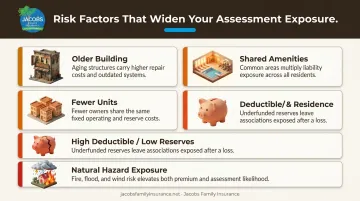
Loss assessment coverage matters most when the gap between what your HOA can cover and what a major claim actually costs falls on unit owners. The more of these risk factors that apply to your building, the wider that gap tends to be.
Higher-risk scenarios include:
- Living in an older building — CAI's 2025 survey found the oldest structures in 49% of surveyed communities exceeded 40 years, with significant reported issues involving roofs (56%), plumbing (51%), and structural components (42%)
- Communities with pools, gyms, or other amenities that increase liability exposure
- Smaller buildings where fewer unit owners share the assessment cost, making each person's share proportionally larger
- Associations with high deductibles, limited reserve funds, or lower liability limits on the master policy
- Properties in areas with elevated natural hazard exposure — including hail, monsoon flooding, and wildfire
New Mexico condo owners often face several of these risk factors at once. The National Weather Service recorded an average of 150 hail events per year across the state over the 10-year period ending in 2024, with flash floods concentrated in July and August.
Northern New Mexico adds wildfire exposure on top of that. Jacobs Family Insurance flags it as a priority risk for property owners in the Santa Fe area — and for good reason, since a single large fire or storm event can generate association claims that result in thousands of dollars in assessments per unit.
How Much Loss Assessment Coverage Do You Need?
Start with your association's master policy. Look at three numbers: the property damage limit, the liability limit, and the deductible. The gap between those figures and the potential cost of a major loss determines how much exposure each unit owner carries.
Key factors that affect your coverage amount:
- Larger master policy deductibles mean higher out-of-pocket exposure if reserves fall short
- Fewer units in your building means each owner absorbs a larger share of any assessment
- Older buildings or those with extensive amenities carry more claim risk overall
- Location matters — wildfire, hail, and flood exposure all factor into potential loss size
The standard $1,000 default is almost never adequate for a serious loss. Allstate, for example, offers loss assessment coverage up to $50,000 — and the right limit for your situation depends on your master policy details, not a one-size-fits-all answer. A local agent can pull those numbers and help you match your coverage to your actual exposure.
Mortgage lenders may require proof of loss assessment coverage, and your condo association's bylaws may specify a minimum amount. Check both documents before settling on a limit — and if you're unsure where to start, Jacobs Family Insurance serves condo owners across Santa Fe and northern New Mexico and can walk you through the math.
How to Add Loss Assessment Coverage to Your Condo Policy
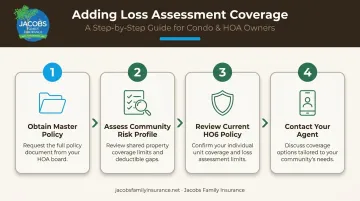
Adding this protection is straightforward: it's typically an endorsement to your existing HO6 policy, not a standalone policy.
Steps to get it right:
- Obtain the master policy — Request a copy from your condo association. Note the property damage limit, liability limit, deductible amount, and which master policy form applies (bare walls, all-in excluding improvements, or all-in).
- Assess your community's risk profile — Consider building age, local hazard exposure, and the amenities your association maintains.
- Review your current HO6 policy — Check whether you have any default loss assessment coverage and what the limit is.
- Contact your agent — Discuss how much more coverage you need given the master policy details and your community's risk factors.
Loss assessment coverage is a low-cost addition. Because endorsement pricing is highly individualized — varying by coverage limit, master policy structure, and your overall policy profile — the most accurate cost information comes from a quote from your agent.
Working with a local agent who knows New Mexico's risk environment makes a real difference. The team at Jacobs Family Insurance, an Allstate Elite Agency serving Santa Fe and northern New Mexico, can pull the master policy details, factor in regional risks like hail and monsoon season, and recommend a limit that reflects what you'd actually owe if your association levied a major assessment.
Reach them at (505) 557-2067, Monday through Friday.
Frequently Asked Questions
Is loss assessment coverage worth it?
For most condo owners, yes. The endorsement adds a modest amount to your annual premium while a single major assessment could reach thousands or tens of thousands of dollars. It's especially valuable when the master policy carries a high deductible or the association maintains limited reserves.
Is loss assessment coverage the same as a deductible?
No. A deductible is what you pay before your own insurance responds; a loss assessment is a fee your HOA charges when its master policy falls short. Loss assessment coverage can help cover your share of an assessment tied to the master policy's deductible, though your endorsement wording determines whether that applies.
What is an example of loss assessment coverage?
A fire causes $330,000 in damage to the building. The master policy covers $300,000. The remaining $30,000 is split among 30 unit owners at $1,000 each. Loss assessment coverage pays that $1,000 charge on the owner's behalf, up to the policy limit.
Does loss assessment coverage have its own deductible?
Some endorsements do carry a separate deductible, which is typically smaller than the master policy deductible. The specifics vary by insurer and policy form, so ask your agent directly when adding the endorsement.
How much loss assessment coverage do I need?
Review your association's master policy limits, deductible, and total unit count, then talk it through with your agent. The standard $1,000 default is rarely enough — a minimum of $50,000 is a reasonable starting point, adjusted to match your actual master policy exposure.