If you're boating on Cochiti Lake, Elephant Butte, or the Rio Grande, you might assume coastal-state pricing applies to you. It doesn't. New Mexico sits in a medium-cost tier nationally, and knowing why can save you real money.
This guide breaks down average costs by tier, the factors that push your premium up or down, what each coverage type actually protects, and practical steps to lower your rate without leaving gaps that show up after a storm or theft.
Key Takeaways
- Premiums run $300–$650+ annually, based on state, boat type, and coverage
- Boat type, size, age, horsepower, storage, and experience drive pricing
- New Mexico ranks medium-cost, averaging about $420 per year (per Progressive)
- Bundling policies and taking a safety course cut premiums fastest
- Local agents tailor coverage to actual usage, not one-size-fits-all plans
How Much Does Boat Insurance Cost? (Pricing Overview)
Insurers price boat policies based on the boat itself, how it's used, and where it's kept, not a flat formula. Still, industry data shows consistent patterns across states.
National Cost Tiers
Progressive's carrier data breaks the country into three tiers:
- Low-cost states: around $301/year average, typically inland states with shorter boating seasons
- Medium-cost states: around $400/year average. New Mexico falls into this tier, according to Progressive's 2023-2024 customer data
- High-cost coastal states: around $657/year average, driven largely by hurricane exposure
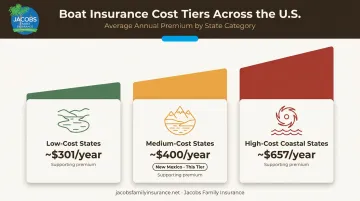
Progressive's state-specific figures put New Mexico's average annual premium at $420.74, close to the medium-cost benchmark and a useful number to budget against.
Monthly Cost Ranges
Breaking annual premiums into monthly terms gives a clearer picture:
- Small boats (fishing boats, small pontoons, personal watercraft): roughly $25 to $75/month
- Larger or high-performance boats (cabin cruisers, wake boats, small yachts): roughly $100 to $300+/month
Where your boat lands on that spectrum depends on value, horsepower, and how often you're on the water. Location adds another variable to that equation, especially for boats docked near hurricane-prone coastlines.
Why Location Matters
Coastal states pay more because they face longer boating seasons and heavier storm exposure. NOAA's 30-year climate data shows the Atlantic averages 14 named storms, 7 hurricanes, and 3 major hurricanes annually. None of that threatens a boat stored on Heron Lake.
New Mexico's inland lakes and shorter season mean lower theft and storm risk, which keeps premiums in the medium tier instead of the coastal high tier.
What These Averages Include (and Don't)
Tier averages typically reflect liability and basic hull coverage only. They usually exclude:
- Towing and on-water assistance
- Personal effects coverage
- High-value electronics like fish finders and navigation systems
These figures are national averages, not quotes. Your actual premium depends on your specific boat, how you use it, and the insurer you choose, which is why a personalized quote matters more than any published average.
Key Factors That Affect Your Boat Insurance Cost
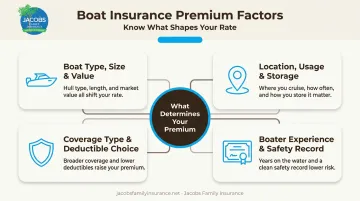
Insurers price your policy based on four things: the vessel itself, how and where you use it, the coverage you choose, and who's behind the wheel.
Boat Type, Size & Value
Horsepower, hull design, and vessel category all factor into risk:
- Pontoons and fishing boats typically cost less to insure, given lower speeds and reduced claim severity
- Speedboats and performance boats cost more due to higher horsepower and accident risk
- Sailboats often land in between, depending on size and rigging complexity
- Yachts carry the highest premiums, reflecting both value and repair costs
Newer or higher-value boats generally cost more to insure but may qualify for an agreed-value policy, meaning a fixed payout instead of a depreciated one.
Location, Usage & Storage
Where you keep your boat and how often you use it both matter:
- Coastal, hurricane-exposed storage costs more than inland lakes and rivers common across New Mexico
- Seasonal use, typical for most New Mexico boaters, can cost less than year-round boating in warmer climates
- Marina storage versus home or garage storage can shift your rate in either direction, depending on theft exposure and security
Coverage Type & Deductible Choice
Liability-only policies cost less than comprehensive coverage, but they leave your own boat unprotected. Adding collision and comprehensive coverage raises the premium while closing that gap.
Your deductible choice matters too. A higher deductible lowers your premium but increases your out-of-pocket cost if you file a claim. It's a trade-off worth discussing with your agent rather than defaulting to the lowest available number.
Boater Experience & Safety Record
A clean claims history and years of boating experience typically earn lower rates. Insurers view experienced boaters with no prior claims as lower risk.
Completing a certified boating safety course is one of the most common discount qualifiers across carriers, an easy way to shave dollars off your premium regardless of boat type.
Types of Boat Insurance Coverage (What You're Really Paying For)
Your premium comes from a combination of coverage choices, and that combination is the single biggest factor in your final cost.
Core Coverage Types
Most boat policies combine these components:
- Liability covers injury or property damage you cause to others
- Collision/hull covers damage from a crash, dock strike, or submerged object
- Comprehensive covers theft, fire, vandalism, and storm damage
- Uninsured boater coverage protects you if another boater has no or insufficient insurance
- Medical payments covers medical or funeral costs for injured occupants
- Towing/assistance covers on-water towing, jump-starts, and fuel delivery
- Personal effects covers belongings on board, up to a set limit
Jacobs Family Insurance's Allstate-backed boat policies include liability, physical damage, theft protection, and medical payments as standard, with towing assistance available as an add-on. That's a solid framework for most New Mexico lake boaters.
Agreed Value vs. Actual Cash Value
How your policy pays out after a total loss depends on the valuation method you choose:
| Valuation Type | How It Pays | Premium Impact | Best For |
|---|---|---|---|
| Agreed value | Fixed, pre-agreed payout amount | Higher premium | Newer or higher-value boats |
| Actual cash value | Market value minus depreciation | Lower premium | Older boats, budget-conscious owners |
Agreed-value policies remove the guesswork after a total loss since you and the insurer settle on a number upfront. Actual-cash-value policies cost less, but depreciation eats into your payout the longer you own the boat.
How to Lower Your Boat Insurance Costs
The right cost balances affordability with protection that actually holds up when you file a claim.
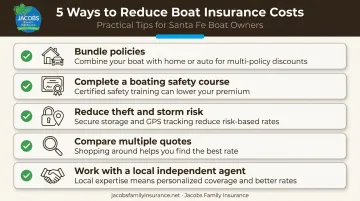
Here's what really moves the needle:
- Bundle your policies. Combining boat insurance with an existing home or auto policy through one agency can unlock multi-policy discounts across your entire portfolio, not just the new policy.
- Complete a boating safety course. A state-approved or NASBLA-approved course is one of the most reliable discount qualifiers, and BoatUS offers free options in many states.
- Reduce theft and storm risk. GPS tracking, anti-theft devices, and secure off-season storage all support a lower-risk profile, even if the discount isn't guaranteed by every carrier.
- Compare multiple quotes. Rates vary by insurer even for identical coverage, so shopping around is worth the hour it takes.
- Work with a local independent agent. A one-size-fits-all policy often overcharges for coverage you don't need or leaves gaps you won't notice until a claim.
Working with a local agent matters most when your boat doesn't fit a standard risk profile. Jacobs Family Insurance, an Allstate Elite Agency serving Santa Fe and northern New Mexico, works through your actual usage, storage location, and boat value before recommending coverage. That's different from a call-center quote built on generic assumptions.
Review Your Policy Annually
Buying a new boat, upgrading your current one, or relocating changes your risk profile. Reviewing your policy each year, especially after any of those events, keeps your premium accurate and prevents both over-insuring and under-insuring.
What Most Boat Owners Get Wrong About Insurance Costs
Even experienced boaters make pricing mistakes that cost them later:
- Assuming liability-only is enough. It meets minimum requirements, but a storm or theft claim reveals the gap fast. Your own boat isn't covered at all.
- Ignoring deductible trade-offs. A lower premium from a high deductible feels good until you're paying $1,000 or more out of pocket after a claim.
- Overestimating homeowners coverage. The Insurance Information Institute notes homeowners policies typically cover only small, non-motorized craft. Larger or motorized boats need a dedicated policy.
- Skipping the shopping process. Failing to compare quotes or bundle policies means leaving savings on the table year after year.
None of these mistakes are complicated to fix. They just require checking assumptions before a claim forces the issue, not after.
Frequently Asked Questions
How much does boat insurance cost?
Nationally, annual premiums typically range from $300 to $650+, depending on your state, boat type, and coverage. New Mexico falls into the medium-cost tier, averaging around $420/year.
What insurance do I need for my boat?
Liability coverage is often required by lenders and some marinas. Comprehensive, uninsured boater, and towing coverage are recommended add-ons for fuller protection.
What is the average deductible for boats?
Deductibles commonly range from $250 to $1,000, chosen based on how much out-of-pocket risk you're comfortable taking on. Coastal regions sometimes carry separate named-storm deductibles.
Is boat insurance required in New Mexico?
New Mexico doesn't mandate boat insurance by state law, but lenders financing your boat and some marinas may still require liability coverage.
Does homeowners insurance cover my boat?
Homeowners policies may offer limited coverage for small, non-motorized boats, but they typically exclude larger or motorized watercraft. A dedicated boat policy fills that gap.
How can I lower my boat insurance premium?
Bundling with home or auto insurance, completing a safety course, choosing a higher deductible, and adding anti-theft equipment are the fastest ways to reduce your cost.