Many New Mexico drivers aren't sure, and that confusion gets expensive fast. Pick the wrong coverage combination and you could be stuck paying repair bills or medical costs entirely out of pocket.
This guide breaks down what collision and uninsured motorist (UM) coverage actually do, where they overlap, and how to decide what mix makes sense for your situation on New Mexico roads.
Key Takeaways
- Collision coverage pays for crash damage regardless of fault, minus your deductible
- UM coverage kicks in when the at-fault driver is uninsured or underinsured, covering vehicle and medical costs
- New Mexico had a 24.1% uninsured driver rate in 2023, the second-highest in the nation
- Most drivers need both — each one fills a gap the other leaves open
- Your ideal combination depends on your loan status, budget, and risk tolerance
Collision vs. Uninsured Motorist Coverage: Quick Comparison
These two coverages get confused constantly, mostly because both deal with "accident damage." But they respond to completely different triggers.
| Factor | Collision | Uninsured Motorist (UM) |
|---|---|---|
| Trigger event | Any collision with a vehicle, object, or rollover, regardless of fault | Only when the at-fault driver has no insurance or fled the scene |
| Deductible | Always applies ($250-$1,000 range) | UMBI typically has none; UMPD may have a small one |
| What's covered | Vehicle repair or replacement only | Vehicle damage (UMPD) and/or medical bills, lost wages, pain and suffering (UMBI) |
| Fault requirement | None needed | Must prove the other driver was at fault and uninsured |
| Mandatory? | Never required by state law, often required by lenders | Insurers must offer it in New Mexico; you can decline in writing |
The short version: collision cares about what happened to your car. UM cares about who caused it and whether they had insurance. Carry both, and a hit-and-run or an uninsured driver won't leave you covering repairs and medical bills out of pocket.
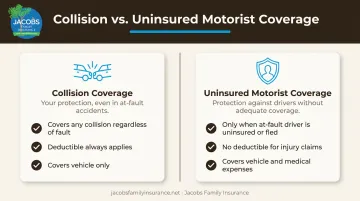
Not sure which limits make sense for your vehicle or driving habits? A quick call with a local agent can settle that in minutes.
What Is Collision Coverage?
Collision coverage pays to repair or replace your vehicle after it collides with another car, an object, or rolls over, no matter who's at fault. Hit a guardrail, rear-end someone, get rear-ended yourself — collision responds the same way in each scenario.
The core benefit is predictability. You don't need to prove fault, wait on another insurer's investigation, or chase a claim through someone else's company. Your insurer handles it, subject to your deductible.
Key limitations to know:
- Doesn't cover medical expenses for you or your passengers
- Always requires a deductible, which reduces your payout
- Won't pay more than your car's actual cash value if it's totaled
- Filing a claim may affect future premiums
Given these tradeoffs, most drivers pair collision with comprehensive coverage as part of what's known as "full coverage." If you're financing or leasing your vehicle, your lender will almost certainly require it.
Use Cases of Collision Coverage
Collision earns its premium in single-car accidents or situations where fault is murky. Think about northern New Mexico's winter roads: sliding off an icy stretch near Taos with no other vehicle involved, or clipping a pothole-damaged guardrail outside Los Alamos. There's no other driver to pursue for damages, so without collision, you're covering the full repair bill out of pocket.
What Is Uninsured Motorist Coverage?
Uninsured motorist coverage steps in when the driver who caused your accident either has no insurance at all (UM) or has insurance that isn't enough to cover your losses (UIM). It has two components:
- UMBI (Bodily Injury): Covers medical bills, lost wages, and pain and suffering for you and your passengers
- UMPD (Property Damage): Covers repairs to your vehicle when an uninsured driver caused the damage
Without UM/UIM, a driver hit by someone with no insurance has limited options. You'd need to pursue the at-fault driver directly through civil court, which often goes nowhere if that person has no assets to collect from.
Why this matters in New Mexico specifically: the state had a 24.1% uninsured motorist rate in 2023, according to the Insurance Research Council's 2025 study, making it the second-highest rate in the country behind Mississippi. That's roughly one in four drivers you share the road with.
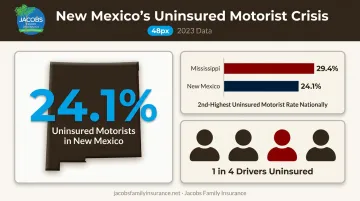
New Mexico law requires insurers to offer UM/UIM coverage on every policy. You can decline it, but only in writing, and the rejection becomes part of your policy file. Given how common uninsured drivers are on New Mexico roads, it's worth understanding exactly when this coverage pays off.
Use Cases of Uninsured Motorist Coverage
UM coverage matters most in two scenarios:
- Hit-and-run accidents — the other driver flees, so there's no one to pursue for damages
- Underinsured at-fault drivers — the other driver has minimal liability limits that don't come close to covering your medical bills or repair costs
It's also valuable for drivers who skip collision coverage on an older car but still want bodily injury protection that collision simply doesn't provide. A local agent can walk through your specific driving habits and vehicle value to determine how much UM/UIM protection makes sense for your policy.
Collision vs. UM: Which Coverage Is Right for You?
This isn't really an either-or question. Most well-built policies carry both, because each one covers a gap the other leaves wide open.
A few situational pointers:
- Financed or leased vehicle? Collision is typically non-negotiable, since your lender requires it regardless of your preference
- Paying cash for an older car? You might reasonably drop collision if the vehicle's value is low, but keep UM/UIM for injury protection
- Worried about cost? UM/UIM is generally worth the added premium given how much financial exposure it removes. Reports suggest close to one in four New Mexico drivers carries no insurance at all
Here's a realistic scenario: a Santa Fe driver carries both collision and UM/UIM. An uninsured driver runs a red light and totals their car. Collision covers the vehicle repair after the deductible. UMBI covers the driver's ER visit and a few weeks of missed work. Without both, that driver would have absorbed thousands of dollars in costs with no other party to collect from.
Since coverage limits, deductibles, and pricing vary by driver, vehicle, and location, a quote tailored to your situation is the only way to know your real numbers.
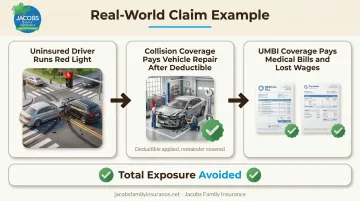
If you're weighing this decision for your own policy, Jacobs Family Insurance can walk through your options and help you land on a combination that fits your budget and New Mexico's driving conditions. Call (505) 557-2067 or request a free quote online — no pressure, just a straightforward conversation with a local agent.
Conclusion
Collision and uninsured motorist coverage solve different problems. Collision protects your car regardless of fault. UM protects you specifically when the other driver can't or won't pay. Understanding both is how you avoid the coverage gaps that turn a fender-bender into a financial headache.
Uninsured drivers are common enough on New Mexico roads that this isn't a hypothetical risk — it's a real possibility every time you're on the road. If you're not sure your current policy has you covered on both fronts, reach out to Jacobs Family Insurance at 1547 South St. Francis Drive, Santa Fe, or call (505) 428-4735 for a straightforward review of your coverage.
Frequently Asked Questions
Who pays when you are hit by an uninsured driver?
If you carry UM/UMPD coverage, your own insurer pays for damages and injuries up to your policy limits. Without it, you'd need to sue the at-fault driver directly, which is often futile if they have no assets to collect from.
Is uninsured/underinsured motorist coverage worth it?
Yes. New Mexico has one of the higher uninsured driver rates in the country, so UM/UIM offers meaningful protection against large medical and repair costs for a relatively modest premium increase.
What are the limitations of collision coverage?
Collision doesn't cover medical bills, always requires a deductible, and excludes theft or weather damage (that's comprehensive). It also won't pay more than your car's actual cash value.
Do I need both collision and uninsured motorist coverage?
They're not legally required together, but having both closes real gaps. Collision handles vehicle damage broadly, while UM adds the medical and injury protection collision doesn't offer.
Is uninsured motorist coverage required in New Mexico?
Insurers must offer UM/UIM coverage on every policy, but drivers can decline it in writing. Opting out means you'd have no coverage if hit by an uninsured driver.
What's the difference between UM and UIM coverage?
UM applies when the at-fault driver has no insurance at all. UIM applies when they have insurance, but not enough to cover your full damages.