It's a question many New Mexico waterfront property owners don't ask until it's too late. The answer isn't simple. Coverage depends on where your dock sits, how your insurer classifies it, and which policies you carry.
This guide breaks down exactly how homeowners, flood, and boat insurance each handle dock coverage — including the exclusions that catch most people off guard.
Key Takeaways
- A dock on your residential property likely falls under Coverage B (other structures) in your homeowners policy — typically capped at 10% of your dwelling's insured value
- NFIP flood insurance explicitly excludes docks, piers, seawalls, and bulkheads
- Boat insurance covers your vessel, not your dock — though liability coverage may apply if your boat damages someone else's dock
- Removable or seasonal docks may be classified as personal property, not a structure, which affects both coverage limits and claims handling
- Docks away from your primary residence — including rental slips — typically need a separate endorsement or standalone policy
Does Homeowners Insurance Cover Your Boat Dock?
The Coverage B Baseline
If your dock is permanently attached and located on your residential property, it qualifies as an "other structure" under Coverage B of a standard HO-3 homeowners policy. The ISO HO-3 sample form defines Coverage B as structures on the residence premises set apart from the dwelling by clear space — a definition that fixed docks generally meet. State Farm specifically lists docks as an example of structures that may be included under home insurance coverage.
That said, limits matter.
The catch: Coverage B is capped at 10% of your dwelling's insured value (Coverage A). If your home is insured for $300,000, you have $30,000 in other structures coverage — total. That has to cover your dock, detached garage, fence, and any other qualifying structures. For a high-end dock with a boat lift, lighting, and electrical systems, $30,000 may fall short fast.
Permanent vs. Removable Docks
How your insurer classifies your dock matters more than you might expect:
- Permanently installed dock → typically qualifies as Coverage B (other structures)
- Removable or seasonal dock → may be classified as personal property (Coverage C) instead
- Personal property classification means different limits, different deductibles, and potentially less protection
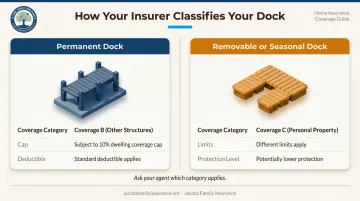
Ask your agent directly which category applies to your specific dock before assuming coverage.
Off-Premises Docks
Coverage B is limited to structures on your residence premises. If you own a dock or slip at a lake community separate from your home — say, at Abiquiu Lake or Navajo Lake — that structure gets no default Coverage B protection under a standard HO-3.
Your options for off-premises dock coverage include:
- A policy endorsement to extend other structures coverage beyond the residence premises
- A standalone waterfront property policy
- Verification with your agent that the structure qualifies under any existing coverage
Liability on Your Dock
If a guest slips and falls on your dock, your homeowners Coverage E (personal liability) may cover medical expenses and legal costs. Coverage terms vary significantly by insurer, so a few things worth confirming with your agent:
- Whether dock-related incidents fall within your liability coverage
- The per-occurrence limit and whether it's adequate for your exposure
- Whether an umbrella policy makes sense for additional protection
Jacobs Family Insurance serves homeowners across Santa Fe and northern New Mexico and can review your current policy to confirm whether your dock qualifies under Coverage B — and whether your limits are adequate for your property.
What Dock Damage Is NOT Covered by Homeowners Insurance?
Even when your dock qualifies as a covered structure, several common causes of dock damage fall outside homeowners coverage entirely.
The Four Key Exclusions
1. Flood damage Standard homeowners policies explicitly exclude flood damage — rising water, storm surge, overflow from any body of water. The New Mexico Office of Superintendent of Insurance confirms this applies to all standard policies in the state. For dock owners on New Mexico reservoirs like Elephant Butte or Abiquiu Lake, where monsoon runoff and sudden water level changes are real risks, this gap is worth understanding before a claim arises.
2. Ice and freeze damage Homeowners policies typically exclude damage from freezing, thawing, and the weight of ice. For seasonal docks left in the water through winter, this can be a significant vulnerability.
3. Deterioration, rot, and structural aging The HO-3 sample form specifically excludes collapse of a "pier, wharf or dock" unless a building or vehicle directly causes it. Rot, rust, dry rot, wear and tear, and general structural failure over time are all excluded. If your dock gives way after years of use, insurers treat that as a maintenance issue — not a covered peril.
What IS Typically Covered
For contrast, perils that commonly are covered when the dock qualifies as an other structure:
- Fire and lightning strikes
- Wind and hail damage
- Vandalism or malicious mischief
- Vehicle impact
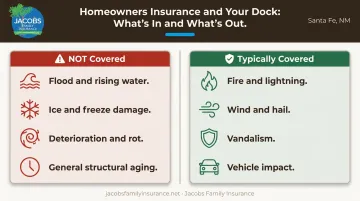
If you're unsure whether your dock qualifies or which perils apply to your specific policy, a quick conversation with your agent can clarify exactly where your coverage stands.
Does Flood Insurance or Boat Insurance Cover Your Dock?
Flood Insurance and Docks
The answer here is straightforward: NFIP flood insurance does not cover docks.
The Standard Flood Insurance Policy (SFIP) Dwelling Form, Section IV, Item 12, explicitly excludes fences, retaining walls, seawalls, bulkheads, wharves, piers, bridges, and docks. This isn't a gray area — it's a named exclusion.
The SFIP also separately excludes:
- Open structures, including boathouses into which boats are floated
- Personal property in, on, or over water
- Buildings constructed entirely in, on, or over water (if built after September 30, 1982)
Private flood insurance may offer broader terms than NFIP. Carriers like Chubb and Neptune Flood sometimes provide more flexible coverage options. If you're comparing private flood policies, ask the carrier directly whether dock structures are covered before signing.
Boat Insurance and Dock Damage
Boat insurance follows the vessel — not the dock. Storm damage to your dock falls outside your boat policy's scope entirely.
The one meaningful exception: if your boat causes damage to someone else's dock, your boat's property damage liability coverage may pay for those repairs up to your policy limits. This applies if your boat breaks free and hits a marina dock, or if you accidentally collide with a slip at a yacht club.
Marina owners carry their own insurance for dock structures. Your boat liability only enters the picture when your watercraft is the cause of the damage.
What About Docks at Marinas or Off Your Property?
Marina slips, off-site docks, and rented-out slips each fall into their own coverage category — and standard homeowners insurance often leaves gaps in all three.
Rented Marina Slips
If you rent a slip at a marina or yacht club, the marina owns and insures the dock structure. Your homeowners insurance provides no coverage for that dock — it's not your property, and it's not on your residence premises.
Your responsibility: ensure your boat is properly insured for liability, so that if your vessel damages the marina's dock, your boat policy responds.
Docks You Own Off Your Property
Owning a dock at a lake community separate from your home creates a coverage gap that catches many property owners off guard. Coverage B simply doesn't extend beyond your residence premises under a standard HO-3.
To close that gap, you'll typically need:
- A policy endorsement specifically adding off-premises other structures coverage
- A standalone waterfront or dock insurance policy
Renting Your Slip to Others
This is a critical edge case. If you rent your boat slip to others, the HO-3 form excludes Coverage B for structures rented to someone who isn't a tenant of your dwelling. Beyond property coverage, you also lose homeowners liability protection when the space is rented commercially. If you rent out a slip — even occasionally — you likely need a commercial policy. Talk to an agent before assuming your existing coverage applies.
Standalone Boat Dock Insurance: When You Need More Coverage
When homeowners coverage isn't enough — or doesn't apply at all — a standalone dock or waterfront property policy may be the right solution.
What These Policies Can Cover
Specialized dock insurance policies typically address coverage areas that standard homeowners policies miss:
- Physical structure coverage — the dock, walkways, pilings, boat lifts, and electrical systems
- Liability protection — injuries occurring on or around the dock
- Scheduled value coverage — based on actual replacement cost, not a 10% dwelling cap
When a Standalone Policy Makes Sense
Consider a separate dock policy if any of these apply:
- Your dock's replacement value exceeds your Coverage B limit
- Your dock is located off your residence premises
- Guests or renters frequently use your dock
- Your dock includes high-value equipment like hydraulic lifts or fuel systems
- You're in a severe weather zone with elevated wind, flood, or ice risk
The specialty insurance market offers pier and dock policies with scheduled physical damage and liability coverage. If any of these situations apply to you, a knowledgeable local agent can identify which carriers write these policies and whether they're available for your property — the team at Jacobs Family Insurance can help you find the right fit.
How to Make Sure Your Dock Is Properly Covered
Take these steps before you need to file a claim:
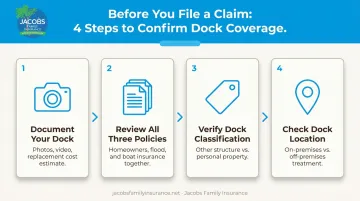
Document your dock thoroughly — photos, video, construction materials, recent repairs, and a current replacement cost estimate. This documentation is essential at claim time.
Review all three policies together — homeowners, flood, and boat insurance can overlap in confusing ways. A single coordinated review with your agent clarifies exactly what's covered and where the gaps are.
Verify your dock's classification — ask your agent whether your insurer treats the dock as an other structure or personal property. The answer changes your coverage limits and deductible.
Check whether your dock location affects coverage — on-premises docks and off-premises docks are treated very differently under standard HO-3 policies.
Jacobs Family Insurance, serving Santa Fe and throughout New Mexico, can help homeowners review their Allstate homeowners policy, identify gaps, and explore endorsements or additional coverage options built around waterfront property needs. Call (505) 557-2067, Monday through Friday, 9AM–5PM, to schedule a coverage review.
Frequently Asked Questions
Frequently Asked Questions
Is my boat dock covered by insurance?
It depends on where the dock is and what policies you carry. A permanently installed dock on your property is likely covered under homeowners "other structures" coverage, but exclusions for flood, ice, and deterioration apply. Off-premises docks are generally not covered without an endorsement.
What types of insurance coverage are available for a boat dock?
The main options include:
- Homeowners Coverage B (other structures) for docks on your property
- Endorsements for off-premises dock structures
- Standalone boat dock or waterfront property insurance
- Boat liability coverage if your vessel damages someone else's dock
Is a covered boat dock eligible for NFIP coverage?
No. The SFIP Dwelling Form explicitly excludes docks, piers, wharves, seawalls, and bulkheads from NFIP coverage. Private flood insurance policies may offer broader terms — confirm the details with your carrier and agent.
How much does a $1,000,000 liability insurance policy cost for a boat dock?
Pricing varies significantly based on dock size, location, use, and risk factors. No standard premium applies. Contact an insurance agent for an accurate quote specific to your property and situation.
Does boat insurance cover damage to my dock?
No — boat insurance covers your vessel, not your dock structure. However, if your boat causes damage to someone else's dock, your boat's liability coverage may pay for those repairs up to your policy limits.
What happens if someone gets injured on my boat dock?
Your homeowners personal liability coverage (Coverage E) may cover medical expenses and legal costs if a guest is injured on your dock. Coverage limits and conditions vary by policy, so confirm the details with your agent before assuming protection applies.