That's the good news. The less simple news: your actual price depends on where you live (including specific New Mexico pricing), how much coverage you carry, your deductible, and your credit and claims history. A renter in Santa Fe won't pay the same as one in Louisiana or Rhode Island.
This guide breaks down 2026 pricing by state and coverage level, explains what actually moves your premium up or down, and shows practical ways to pay less without cutting corners on protection.
Key Takeaways
- National average renters insurance runs $13-$27/month ($151-$288/year), depending on the data source.
- New Mexico averages roughly $21-$22/month, slightly below the national figure in most studies.
- Location, coverage limits, deductible, and credit/claims history are the four biggest price drivers.
- Upgrading from basic to robust coverage often costs just a few dollars more each month.
How Much Does Renters Insurance Cost in 2026? (Pricing Overview)
There's no single sticker price for renters insurance. Insurers calculate it per person, blending your ZIP code, chosen coverage limits, deductible, and personal risk profile into a custom rate. That's exactly why national studies produce different headline numbers.
National Average Cost Per Month and Year
NerdWallet's 2026 research puts the median cost at $151/year, about $13/month, based on a 30-year-old renter with good credit, $30,000 in personal property, $100,000 liability, and a $500 deductible.
ValuePenguin's separate 2026 analysis lands at $23/month, using a slightly different profile: $30,000 property, $100,000 liability, $1,000 guest medical payments, and a $500 deductible for a single renter with no pets or prior claims.
Why the gap? A few reasons:
- Different coverage limits used in each study's test profile
- Different deductibles (some use $500, others $1,000)
- Different demographic assumptions (age, credit tier, claims history)
- Different insurer panels feeding the averages
None of these figures are wrong. They're just answering slightly different questions, so treat each one as a separate benchmark rather than a direct apples-to-apples comparison.
Cost by State (New Mexico Spotlight)
Location swings renters insurance pricing more than almost any other factor. Here's how the extremes compare, based on ValuePenguin's state-by-state table:
| State | Average Monthly Cost |
|---|---|
| Louisiana (highest) | $36 |
| Montana, North Dakota, Wyoming (lowest) | $16 |
| New Mexico | $21-$22 |
| National average | $23 |
Louisiana's high rate reflects hurricane and flood exposure driving up claims frequency across the state. Northern states with lower storm and theft risk sit near the bottom.
New Mexico renters get a modest break compared to the national average. Insurance.com's separate New Mexico analysis puts the state average at $185/year, about $15/month, using a $40,000 property/$100,000 liability profile, a lower figure than ValuePenguin's $21-$22 estimate because each source tests a different coverage profile. Santa Fe specifically runs close to the state average, with Los Alamos slightly lower and Farmington slightly higher.
For renters across Jacobs Family Insurance's service area, meaning Santa Fe, Albuquerque, and the broader Northern New Mexico region, renters insurance typically costs less than a single streaming subscription each month.
Cost by Coverage Amount ($15,000 to $100,000)
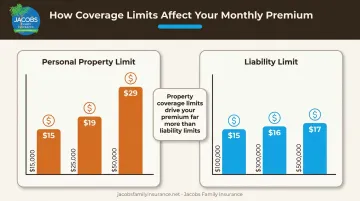
Coverage amount is the single biggest lever you control. ValuePenguin's 2026 test profile shows how personal property limits scale premium:
| Personal Property Limit | Monthly Premium |
|---|---|
| $15,000 | $15 |
| $25,000 | $19 |
| $50,000 | $29 |
Compare that to liability limits, which barely move the needle:
| Liability Limit | Monthly Premium |
|---|---|
| $100,000 | $15 |
| $300,000 | $16 |
| $500,000 | $17 |
The takeaway: tripling your liability limit from $100,000 to $300,000 adds just $1/month. Increasing property coverage from $15,000 to $50,000 adds $14/month. Liability is cheap to increase; property coverage is what drives your bill.
If you own $75,000-$100,000 in belongings, expect your premium to continue climbing past the $50,000 mark. The exact jump depends on your insurer and ZIP code, so a personalized quote is the only way to nail down that number precisely.
What's Typically Included at Each Price Range
There's no official industry standard for "basic," "standard," and "enhanced" tiers, but pricing does tend to cluster into three practical groups:
- Basic/entry-level policies carry minimum property and liability limits with a higher deductible ($1,000+), best suited for renters with few valuable belongings and a tight budget
- Standard/mid-range policies carry moderate property and liability limits matched to an actual home inventory, typically with a $500 deductible; this fits most renters
- Enhanced policies add replacement cost coverage instead of actual cash value, higher liability limits, and scheduled riders for jewelry, electronics, or collectibles, benefiting renters with high-value items most
Regardless of tier, standard renters policies exclude flood and earthquake damage and cap high-value item categories, like jewelry, at low sublimits (often $1,000-$2,500) unless you add a scheduled-property rider.
Key Factors That Affect the Cost of Renters Insurance
Your premium blends three things: where you live, your personal risk profile, and the coverage choices you make. Here's how each piece factors in.
Location (State, City, and ZIP Code)
Insurers price ZIP codes based on local theft rates and weather-related claim frequency. A downtown apartment in a high-crime area costs more to insure than a similar unit in a quiet suburb, even within the same city.
Coverage Limits (Personal Property & Liability)
Personal property limits drive most of your premium, while liability increases barely register. If you're choosing where to spend your coverage dollars, liability is the cheap upgrade.
Deductible Amount
Your deductible and premium move in opposite directions. For a $25,000 property policy, ValuePenguin found:
- $250 deductible: $18/month
- $500 deductible: $17/month
- $1,000 deductible: $15/month
NerdWallet's national profile shows a similar pattern: $151/year at a $500 deductible versus $140/year at $1,000. The savings aren't dramatic, but they add up over a policy term.
Claims and Credit-Based Insurance History
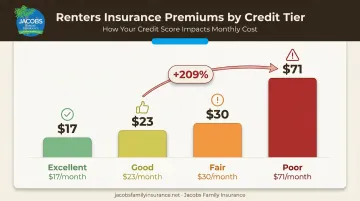
Poor credit hits harder than almost any other single factor. Insurance.com's data shows renters with excellent credit paying around $17/month, good credit $23, fair credit $30, and poor credit $71, a roughly 209% jump between good and poor credit tiers.
Prior claims, especially liability or large property claims, also push rates higher, though insurers rarely publish exact surcharge percentages.
Type of Residence and Building Safety Features
Renting a detached single-family home can cost more than an apartment, since standalone homes often carry higher theft exposure. On the flip side, high-rise buildings with sprinklers, monitored security, and fire suppression systems sometimes earn lower rates than smaller walk-up buildings.
Pets and Household Members
Most renters policies include pet liability by default, but certain dog breeds can raise premiums or trigger exclusions with some insurers. If you own a breed on a restricted list, ask your Jacobs Family Insurance agent directly rather than assuming standard coverage applies.
How to Lower Your Renters Insurance Costs
A few practical moves can meaningfully cut your premium without gutting your protection.
- Bundle with auto insurance. Pairing renters and auto policies typically triggers a multi-line discount that offsets much of the premium. Local agencies like Jacobs Family Insurance can walk you through the options directly, skipping the call center.
- Raise your deductible. If you can comfortably cover $1,000 out of pocket during a claim, you'll pay less every month for the life of the policy.
- Add safety features. Smoke detectors, monitored alarm systems, and deadbolts often qualify for insurer discounts, and most renters already have some of these in place.
- Shop your policy annually. Rates and discounts shift year to year. Auto-renewing without comparing quotes means you could be leaving savings on the table.
Common Mistakes That Lead to Overpaying or Being Underinsured
Renters often make the same costly errors when shopping for coverage:
- Skipping the home inventory: Picking the cheapest bare-minimum policy without tallying what your belongings would cost to replace often leaves renters underinsured exactly when they need coverage most.
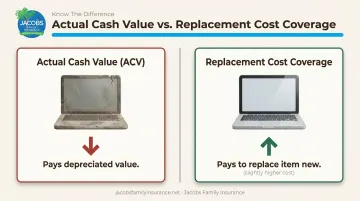
- Confusing actual cash value with replacement cost: ACV policies pay depreciated value, so a five-year-old laptop might fetch only a fraction of its price. Replacement cost coverage pays to replace items new for a slightly higher premium.
- Dropping liability coverage to save a few dollars: As shown earlier, raising liability from $100,000 to $300,000 costs just $1 more per month, so skipping it entirely risks real financial exposure if a guest is hurt or your dog damages a neighbor's property.
Conclusion
Renters insurance remains genuinely affordable relative to what it protects. But the "right" price is the one that matches your location, your belongings, and the deductible you can actually afford if something goes wrong, not simply the lowest number on the page.
Understanding these pricing pieces—location, coverage limits, deductible, and credit history—helps you budget with confidence instead of guessing.
If you rent in Santa Fe, Albuquerque, or anywhere across Northern New Mexico, Jacobs Family Insurance can walk you through a personalized quote and show you where bundling could save the most. No call center, just a family-owned Allstate Elite agency that's been part of this community for over 10 years.
Frequently Asked Questions
How much does renters insurance cost per month?
The national average runs $13 to $27 a month depending on the study and coverage profile. Your actual cost depends on your state, coverage limits, and deductible.
How much does renters insurance cost for different coverage amounts (for example, $25,000 or $100,000)?
A $25,000 personal property limit averages around $19/month, while $50,000 runs closer to $29/month. Coverage above that continues to climb, so contact Jacobs Family Insurance for an exact $100,000 quote tailored to your rental.
Is $20 a month for renters insurance a good price?
$20/month sits right around the national average, so it's a reasonable starting point. Whether it's a good deal, though, depends on the coverage limits and deductible bundled into that price.
Is renters insurance required by law?
No state legally requires renters insurance, but many landlords make it a lease condition. Check your lease before assuming it's optional.
What is the average renters insurance cost in New Mexico?
New Mexico renters pay roughly $21-$22/month, slightly below the national average, with Santa Fe pricing close to that state figure.
How can I lower my renters insurance premium?
Bundle with auto insurance, raise your deductible if you can afford the out-of-pocket cost, and ask your Jacobs Family Insurance agent about discounts for smoke detectors or security systems.