Here's the honest answer: there's no single price tag. New Mexico boat owners with Progressive paid an average of $420.74 in 2024 for a one-watercraft policy — but that number swings widely based on your boat, your coverage, and how you use it.
This guide breaks down real pricing ranges, the factors that move your rate up or down, and where New Mexico boaters can find savings without cutting corners on protection.
Key Takeaways
- Standard boats typically cost a few hundred dollars a year; yachts cost far more.
- Boat type, size, location, and coverage level drive most of the price difference.
- New Mexico sits in the medium-cost tier, above low-risk inland states but below coastal states.
- Bundling, safety courses, and secure storage can meaningfully cut your premium.
- Only a personalized quote tells you your actual number.
How Much Does Boat Insurance Cost? (Pricing Overview)
Boat insurance pricing isn't a flat rate card. Insurers weigh your vessel's value, your location, how you use it, and the coverage you select before landing on a number that reflects your specific risk.
Get this wrong and you'll feel it later. Common missteps include:
- Underinsuring a valuable boat, leaving you short after a total loss
- Choosing liability-only when your lender or marina actually requires full coverage
- Ignoring storm or theft exclusions, then discovering the gap after a claim
Cost by Boat Type & Value
Your boat's category is the single biggest lever on price.
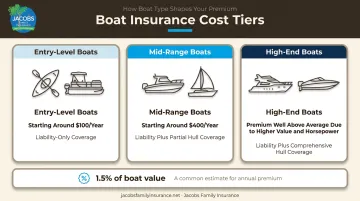
- Entry-level boats (kayaks, small fishing boats, small pontoons): These usually qualify for liability-focused policies, with some insurers advertising liability-only coverage starting around $100 per year.
- Mid-range boats (standard powerboats, sailboats, larger pontoons): These typically carry liability coverage plus partial hull protection, landing somewhere in the middle of the national range.
- High-end boats (yachts, high-performance speedboats): Higher value and horsepower push costs up substantially. Yacht insurance regularly runs well above the average recreational boat policy, since insurers are covering more expensive hulls, faster speeds, and pricier repairs.
A useful rule of thumb from Bankrate: budget roughly 1.5% of your boat's value annually for insurance — meaning a $20,000 boat might cost around $300 a year to insure. Treat this as a ballpark, not a quote.
Cost by Location
Insurers group states into low, medium, and high-cost tiers. According to Progressive's boat insurance cost data, low-cost states averaged $301 annually, medium-cost states averaged $400, and high-cost states averaged $657.
New Mexico falls into that medium-cost tier. Why not the cheapest?
- New Mexico's shorter boating season limits exposure, though it doesn't match the rock-bottom risk profile of purely inland states
- Coastal, hurricane-prone states pay more because of storm damage and higher theft rates near open water
If you boat primarily on Elephant Butte, Navajo Lake, or Cochiti, you're avoiding hurricane and saltwater corrosion risk entirely, a real advantage over Gulf Coast or Atlantic seaboard boat owners.
Key Factors That Affect the Cost of Boat Insurance
Beyond boat type and location, insurers blend several personal and policy details into your final number.
Boat Type, Age & Horsepower
Bigger engines mean higher premiums. A large powerboat with a strong engine typically costs more to insure than a small sailboat, since speed and horsepower both raise accident risk.
Age cuts both ways too: newer boats often cost more to fully insure because they're worth more, while older boats may face eligibility or coverage limits despite their lower value.
Location & Storage
Where you keep your boat matters almost as much as where you drive it.
- Coastal vs. inland storage: saltwater and storm exposure raise risk
- Marina vs. dry storage: secure, on-land storage generally lowers theft and weather exposure
- Seasonal vs. year-round use: a boat stored off-season during winter (common in New Mexico) may qualify for lay-up savings
Boater Experience & Safety Record
Experience and training genuinely matter here. According to the U.S. Coast Guard's 2024 recreational boating statistics, where the operator's training status was known, 69% of boating deaths involved operators with no safety instruction at all, compared to just 19% among operators holding a nationally approved safety certificate.
That gap is exactly why many carriers discount policies for completed safety courses — fewer accidents on the water tend to mean fewer claims.
Coverage Level & Deductible Choice
Two decisions shape your premium more than almost anything else:
- Liability-only vs. comprehensive/collision: Liability-only is cheaper but only covers damage to others. Comprehensive/collision costs more, adding protection for your own boat.
- Agreed value vs. actual cash value: Agreed value pays a preset amount after a total loss for a higher premium. Actual cash value pays depreciated market value for less.
Credit & Claims History
Similar to auto insurance, a clean claims record and a strong credit-based insurance score both help your rate. Prior boat insurance claims, even ones where you weren't at fault, can raise your premium at renewal. Staying claims-free over time is one of the more overlooked ways to keep costs down.
Cost Breakdown of Boat Insurance (Where Your Premium Goes)
Your total premium combines several types of coverage stacked together into one price.
- Liability coverage: The baseline protection if you injure someone or damage their property, usually the minimum a marina or lender requires.
- Hull, collision & comprehensive coverage: Protects your boat from accidents, theft, fire, and storm damage — usually the biggest driver of a higher premium since it covers your own asset, not just others' losses.
- Optional add-ons: Towing and on-water assistance, uninsured boater protection, and personal effects coverage add modest costs for real protection when something goes wrong.
Deductible choice matters too. A higher deductible lowers your premium but raises what you pay out of pocket during a claim.
As your boat ages, gains equipment, or changes storage locations, review your policy so you aren't paying for coverage you no longer need or carrying too little when it matters most.
How to Lower Your Boat Insurance Costs
A few practical moves can meaningfully reduce what you pay without sacrificing protection.
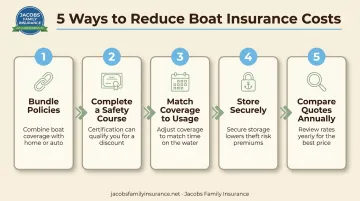
- Bundle your policies. Combining boat coverage with an existing home or auto policy often triggers multi-line discounts. Our team at Jacobs Family Insurance can shop bundling options tailored to New Mexico boaters.
- Complete a boating safety course. State-approved courses often qualify you for a discount, and given the USCG data above, insurers have good reason to reward trained operators.
- Match coverage to actual usage. If your boat sits most of the season, don't pay for a policy sized for year-round use.
- Store securely. Dry storage, off-season lay-up, and anti-theft or GPS tracking devices all reduce risk-based pricing factors.
- Compare quotes annually. Revisit your coverage whenever your boat's value, usage pattern, or storage location changes.
Frequently Asked Questions
How do you calculate marine insurance cost?
Insurers weigh the boat's value, type, age, and horsepower alongside your location, usage, and boating or claims history. Because every factor combines differently for each owner, a personalized quote is the only accurate way to know your cost.
How much does it cost to insure a yacht?
Yacht insurance costs far more than standard boat policies because of higher value, larger size, and greater performance capability. Owners should expect premiums well above the typical recreational boat range.
How can I lower my boat insurance?
Bundle your boat policy with home or auto coverage, complete a certified safety course, store your boat securely, and compare quotes from multiple carriers each year. Each lever can meaningfully reduce your rate.
What is the average cost of boat insurance per year?
National averages generally fall between $300 and $839 annually depending on the carrier and state, with New Mexico landing in the medium-cost tier around $420 based on Progressive's 2024 data.
Is boat insurance required in New Mexico?
Boat insurance isn't federally mandated, and New Mexico doesn't broadly require it either. That said, lenders financing your boat or marinas storing it may still require proof of coverage.
Does boat insurance cover storm or theft damage?
Comprehensive coverage typically covers theft, storm damage, and vandalism, while liability-only policies don't cover your own boat at all. Your coverage choice determines whether you're protected against these losses.
Final Thoughts
Boat insurance cost comes down to four factors: your boat's type and value, where you keep it, how you use it, and the coverage level you choose. There's no universal price.
Understanding these pieces helps you budget accurately instead of guessing. It also keeps you from over-insuring a boat you use twice a summer, or under-insuring one that's worth real money.
If you're boating on Elephant Butte, Navajo Lake, Cochiti, or anywhere else in northern New Mexico, Jacobs Family Insurance can help. We'll walk you through a personalized quote built around your specific boat and how you actually use it.
Call (505) 557-2067, stop by the Santa Fe office at 1547 South St. Francis Drive, or request a free quote online. No pressure, just neighborly guidance.