

Introduction
Picture this: a guest slips on your condo's tile entryway and breaks a wrist. Or your dog nips a visitor during a hallway greeting. Who pays for the ER visit, the lawyer, the settlement?
Many condo owners assume their HOA's master policy has them covered. It often doesn't — at least not for incidents inside your unit.
That gap is exactly where personal liability insurance comes in. It's a core piece of your HO-6 condo policy, though frequently misunderstood, and it's separate from the liability coverage your homeowners association carries for common areas like lobbies and parking lots.
This guide breaks down what personal liability coverage actually includes, how much you need, and how it stacks up against other condo insurance components.
Key Takeaways
- Personal liability coverage pays for injuries or property damage you're responsible for inside your unit
- HO-6 liability limits typically start at $100,000, with options up to $500,000
- HOA master policies cover liability only in shared spaces, not inside individual units
- Umbrella insurance extends protection beyond your condo policy's standard limits
What Is Personal Liability Insurance for Condos?
Personal liability coverage is a standard piece of an HO-6 condo insurance policy. It protects you and members of your household if you're found legally responsible for someone else's injury or property damage.
Say a friend trips over a rug in your living room and needs stitches. Or your teenager accidentally cracks a neighbor's patio window with a baseball. This coverage steps in to pay for:
- Medical costs the injured party incurs
- Legal defense fees if you're sued
- Court costs and settlements up to your policy limit
- Damage claims from household members, including kids and pets
This protection is not the same as your HOA's master policy. The association's general liability coverage responds to claims tied to common areas and shared facilities — think hallways, elevators, pools, and parking structures.
Your personal liability coverage, on the other hand, kicks in for incidents tied to your unit and your household's actions, according to the Community Associations Institute.
Why Condo Owners Shouldn't Assume the HOA Policy Is Enough
It's tempting to think the HOA has liability "handled." That's a costly assumption.
New Mexico's Office of the Superintendent of Insurance confirms this split directly. A master policy typically covers the building and liability in common areas, while a basic condo policy should provide liability protection for something like a person tripping inside the unit, according to the NM OSI.
In other words, the master policy and your personal coverage protect two different exposures. One doesn't substitute for the other. If you skip personal liability coverage, you're personally exposed for anything that happens within your four walls.
What Does Personal Liability Coverage Include and Exclude?
Not every incident falls under this coverage: here's what typically applies and what doesn't.
Commonly covered:
- Guest injuries inside your unit (a fall, a burn, a cut)
- Accidental property damage caused by you or a family member
- Dog bites, though this varies by insurer and sometimes by breed
- Legal defense costs and settlements if you're sued
Commonly excluded:
- Car accidents (these fall under your auto policy)
- Intentional harm or damage
- Injuries to you or your own family members
- Business-related claims tied to work conducted from home
Damage from earthquakes, flooding, or disputes over shared walls generally falls outside personal liability coverage entirely; those situations may require separate policies or direct involvement from your HOA.
A Real-World Comparison
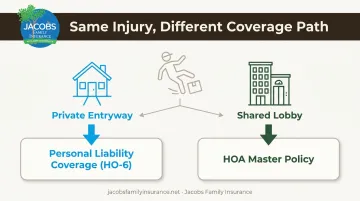
These boundaries become clearer with a specific scenario: consider a delivery driver who slips on ice. If it happens at your private entryway, your personal liability coverage likely responds. If it happens in the building's shared lobby, that's typically the HOA master policy's territory. The exact same injury, two very different coverage paths.
Medical payments coverage is a related but distinct protection worth knowing about. It pays medical bills for injured guests regardless of fault, though limits are usually much lower than your liability coverage, often in the $1,000 to $5,000 range. Unlike liability coverage, you don't need to be found "at fault" for this to apply.
How Much Personal Liability Insurance Do You Need for a Condo?
Most HO-6 policies offer liability limits in three standard tiers:
| Limit | Best For |
|---|---|
| $100,000 | Minimal risk exposure, lower net worth |
| $300,000 | Moderate exposure, average net worth |
| $500,000 | Higher exposure, higher net worth or frequent guests |
The general rule: your liability limit should match or exceed your net worth. That means adding up savings, investments, home equity, and vehicles. If a lawsuit exceeds your coverage, your personal assets become fair game.
Risk Factors That Push You Toward Higher Limits
Some lifestyle factors increase your exposure and justify a higher tier:
- Hosting guests frequently or renting out your unit short-term
- Owning a dog, especially certain breeds insurers flag as higher-risk
- Having a balcony, hot tub, or in-unit pool
- Working from home in a client-facing capacity
When $500,000 Isn't Enough
If your net worth exceeds your policy's maximum liability tier, an umbrella policy is worth considering. It extends liability protection beyond your condo policy's limits, and it's often more affordable than people expect. According to Mercury Insurance, umbrella coverage typically costs $300 to $600 annually for $1 million in additional protection, based on recent customer data from select states.
Local risk factors, from short-term rental rules to wildfire exposure, vary across New Mexico, so a local, licensed agent can pinpoint what applies to you. The team at Jacobs Family Insurance can assess your net worth, lifestyle risks, and New Mexico-specific factors to help you land on the right liability limit for your situation.
HO-6 vs. HO-3: Where Does Condo Liability Fit?
HO-6 is the policy form built for condos and co-ops. HO-3 is the standard form for single-family homeowners. Both include personal liability coverage. That part doesn't change.
Where they differ is structural coverage. HO-3 covers the entire dwelling structure, inside and out, while HO-6 covers only the interior of your unit, plus your personal property and liability.
This distinction matters because condo buildings typically carry one of three master policy structures:
- Bare walls: the association covers only up to the uncovered sheetrock and subfloor
- Single entity: the association covers the unit's original finishes, but not upgrades
- All-in: the association covers exterior and original interior finishes
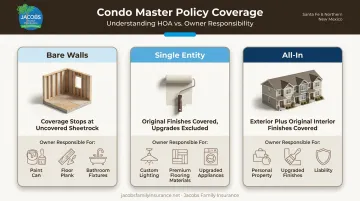
Each structure shifts different responsibilities onto you as the owner. Check with your HOA to confirm which arrangement applies to your building, since it directly affects what your HO-6 policy needs to cover beyond liability.
Protecting Your Condo the Right Way: Cost Factors and Next Steps
Here's some good news: personal liability coverage is typically one of the least expensive parts of a condo policy. Bumping your limit from $100,000 to $300,000 or $500,000 usually adds very little to your total premium compared to the added protection you get.
Quick tips for condo owners:
- Review your HOA's master policy liability limits annually — coverage structures change
- Bundle your condo and auto insurance for potential multi-line discounts across your entire portfolio
- Increase your liability limit as your net worth grows, not just when you first buy the policy
- Ask your agent about umbrella coverage once you approach your policy's maximum tier
If you own a condo in Santa Fe or anywhere across Northern New Mexico, getting the right liability limit shouldn't be guesswork. Jacobs Family Insurance is a family-owned Allstate Elite agency that's been serving this region for more than a decade, with no call centers and no one-size-fits-all answers.
Reach out for a personalized condo insurance quote and find out exactly where your coverage stands.
Frequently Asked Questions
How much liability insurance do I need for a condo?
Your coverage should generally match or exceed your net worth. Common limits range from $100,000 to $500,000, and umbrella policies are available if you need more.
What is personal liability on a condo policy?
It's protection against costs if you or a household member is responsible for injury or property damage to others. This includes legal fees, court costs, and settlements.
Is condo insurance HO-3 or HO-6?
Condo insurance uses the HO-6 policy form. HO-3 is for single-family homes. Both include liability coverage but differ in how much structural coverage they provide.
Does condo liability insurance cover injuries in common areas?
Usually not. Injuries in shared spaces like lobbies or hallways are typically the HOA master policy's responsibility, not your individual HO-6 coverage.
Is personal liability insurance required for condo owners?
Lenders often require it if you have a mortgage, and many HOAs mandate minimum liability coverage through their association bylaws.
Can I increase my condo liability coverage with an umbrella policy?
Yes. Umbrella insurance extends your liability protection beyond your condo policy's standard limits, often for a relatively low added premium.