But condo ownership brings a different insurance puzzle than a single-family home. Many new owners assume their homeowners association's master policy covers everything inside their walls. It doesn't, and that gap can cost thousands out of pocket after a burst pipe or a guest's slip-and-fall.
This guide breaks down what condo insurance actually covers, what it leaves out, what it costs in New Mexico, and whether you're required to carry it.
Key Takeaways
- HO-6 policies cover your belongings and liability beyond the HOA's master policy.
- Water damage, not fire or theft, drives the most homeowner insurance claims nationally.
- New Mexico condo owners pay roughly $405 a year on average for HO-6 coverage.
- Most lenders and HOAs require coverage, even after your mortgage is paid off.
What Is Condo Insurance?
Condo insurance is a policy built to cover everything the HOA's master policy skips over: the inside of your unit, your personal belongings, and your personal liability. Think of it as the piece that completes the picture your association's coverage starts.
HO-6 Policy Explained
In the insurance world, condo insurance goes by a specific name: the HO-6 policy. It's one of several standardized home insurance forms used across the industry, and it's built specifically for condo and co-op unit owners.
Here's how it compares to other common forms:
| Policy Type | Who It's For | What It Covers |
|---|---|---|
| HO-3 | Single-family homeowners | Open-peril (all-risk) building coverage plus personal property |
| HO-4 | Renters | Personal property only, no building coverage |
| HO-6 | Condo/co-op owners | Personal property, liability, and limited building items within the unit |
An HO-6 sits between HO-3 and HO-4. You own a piece of the structure, but not the whole building, so your policy insures your interior and belongings rather than the roof or exterior walls.
Individual Policy vs. Master (HOA) Policy
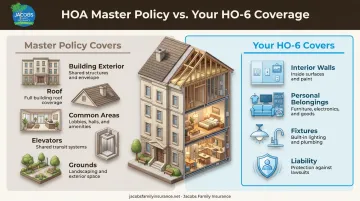
Your HOA's master policy typically covers the building's exterior, structural elements, and shared spaces, meaning lobbies, elevators, hallways, and the grounds. What it doesn't cover depends heavily on which type of master policy your association carries.
There are three common versions:
| Master Policy Type | Typical Coverage | What This Means for You |
|---|---|---|
| Bare walls | Common areas and structure only, no interior fixtures | You need HO-6 coverage for appliances, cabinets, flooring, and fixtures |
| Single entity | Common areas plus original fixtures installed by the builder | You need HO-6 coverage for upgrades and improvements you added |
| All-in / all-inclusive | Most comprehensive; covers most unit fixtures | You may only need to insure personal belongings and liability |
The problem? Many owners never check which type applies to them. Request a copy of your association's master policy from the board or property manager before buying an HO-6 policy. It's the only way to know exactly where the master policy's coverage stops and where yours needs to start.
What Does Condo Insurance Cover?
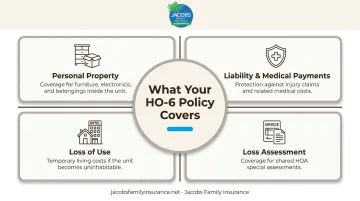
A standard HO-6 policy bundles four core coverages into one package. Together, they protect your finances from the most common risks of condo ownership.
Personal Property Coverage
This protects your belongings, furniture, electronics, clothing, and more, against named perils like fire, theft, vandalism, and water damage from a burst pipe. A deductible applies before your claim payout kicks in, so choosing that number matters (more on that below).
Water damage deserves special attention here. Across a five-year national average, water and freezing claims occurred at a rate of 1.61 per 100 insured homes annually, ranking as the second most frequent cause of homeowner insurance claims behind wind and hail, according to the Insurance Information Institute's homeowners claims data.
In condo buildings, where units share plumbing and walls, a leak two floors up can just as easily end up in your living room.
Liability & Medical Payments Coverage
Personal liability coverage applies if you're found responsible for injuring someone or damaging their property. Limits typically start around $100,000 and can be increased.
Medical payments coverage is smaller and works differently. It's a no-fault benefit that pays a guest's medical bills after an injury in your unit, regardless of who caused it. Limits are often modest, commonly ranging from $1,000 to $5,000.
For example, if a guest trips on a loose rug and breaks a wrist, medical payments coverage handles the emergency room bill right away, while liability coverage would step in if they later sue for damages.
Loss of Use Coverage
If a covered event makes your unit unlivable, loss of use coverage pays for temporary housing, meals, and related costs while repairs happen. Picture this: a pipe bursts behind your kitchen wall, and you're displaced for three weeks during repairs. This coverage picks up the hotel bill and extra food costs during that stretch.
Loss Assessment Coverage
When damage exceeds the HOA's master policy limits or deductible, the association can bill unit owners directly through a special assessment. Loss assessment coverage helps offset that unexpected bill.
Here's the catch: standard policies often include only $1,000 in loss assessment coverage by default. That's rarely enough to absorb a major shared-loss event. Owners in older buildings, or in areas prone to severe weather, should talk with a Jacobs Family Insurance agent about raising this limit, sometimes up to $50,000, depending on the endorsement.
What Condo Insurance Doesn't Cover
No HO-6 policy covers everything. Common exclusions include:
- Earthquakes: requires a separate policy or endorsement
- Flooding: ground-up flooding needs separate flood insurance, typically through the NFIP
- Normal wear and tear: gradual deterioration isn't a covered "event"
- Pest damage: rodents, insects, and similar issues are excluded
- Intentional acts: damage you cause on purpose is never covered
There's also a structural boundary to understand. Damage to the building's exterior or common areas generally falls under the association's master policy, not your individual coverage, since you don't own that portion of the property.
The good news is that several exclusions can be closed with optional endorsements:
- Water backup coverage for sewer or drain backups
- Scheduled personal property for jewelry, art, or collectibles above standard limits
- Separate flood or earthquake policies for those specific perils
A Jacobs Family Insurance agent can walk through which of these makes sense for your unit and building type.
How Much Condo Insurance Do You Need — and What Does It Cost?
Figuring out the right coverage amount starts with three steps:
- Take a home inventory: Photograph and list your belongings, including approximate values.
- Estimate replacement cost: Not what you paid, but what it would cost to replace everything today.
- Review your HOA's master policy type: A bare-walls policy means you need more dwelling coverage than an all-in policy would require.
What Drives the Price
Several factors move your premium up or down:
- Location and regional risk: parts of New Mexico face wildfire or hail exposure that can raise rates
- Coverage amount: higher personal property or liability limits cost more
- Building age: older buildings often carry higher risk profiles
- Deductible choice: a higher deductible lowers your premium, and vice versa
For a cost benchmark, New Mexico condo owners pay an average of $405 a year, or about $34 a month, according to NerdWallet's 2026 condo insurance rate analysis. That's noticeably below the national average of $510 annually, though your actual quote will depend on your specific unit and coverage choices.
Locking in the right price is only the first step. Review your policy annually, and also after major purchases, renovations, or any changes to your HOA's master policy. A policy that fit your needs three years ago might leave gaps today.
Is Condo Insurance Required in New Mexico?
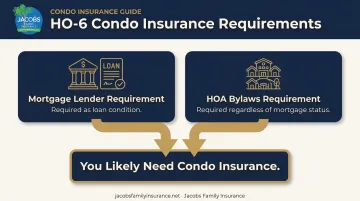
Condo insurance requirements come from two directions:
- Mortgage lenders typically require an HO-6 policy as a condition of your loan, similar to standard homeowners insurance.
- HOAs often mandate individual coverage in their bylaws, regardless of whether you have a mortgage—even a condo owner who paid cash or paid off their loan years ago may still need to meet the association's minimum coverage levels.
New Mexico's own insurance regulator underscores why this matters. The New Mexico Office of the Superintendent of Insurance notes that association coverage generally protects the structure and common areas, not personal belongings or liability for incidents inside your unit.
Even where no strict rule applies, skipping coverage is a gamble. Between plumbing leaks, guest injuries, and surprise assessments, too many losses fall outside what the master policy will ever touch.
Get Local Guidance from Jacobs Family Insurance
Jacobs Family Insurance has served Santa Fe and communities across northern and greater New Mexico for more than 10 years as a family-owned Allstate Elite Agency. Instead of routing you through a call center, you talk directly with a local agent who knows the area.
That local knowledge matters for condo owners. A New Mexico agent can:
- Review your association's master policy alongside your personal HO-6 quote
- Pinpoint coverage gaps specific to your building type and location
- Recommend endorsements suited to New Mexico's regional risks
If you own a condo in Santa Fe, Albuquerque, Rio Rancho, or anywhere across the agency's service area, reach out for a personalized quote backed by competitive Allstate pricing. Call (505) 557-2067 or stop by the office at 1547 South St. Francis Drive, Santa Fe, NM 87505.
Frequently Asked Questions
How does a condo insurance policy work?
An HO-6 policy works alongside your HOA's master policy, covering personal belongings, unit interior, and liability for costs the master policy doesn't address. The two policies work together rather than duplicating each other.
What is the best condo insurance policy?
The "best" policy depends on your HOA's master policy type, the value of your belongings, and your liability needs. Comparing quotes with a local agent gives you a policy sized to your actual situation, not a generic default.
What does an HO-6 condo insurance policy cover?
It typically covers personal property, liability and medical payments, loss of use, and loss assessment, plus interior fixtures depending on what your master policy already includes.
What are the 4 types of condo insurance coverage?
The four core coverages are personal property, liability and medical payments, loss of use, and loss assessment. Each addresses a different financial risk of condo ownership.
Is condo insurance required if my condo is paid off?
Lenders no longer require it once your mortgage is paid off, but most HOAs still mandate coverage through their bylaws. It also remains essential for protecting your belongings and liability.
Does condo insurance cover water damage?
Sudden, accidental water damage, like a burst pipe, is typically covered. Damage from backed-up drains or flooding requires additional endorsements or a separate flood insurance policy.