Many landlords assume their own property policy has this covered. It doesn't. A landlord's dwelling policy protects the building itself, not the tenant's couch, laptop, or clothing sitting inside it. That gap is exactly why more property owners across Santa Fe, Albuquerque, and the rest of New Mexico are building insurance requirements directly into their leases.
This guide breaks down what the law actually says, what landlords can require, and how much coverage makes sense for your rental.
Key Takeaways
- No law mandates renters insurance, but landlords can require it via lease terms.
- Landlords typically require $100,000+ in liability coverage and property coverage matching tenant belongings.
- "Interested party" status lets landlords catch policy lapses early.
- Move-in insurance requirements shift financial risk for tenant losses away from property owners.
Is Renters Insurance Required by Law?
No federal or state statute requires a tenant to carry renters insurance. This is confirmed across the insurance industry: it's a private matter between landlord and tenant, not a legal mandate. There are a few exceptions worth noting.
Rare exceptions include:
- Certain subsidized housing programs or municipal housing authorities that build insurance into program terms
- HUD guidance confirms landlords participating in Housing Choice Voucher programs can require renters insurance, as long as the rule applies equally to assisted and unassisted tenants
This legal gap is exactly why landlords have stepped in on their own. Nationally, only an estimated 55% of renter households carry renters insurance — meaning close to half go without coverage unless someone requires it.
Where New Mexico Law Stands
New Mexico's landlord-tenant statute (NMSA 1978 Section 47-8-14) permits owners and residents to include lease terms not otherwise prohibited by the Uniform Owner-Resident Relations Act. Nothing in that law bars an insurance requirement, which makes it a common and enforceable practice across the state.
Can Landlords Require Renters Insurance in a Lease?
Since there's no government mandate either way, the requirement becomes a private contractual matter. Landlords are free to add it, as long as it applies consistently to every tenant at the property.
Getting tenants to actually carry the coverage is a different challenge. Industry data from the National Apartment Association shows 55% of renters carry insurance, and 75% of those say it was required by their landlord.
That's encouraging, but it also means a quarter of "insured" tenants let coverage lapse or never renew it, often without their landlord noticing.
What Happens If a Tenant Refuses or Lapses
Landlords generally have a few options when a tenant won't comply:
- Deny move-in until proof of coverage is provided
- Decline lease renewal for existing tenants who let coverage drop
- Force-place a policy on the tenant's behalf (check your lease language and local rules first)
Most landlords start with the least disruptive step and escalate only if the tenant continues to ignore the requirement.
The "Interested Party" Advantage
One practical tool: ask to be listed as an interested party or additional interest on the tenant's policy. This doesn't give you coverage rights, but it does mean the insurer notifies you if the policy lapses, cancels, or changes limits. That early notice lets you address a lapse before a claim exposes the gap.
Write the requirement clearly into the lease before signing. Spell out:
- Minimum coverage amounts
- Deadline for providing proof
- Renewal proof requirements
Pair this with thorough tenant screening, and you've covered two of the biggest risk-reduction moves available to any landlord.
How Much Renters Insurance Should Landlords Require?
Two coverage types matter here: personal property and personal liability. Each protects against a different kind of loss.
Setting a Liability Minimum
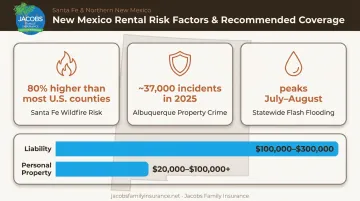
State Farm identifies $100,000 as the typical liability limit on a standard renters policy. The Insurance Information Institute notes that some experts recommend going as high as $300,000, particularly for properties where guest injuries or larger claims are more likely.
Jacobs Family Insurance typically structures its Standard Renters Policy (HO-4) with liability starting at $100,000, with room to increase through an endorsement for tenants who need more protection.
Setting a Personal Property Baseline
Allstate suggests $25,000 in personal property coverage as a reasonable starting point for many renters. Rather than relying on a flat number, personal property coverage should scale to what the tenant actually owns.
A practical range for most New Mexico rentals runs $20,000 to $100,000+, especially for tenants with higher-value electronics, jewelry, or collectibles.
Location Matters More Than You'd Think
New Mexico's risk landscape isn't uniform, and that's worth factoring in:
- Santa Fe County has greater wildfire likelihood than 80% of U.S. counties, based on modeled annual probability data
- Albuquerque recorded nearly 37,000 property crimes in 2025, including over 16,000 larceny/theft offenses
- Flash flooding occurs somewhere in New Mexico almost every year, with activity spiking during the July–August monsoon season
These risks tend to affect personal property exposure more than liability minimums, since flood damage is often excluded from standard renters policies anyway.
Replacement Cost vs. Actual Cash Value
Tenants choosing a policy will typically pick between two payout structures:
| Type | What It Pays | Best For |
|---|---|---|
| Replacement Cost | Full cost of a new equivalent item | Tenants who want to fully replace belongings after a loss |
| Actual Cash Value | Item's value at time of loss, minus depreciation | Lower premiums, but smaller payout |
Landlords don't need to dictate which one a tenant chooses, but knowing the difference helps when reviewing proof of insurance. A cheap policy with actual cash value coverage might technically meet your dollar minimum while still leaving a tenant underinsured after a real loss.
Because risk profiles vary so much between a downtown Albuquerque apartment and a Santa Fe hillside rental, it's worth talking to a local licensed agent who understands both the property type and its specific location.
How to Enforce and Document the Requirement
A verbal agreement won't hold up when something goes wrong. The requirement needs to live in writing, with a clear process behind it.
Build this into your lease:
- State the requirement explicitly, specifying minimum liability and personal property coverage amounts.
- Set a proof deadline: require a certificate of insurance before handing over keys.
- Require renewal proof so tenants submit updated documentation at each lease renewal, not just at move-in.
- Verify the details on any submitted certificate, including the named insured, rental address, coverage limits, and policy dates.
- Request interested party status, which triggers automatic notice if the policy lapses or cancels.
Skipping the renewal step is one of the most common gaps. The National Apartment Association (NAA) has flagged cases where a 14-month lease was backed by only a 12-month policy, leaving a two-month window with zero coverage. Building a renewal check into your process closes that gap before it becomes a problem.
Why Requiring Renters Insurance Protects Your Property Investment
Here's the core issue: your landlord or dwelling policy insures the structure. It doesn't touch the tenant's belongings, and it typically doesn't extend liability protection to something the tenant did.
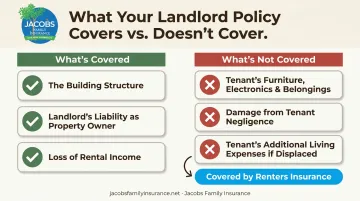
What a landlord policy generally covers:
- The building itself
- Landlord's own liability as the property owner
- Loss of rental income after a covered event
What it does not cover:
- The tenant's furniture, electronics, or personal items
- Injuries or damage caused by the tenant's own negligence
- The tenant's additional living expenses if they're displaced
That gap gets expensive fast. U.S. fire departments responded to an estimated 76,000 apartment and multifamily housing fires in 2024, causing roughly $2 billion in direct property damage, according to the New Mexico Office of the Superintendent of Insurance.
A kitchen fire or a plumbing mishap the tenant caused can trigger liability claims that a landlord's own policy simply won't touch.
Requiring renters insurance shifts that financial responsibility back where it belongs: on the tenant's own policy. Fewer disputes over who pays, fewer out-of-pocket surprises, and a cleaner claims process if something does go wrong.
Jacobs Family Insurance works with New Mexico property owners on both sides of this equation, helping landlords pair the right dwelling policy with sensible tenant insurance requirements.
As a local Allstate Elite agency based in Santa Fe, the focus stays on personalized guidance rather than a call-center experience. That holds true whether you're managing a single rental or a small portfolio across northern New Mexico.
Frequently Asked Questions
What is the minimum requirement for renters insurance?
There's no universal minimum. Most landlords ask for $100,000 in liability coverage and enough personal property coverage to match the tenant's belongings, often in the $20,000+ range.
Is renters insurance required by law?
No federal or state law requires it. Landlords can make it mandatory by writing it into the lease agreement.
Who needs to be on renters insurance?
The lease should list the leaseholder(s) on the policy. Adult roommates typically need their own separate policy or should add themselves to an existing one.
Can a landlord cancel a lease if a tenant doesn't get renters insurance?
If insurance is a written lease condition, landlords can generally deny move-in, decline renewal, or in some cases purchase a policy on the tenant's behalf.
Can landlords require a specific insurance company or provider?
Landlords can set coverage minimums and request proof, but generally can't force tenants to use one specific insurer unless state law says otherwise.
Does renters insurance cover damage the tenant causes to the landlord's property?
Many renters policies include liability coverage that helps pay for accidental damage, like a kitchen fire or plumbing mishap.
Have questions about pairing your landlord policy with tenant insurance requirements? Contact Jacobs Family Insurance at (505) 557-2067 for a personalized consultation on your Santa Fe or northern New Mexico rental property.