This article breaks down what New Mexico riders actually pay, what pushes rates up or down, how your bike type and coverage choices factor in, and what you can do to get a better price before you sign anything.
Key Takeaways
- Full coverage motorcycle insurance averages $33/month nationally and $32/month in New Mexico
- Liability-only policies typically run $12–$30/month, depending on insurer and state
- The biggest rate drivers: rider age, bike type, location, driving history, and coverage level
- Sport bike riders pay over 3.5 times more than cruiser riders for the same coverage
- Comparing quotes, taking a safety course, and bundling policies are the fastest ways to lower your rate
How Much Does Motorcycle Insurance Cost?
Motorcycle insurance doesn't have a single price — it's built from a combination of personal, vehicle, and geographic factors that insurers weigh differently. Riders who skip comparison shopping often overpay, sometimes by a wide margin.
Typical Cost Ranges
According to ValuePenguin's 2026 data, the national benchmarks look like this:
| Coverage Type | Monthly Average | Annual Average |
|---|---|---|
| Full coverage (national) | $33/month | $399/year |
| Liability-only (national) | ~$16/month | ~$196/year |
| Full coverage (New Mexico) | $32/month | ~$384/year |
Full coverage typically means liability + collision + comprehensive. Liability-only covers damage or injuries you cause to others — nothing for your own bike.
New Mexico rates vary by city:
- Belen / Los Lunas: $37/month
- Albuquerque: $35/month
- Santa Fe: $31/month
- Taos: $30/month
These figures come from aggregator data using a standard rider profile — your actual quote will differ.
How Rates Vary by Insurer
Geography explains part of the price picture. The insurer you choose explains the rest. Among major national providers, ValuePenguin's 2026 data shows:
- Dairyland: $22/month
- Progressive: $23/month
- Harley-Davidson Insurance: $24/month
- Geico: $36/month
- Allstate: $37/month
Allstate sits near the higher end of this national comparison, which is worth understanding in context. Price is one variable, but what's covered, claims handling, and agent accessibility matter too. For riders in Santa Fe and northern New Mexico, a local agency like Jacobs Family Insurance offers the ability to talk through coverage options directly with someone who knows the area.
The takeaway: even for the same rider and bike, premiums across insurers can differ by $15–$30+ per month. Comparing quotes isn't optional.
Key Factors That Affect Motorcycle Insurance Rates
Insurers combine personal history, vehicle data, and geographic factors to set your premium. No single variable determines your rate, but some carry considerably more weight than others.
Rider Age and Experience
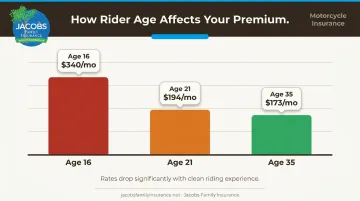
Age is one of the sharpest pricing variables in motorcycle insurance. Younger riders file claims more frequently, and the safety data reflects that — 33% of fatally injured motorcyclists in 2024 were under 30.
The premium difference is dramatic:
| Rider Age | Estimated Monthly Premium |
|---|---|
| 16 years old | $340/month |
| 21 years old | $194/month |
| 35 years old | $173/month |
(Source: ValuePenguin, 2026 — aggregator data using a standard profile)
Rates drop meaningfully as riders accumulate clean, accident-free years. For a new rider, this is one of the most impactful variables over time — and one of the strongest reasons to start with a safer, lower-cost bike.
Your Location and Riding Season
Where you live shapes your premium through local traffic density, crime rates, accident frequency, and the length of the riding season. Warmer states with year-round riding generally carry higher rates because more road time means more exposure to risk.
New Mexico's climate — with over 320 days of sunshine in Santa Fe alone — means many riders are out most of the year, which factors directly into premiums. Urban riders in Albuquerque or Santa Fe also pay modestly more than those in rural northern New Mexico. Part of that gap comes down to theft: motorcycle thefts rose 7% from 2021 to 2022, the third consecutive annual increase nationally.
Your Driving and Claims History
Your full driving record — not just your motorcycle history — is fair game when insurers calculate your premium. Speeding tickets can stay on your record for 3–5 years. DUIs may remain for 7–10 years or more, depending on the state, and typically trigger SR-22 requirements. At-fault accidents follow a similar pattern. Every incident in that window has the potential to raise what you pay.
How You Use Your Motorcycle and Coverage Choices
Usage matters because more time on the road means more exposure to risk:
- Daily commuters pay more — higher mileage and constant traffic exposure push risk up
- Recreational or weekend riders typically pay less — some insurers ask about annual mileage during quoting specifically because of this
Deductible level also directly affects your monthly payment. A higher deductible lowers your premium but increases your out-of-pocket cost if you file a claim. Choose a deductible you could realistically cover without financial stress — not just the number that gets your monthly bill lowest.
Liability-Only vs. Full Coverage: What's the Difference?
Choosing between liability-only and full coverage is one of the most consequential decisions you'll make when setting up a motorcycle policy.
Liability-only covers bodily injury and property damage you cause to others. It does not cover:
- Damage to your own motorcycle in a crash
- Theft or vandalism
- Weather-related damage (hail, flooding, etc.)
Full coverage adds collision and comprehensive to the liability base:
- Collision: Covers your bike's damage in an accident (typically up to book value minus your deductible)
- Comprehensive: Covers theft, vandalism, fire, and weather damage
Full coverage nationally averages $33/month; liability-only runs roughly $12–$30/month depending on the insurer and state.
When does each make sense?
- Liability-only: Reasonable for older, lower-value bikes where the cost of comprehensive and collision premiums approaches or exceeds what you'd recover from a claim
- Full coverage: Strongly recommended for newer bikes, financed motorcycles (lenders typically require it), high-value models, or any bike you couldn't easily afford to replace out of pocket
If your bike's market value is only a few thousand dollars and you can handle repairs out of pocket, comprehensive and collision coverage may not be worth the cost. If you're still making payments, though, the choice is made for you: lenders require full coverage until the loan is paid off.
How Motorcycle Type Affects Your Premium
The bike you choose can move your premium dramatically — in either direction.
Sport Bikes vs. Cruisers
Sport bikes and supersports are the most expensive category to insure — by a significant margin. According to HLDI collision loss data, supersport motorcycles have collision losses nearly 3 times the average motorcycle. ValuePenguin puts it more starkly: sport bikes cost over 3.5 times more to insure than cruiser-style motorcycles.
Three factors drive that gap:
- Higher accident rates and more severe crashes
- Higher repair costs and parts prices
- Theft targeting is more concentrated on sport models
Cruisers, touring bikes, and scooters sit at the other end of the spectrum. Slower average speeds, lower crash rates, and less theft appeal all translate into lower premiums. One exception worth noting: vintage or classic motorcycles can be more expensive to insure if replacement parts are rare or costly.
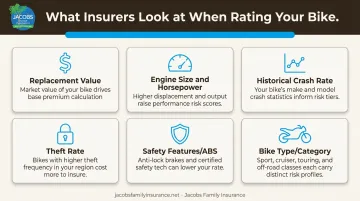
What Insurers Evaluate When Rating Your Bike
- Replacement or market value — higher value means higher potential claim
- Engine size and horsepower — larger, more powerful engines are linked to higher risk
- Historical crash rate for that model — insurers track loss data by make and model
- Theft rate — models targeted more frequently cost more to insure
- Safety features — anti-lock brakes (ABS) are associated with lower crash severity; some insurers recognize this with discounts
How to Lower Your Motorcycle Insurance Costs
Compare Quotes First — Always
Get multiple quotes before committing — it's the single fastest way to cut your premium. Even for the same rider on the same bike, rates across insurers vary enough to matter month to month. Aim for at least three quotes.
For New Mexico riders, working with a local agency like Jacobs Family Insurance in Santa Fe gives you access to Allstate's competitive rates with the added benefit of a real person helping you sort through coverage options rather than guessing on your own.
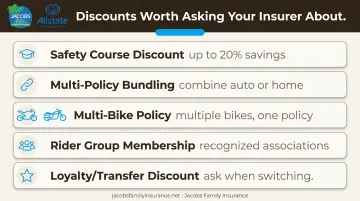
Discounts Worth Asking About
Most major insurers offer several ways to reduce premiums:
- Motorcycle safety course: Completing an MSF-approved course can save up to 10% with Geico; current MSF instructors may save up to 20%. The New Mexico Motorcycle Safety Program offers the MSF Basic RiderCourse for newer riders — one of the most accessible discounts available
- Multi-policy bundling: Combining your motorcycle policy with an existing auto or homeowners policy typically qualifies for a discount. Jacobs Family Insurance specifically offers bundling options across their specialty item and auto coverage products
- Multi-bike policies: Insuring more than one motorcycle under the same policy often comes with a reduced rate
- Rider group or club membership: Some insurers offer discounts for recognized motorcycle associations
- Loyalty or transfer discounts: Worth asking about when switching providers
Right-Size Your Coverage Periodically
Coverage that made sense on a new bike may cost more than it's worth once the bike depreciates. Revisit your policy and consider:
- Dropping comprehensive and collision on an older low-value bike if the math no longer works in your favor
- Raising your deductible if you've built up savings to absorb a larger out-of-pocket cost
- Removing add-ons you don't use — rental reimbursement, for example, if you have another vehicle available
Do this with an agent's input, not just by trimming your bill. Dropping coverage to save $15/month rarely makes sense if it leaves you exposed to a $4,000 repair bill.
Frequently Asked Questions
What is a good motorcycle insurance rate?
Use the national average as a rough benchmark: $33/month for full coverage and $12–$30/month for liability-only. If your quote runs significantly higher, shop around before committing.
Are motorcycles more expensive to insure than cars?
No — motorcycles are typically much cheaper. Full-coverage car insurance runs $175–$203/month nationally, compared to $33/month for motorcycles. The lower replacement value and secondary-vehicle status of most bikes account for much of that gap.
How does rider age affect motorcycle insurance costs?
Younger riders pay significantly more — a 16-year-old might pay $340/month versus $173/month for a 35-year-old. Rates drop as riders accumulate years of clean, accident-free experience.
Is motorcycle insurance required in New Mexico?
Yes. New Mexico requires all motorcyclists to carry minimum liability coverage to ride legally on public roads. The state minimums are $25,000 bodily injury per person, $50,000 per accident, and $10,000 property damage. These minimums often fall short of actual injury and repair costs — carrying higher limits protects your finances if you're at fault in a serious accident.
Does taking a motorcycle safety course lower insurance rates?
Yes. Completing an approved MSF course qualifies you for discounts with most major insurers — up to 10% with Geico, for example.
What is the difference between liability and full coverage motorcycle insurance?
Liability covers damage and injuries you cause to others. Full coverage adds collision (damage to your own bike in a crash) and comprehensive (theft, vandalism, weather). The right choice depends on your bike's value and whether it's financed — lenders require full coverage on financed motorcycles.