Introduction
Two boat owners can have identical policies with one critical difference: how the insurer calculates a payout. Agreed Value and Actual Cash Value are the two settlement methods that decide what you actually receive after a total loss, and the gap between them can run into thousands of dollars.
For boaters on Elephant Butte, Navajo, Cochiti, or Heron Lake, that gap matters. Choose the wrong valuation method and you could end up underpaid after a storm or accident, or you might be paying more in premiums than your boat's risk profile justifies.
This article breaks down both terms, compares them side by side, and helps you figure out which one fits your boat, your loan, and your budget.
Key Takeaways
- Agreed Value locks in a payout amount at policy inception with no depreciation applied
- Actual Cash Value pays depreciated market value at loss, usually lowering premiums
- ACV depreciates canvas and electronics; Agreed Value replaces them new-for-old
- Boat age, financing, and recent upgrades should drive your decision, not just premium price
- A local agent can quote both methods side by side so you see the real dollar difference
Agreed Value vs Actual Cash Value: Quick Comparison
Here's how the two methods stack up across the factors that matter most to boat owners.
| Factor | Agreed Value | Actual Cash Value (ACV) |
|---|---|---|
| Premium cost | Generally higher | Generally lower |
| Total loss payout | Full pre-agreed amount, no depreciation | Market value at time of loss, minus depreciation |
| Partial loss handling | Typically new-for-old replacement | Depreciation applied to canvas, electronics, upholstery, outboards |
| Best suited for | Newer boats, financed boats, recent upgrades | Older boats, boats depreciating quickly, budget-focused owners |
Even Agreed Value policies aren't fully depreciation-proof. BoatUS notes that its Agreed Hull Value coverage generally repairs partial losses "new for old," but still applies depreciation to specified items such as sails, canvas, cushions, outboards, and generators. That distinction trips up a lot of boat owners who assume Agreed Value means zero depreciation, period.
What Is Agreed Value Boat Insurance?
Agreed Value insurance means you and your insurer settle on the boat's insured value before the policy starts. That number becomes the guaranteed payout if the boat is declared a total loss, whether the boat is written off completely or repair costs exceed that agreed amount.
There's no market depreciation subtracted at claim time. That agreed-upon figure is what you'll receive, regardless of what the boat is worth on the market at the time of loss.
This matters most for financing. Many lenders require physical damage coverage on a financed boat to protect their loan balance. Agreed Value coverage aligns well with that requirement since it guarantees a payout that can cover what's still owed. It also protects recent investments properly:
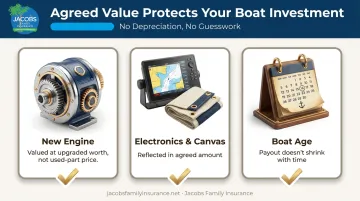
- A new engine installed last season gets valued at its upgraded worth, not treated as a used part
- Recently added electronics or upgraded canvas can be reflected in the agreed amount
- The payout doesn't shrink just because the boat has aged a year or two on the water
These protections matter more for some boats than others. Agreed Value is usually the more common choice for newer boats, high-value vessels, or boats in excellent condition, though insurers don't publish a single universal age cutoff. Eligibility varies by carrier and often depends on a combination of age, value, and condition rather than a strict number.
When Agreed Value Makes Sense
Agreed Value works best when:
- The boat is newer or still being financed
- You've made major upgrades you want reflected in the payout
- You want fewer surprises if you ever have to file a total loss claim
- Predictability matters more to you than shaving a few dollars off the premium
If you go this route, have a local agent verify the agreed amount is accurate. Insuring too high wastes premium dollars; insuring too low defeats the purpose of Agreed Value coverage entirely.
What Is Actual Cash Value (ACV) Boat Insurance?
ACV coverage works differently. Instead of locking in a number upfront, the insurer determines what your boat is actually worth at the moment of loss, factoring in age, condition, and market depreciation.
The trade-off is straightforward: lower premiums now in exchange for a smaller payout later if the boat is totaled. You're not paying to insure the value your boat has already lost to age and wear.
ACV also shapes how partial losses get settled. Items that wear out faster than the hull itself, such as canvas tops, upholstery, marine electronics, and outboard motors, may be paid out at depreciated value rather than full replacement cost. A five-year-old canvas cover damaged in a storm won't be reimbursed at today's retail price under ACV; it's reimbursed at what that worn cover was actually worth.
When ACV Makes Sense
ACV tends to be the practical choice for:
- Older boats, roughly 15-20+ years, where market value has already dropped substantially
- Vessels with cosmetic wear that would inflate an Agreed Value estimate unrealistically
- Owners who'd rather save on premium and accept a reduced total-loss payout
Depreciation hits hardest early. J.D. Power's boat valuation data shows typical depreciation of 10%-20% in the first year alone, 20%-30% by year five, and 30%-40% by year ten for most used boats.
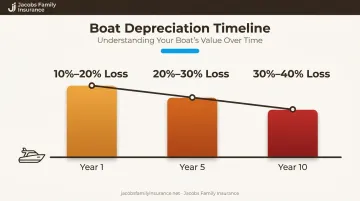
After the first decade, condition and maintenance history start to matter more than age alone. If your boat has already absorbed most of that early depreciation, ACV premiums often make more financial sense than paying extra for Agreed Value protection on a boat whose market value has already settled.
Agreed Value vs ACV: Which One Should You Choose?
The right answer depends on a handful of concrete factors, not a blanket rule:
- Boat age: newer boats lean toward Agreed Value; older boats lean toward ACV
- Lender requirements: check your loan terms for physical damage coverage requirements
- Recent upgrades: new engines or electronics are better protected under Agreed Value
- How you use the boat: frequent lake trips with higher exposure may justify the added protection
- Premium budget: ACV generally costs less, but with a smaller safety net
As a general rule: choose Agreed Value if predictability and full protection after a total loss matter most to you. Choose ACV if lowering your premium is the priority and you're comfortable with a reduced payout in a worst-case scenario.
There's also a third, less common option worth knowing about: Total Replacement Cost coverage. Some insurers offer this for original owners on boats no more than one model year old.
It typically replaces a totaled boat with a new one, or pays the original purchase price if the loss happens within a few model years. This coverage isn't widely available and comes with a narrow eligibility window, but it's worth asking your agent about if your boat is brand new.
Real-World Payout Example
Numbers make this concrete. Consider a three-year-old center console boat that was originally purchased and insured for $40,000, but whose current market value has dropped to $30,000. A new equivalent model now costs $45,000.
United Marine Underwriters illustrates exactly this scenario:
| Valuation method | Payout after total loss |
|---|---|
| Agreed Value | $40,000 |
| Actual Cash Value | $30,000 |
| Replacement Cost | $45,000 |
That's a $10,000 gap between Agreed Value and ACV on the exact same boat, same accident, same day.
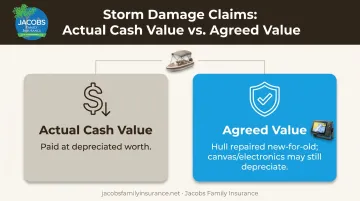
Partial losses tell a similar story on a smaller scale. Imagine a hailstorm damages the canvas bimini top and a chartplotter on that same boat. Under ACV, both items get paid out based on their depreciated value, not what it costs to replace them today.
Under Agreed Value, the hull damage is typically repaired new-for-old, though carriers may still apply some depreciation to the canvas and electronics specifically. Either way, it pays to know which items on your boat are exempt from full replacement before you're filing a claim, not after.
Get Local Guidance for Your New Mexico Boat
Running these numbers on paper is one thing. Getting an actual quote comparison for your specific boat is another.
Jacobs Family Insurance is a local, family-owned Allstate Elite agency serving Santa Fe and northern New Mexico, including lake communities around Elephant Butte, Navajo, Cochiti, and Heron. We've been doing this for over 10 years, and our boat coverage includes:
- Liability protection
- Physical damage coverage
- Theft protection
- Medical payments
- Optional towing assistance
That same personal approach applies to the coverage itself: there's no call center here. You get a neighbor who runs the numbers with you.
If you're not sure whether Agreed Value or ACV fits your boat and your budget, call us at (505) 557-2067 or stop by our office at 1547 South St. Francis Drive, Santa Fe. We'll walk through both valuation options for your specific vessel and help you land on the coverage that makes sense for you.
Conclusion
Neither Agreed Value nor ACV is universally better. The right choice depends on your boat's age, whether it's financed, any recent upgrades you've made, and how much risk you're comfortable carrying yourself.
What matters is making that choice intentionally rather than defaulting to whatever a quote engine spits out first. Getting this wrong can mean a payout gap of thousands of dollars exactly when you need the money most. Before you renew or buy a policy, talk it through with a Jacobs Family Insurance agent who can show you both numbers side by side.
Frequently Asked Questions
What is better, Actual Cash Value or Agreed Value?
Agreed Value tends to work better for newer or financed boats that need predictable, full payouts. ACV suits older boats where lower premiums matter more than maximum payout potential.
What is the Agreed Value clause in marine insurance?
This clause confirms that the insurer and boat owner have pre-agreed on the vessel's insured value. That number becomes the fixed payout in a total loss, with no depreciation deducted.
Does Agreed Value insurance cost more than Actual Cash Value?
Yes, typically. Agreed Value premiums run higher because the insurer guarantees a larger, non-depreciated payout, while ACV trades a lower premium for reduced protection.
Can I switch from ACV to Agreed Value coverage?
Usually, yes. Boaters can generally request a change at renewal or via a mid-term endorsement, though the insurer may require an updated valuation or survey first.
Does Agreed Value ever depreciate?
The core insured amount doesn't depreciate. However, wear-prone items like canvas, upholstery, or electronics may still be subject to depreciation depending on the carrier's specific policy terms.
Is Agreed Value coverage required if I'm financing my boat?
Lenders typically require physical damage coverage to protect their loan balance, and many find Agreed Value coverage aligns well with that requirement. Check your specific loan terms, since requirements vary by lender.