This confusion is more common than most people realize. According to the Foundation for Community Association Research, there are an estimated 369,000 community associations in the U.S. serving 77.1 million residents — and a significant portion of those residents misunderstand where the association's coverage ends and their own begins.
This guide explains exactly what a condo master insurance policy covers, what it leaves unprotected, and what that means for condo owners in New Mexico who need to make smart, informed coverage decisions.
Key Takeaways
- The master policy covers shared areas and the building structure — not your personal belongings or unit interior
- Three master policy types exist — bare walls, single entity, and all-in — and knowing yours determines how much individual coverage you need
- An HO-6 condo policy fills the gaps the master policy leaves behind
- After a major loss, the HOA can bill unit owners for a portion of the master policy deductible
- Review the association's master policy before buying or adjusting your individual condo coverage
What Is a Condo Master Insurance Policy?
A condo master insurance policy is the property and liability insurance policy purchased and maintained by the homeowners association (HOA) or condo association. Premiums are funded through monthly HOA dues — every unit owner contributes to it, whether or not they ever see the policy documents.
The master policy serves two primary purposes:
- Property damage coverage — protects the building structure and shared spaces against covered perils
- General liability coverage — pays for medical costs and legal defense if someone is injured in a common area
What the master policy does not cover is anything inside your unit or specific to you as an individual owner. That means:
- Personal belongings (furniture, electronics, clothing)
- Interior finishes you've installed or upgraded
- Your personal liability if a guest is injured inside your unit
The master policy protects the association's shared property — not yours.
The New Mexico Condominium Act (NMSA Section 47-7C-13) requires associations to maintain both property and liability insurance starting no later than the first unit conveyance — so the legal obligation to carry a master policy exists under state law.
The Three Types of Condo Master Policies
Not all master policies are created equal. Identifying which type your association carries is the single most important step before purchasing individual condo coverage.
Bare Walls-In Coverage
Bare walls is the most limited type. As defined by IRMI, it covers only the bare structure, collectively owned areas, and association-owned personal property. Everything inside the unit walls is the owner's responsibility:
- Flooring (carpet, hardwood, tile)
- Kitchen and bathroom cabinets
- Built-in appliances
- Plumbing fixtures and electrical
Owners in a bare walls building typically need the most comprehensive individual HO-6 coverage because they're responsible for insuring virtually everything inside their unit.
Single Entity Coverage
Single entity coverage goes further: it covers original fixtures, built-in appliances, and finishes as they existed when the building was originally constructed. Improvements made by unit owners after the original build are excluded.
Practical example: if a previous owner replaced the original carpet with hardwood floors, those floors are not covered under a single entity master policy. The owner's individual policy needs to pick up that gap.
All-In (All-Inclusive) Coverage
All-in is the most comprehensive type. It covers both original fixtures and any owner-installed improvements or upgrades, returning the unit to its pre-loss condition. Even so, all-in coverage still leaves meaningful gaps:
- Personal belongings (furniture, electronics, clothing)
- Personal liability inside the unit
- Loss of use / additional living expenses
- Loss assessment from shared-area damage
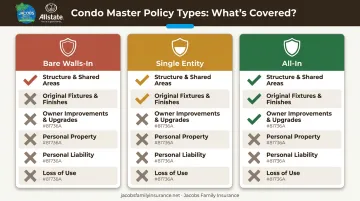
No matter which master policy type your association carries, an individual HO-6 policy fills the gaps that the master policy leaves behind — including your belongings, liability, and living expenses after a covered loss.
What Does the Condo Master Policy Cover?
All master policies share a common coverage foundation, regardless of which type your association carries. That foundation includes the physical building, shared spaces, common-area liability, and named perils — the specific causes of loss the policy will pay out for.
Covered Property
- Building exterior: roof, walls, and foundation
- Common area structures: hallways, stairwells, elevators, and lobbies
- Shared amenities: pool, clubhouse, gym, and parking areas
These are the components the association owns collectively — meaning individual unit interiors typically fall outside this coverage and become the unit owner's responsibility.
Covered Perils
The ISO Broad Causes of Loss Form (CP 10 20) defines the standard named perils included in commercial property coverage:
- Fire and lightning
- Windstorm and hail
- Explosion and smoke
- Vandalism
- Sprinkler leakage and water damage from burst pipes
- Weight of snow, ice, or sleet
- Falling objects
- Riot and civil commotion
Liability Coverage
The master policy's general liability component protects the association when someone is injured in a common area — a visitor who slips near the pool, for example. It pays for medical costs and legal defense up to the policy limit.
Additional Coverages Worth Noting
Many master policies include endorsements beyond the base form:
- Ordinance or Law coverage pays to bring damaged portions up to current building code. This is not built into the standard ISO Condominium Association form and must be added as a separate endorsement
- Equipment Breakdown coverage addresses mechanical or electrical failure of shared systems like central HVAC, elevators, and boilers
- Inflation Guard automatically adjusts coverage limits over time to keep pace with rising construction costs
On valuation: Fannie Mae requires master property insurance to cover 100% of replacement cost value, meaning the policy should cover rebuilding at today's costs — not a depreciated value.
What the Master Policy Doesn't Cover — and Why You Need Your Own HO-6
The master policy will never cover:
- Personal belongings — furniture, electronics, clothing, art, appliances you own
- Personal liability inside your unit — if a guest is injured inside your home
- Loss of use — additional living expenses if a covered loss forces you out temporarily
The Interior Unit Gap
Under bare walls and single entity policies, unit owners bear full responsibility for insuring interior finishes — flooring, cabinetry, countertops, and fixtures. Even under an all-in policy, improvements made after the original build may fall outside coverage. This gap can represent tens of thousands of dollars in unprotected value.
Loss Assessment: The Gap Most Owners Miss
When a loss exceeds the master policy's limit — or damage occurs in a shared area — the association can levy a special assessment against all unit owners to cover the shortfall. The New Mexico OSI confirms that HO-6 policies can include loss assessment coverage to protect against exactly this scenario.
Fannie Mae sets a minimum of $1,000 in loss assessment coverage when an individual unit policy is required — but given that real assessments can reach far higher amounts, this minimum is often inadequate. Loss assessment is just one coverage gap the master policy leaves open. Flood and earthquake exposure is another.
Flood and Earthquake: Excluded Everywhere
Standard master policies exclude floods and earthquakes entirely. For New Mexico condo owners, this matters. The National Weather Service reports that during the 2006 monsoon season alone, 91 flash flood events occurred statewide — and the Sangre de Cristo Mountains have seen flood events with recurrence intervals exceeding 100 years. Separate flood insurance is worth adding to your coverage plan.
An individual HO-6 condo policy (available through Jacobs Family Insurance) fills each of these gaps directly: personal property, personal liability, loss of use, and loss assessment coverage — all in a single policy the master plan doesn't provide.
Who Pays the Condo Master Policy Deductible?
Condo master policies carry deductibles just like any other insurance policy — and these can be substantial.
How deductibles work in practice:
- Deductibles are often expressed as a percentage of the total insured building value, not a flat dollar amount
- Both Fannie Mae and Freddie Mac set a maximum allowable deductible of 5% of the building coverage limit per occurrence for required perils
- Freddie Mac caps per-unit deductibles at $50,000 per unit
On a large complex insured for $5 million, a 5% deductible equals $250,000.
Who actually pays it: Many association bylaws allow the HOA to pass the deductible cost to the unit owner whose unit caused the loss. A fire starting in your kitchen could leave you with a substantial personal bill.
Loss assessment coverage on your HO-6 policy is designed for exactly this situation. Before buying or renewing, confirm two things:
- What is the master policy's deductible? (Ask your HOA or property manager)
- Does your HO-6 loss assessment limit cover it? (Match or exceed the deductible amount)
How to Read Your Master Policy and Close Your Coverage Gaps
Follow these practical steps to identify and fill your specific coverage gaps:
- Request the master policy declarations page and association bylaws — your HOA is required to provide these; in New Mexico, a resale certificate must include a description of the association's insurance coverage
- Identify the master policy type — bare walls, single entity, or all-in. This single fact determines how much interior unit coverage you need on your HO-6
- Note the deductible amount — and check whether per-unit deductible language exists in the bylaws
- Review the exclusions section — specifically for flood, earthquake, and any named-peril limitations
- Match your HO-6 to the gaps — your individual policy should fill the specific holes the master policy leaves, not default to a generic template
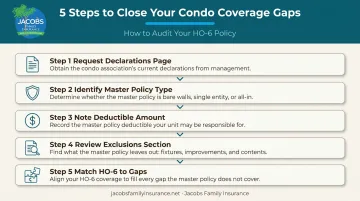
These steps are straightforward on paper, but the details vary by association and policy type. Working with a local agent who knows both documents helps make sure nothing falls through the cracks when a claim is filed. Jacobs Family Insurance has been helping condo owners in Santa Fe and across New Mexico sort through this for over 10 years — reach out for a personalized policy review.
Frequently Asked Questions
What does a master condo policy cover?
The master policy covers the building structure (roof, walls, foundation), common areas (hallways, pool, parking), and shared amenities, along with liability for injuries in those shared spaces. Premiums are funded through HOA dues paid by all unit owners.
What is not covered by condo insurance?
Neither the master policy nor a standard HO-6 covers floods or earthquakes. The master policy also does not cover personal belongings, personal liability inside the unit, or unit owner improvements — depending on whether the association carries bare walls or single entity coverage.
What's the difference between HO-6 and a master policy?
The master policy is held by the HOA and covers shared/common property and the building structure. An HO-6 is the individual unit owner's policy, covering personal belongings, the unit interior, personal liability, loss of use, and loss assessment charges from the HOA.
Who pays the condo master policy deductible?
The HOA pays the deductible from association funds initially, but most association bylaws allow it to assess the responsible unit owner(s) for that amount. Loss assessment coverage on your HO-6 policy protects you if that cost gets passed your way.
Do I still need my own condo insurance if my HOA has a master policy?
Yes. The master policy never covers personal property, personal liability inside the unit, or loss of use expenses. Mortgage lenders — including Fannie Mae and Freddie Mac — typically require individual HO-6 coverage as a condition of financing.