Introduction
You've just finished installing custom hardwood floors and a fully renovated kitchen in your Santa Fe condo. The work took months and cost tens of thousands of dollars. Then a question hits: does your insurance actually cover any of this?
This is one of the most common gaps condo owners discover, often mid-claim. Standard condo insurance (HO-6) can cover interior upgrades, but whether it actually does depends on three things:
- How your policy is structured
- What your HOA's master policy covers
- Whether you've updated your limits since renovating
This guide breaks down each factor — policy structure, HOA master policy types, and coverage limits — so you know exactly where you stand before a claim forces the question.
Key Takeaways
- HO-6 policies cover interior upgrades through additions and alterations coverage — but only if your limits match the upgraded unit value
- Your HOA's master policy type — bare walls, single entity, or all-in — determines how much individual coverage you actually need
- Common upgrades like hardwood floors, custom cabinetry, and upgraded fixtures fall under your personal HO-6 policy, not the HOA's master policy
- Failing to update your policy limits after major renovations can leave you significantly underinsured at claim time
- Document every upgrade with receipts and photos, then review your limits before and after any renovation
What Is Additions and Alterations Coverage in Condo Insurance?
Additions and alterations coverage — sometimes called building property or dwelling coverage in an HO-6 policy — is the portion of your personal condo insurance that covers improvements and upgrades made to your unit beyond the original builder-grade finishes. That includes work you did yourself and work done by a prior owner before you purchased the unit.
HO-6 insurance exists specifically to fill the gap between what the HOA's master policy covers (the building structure and common areas) and what individual owners are responsible for inside their units. As NAIC describes it, HO-6 is the Condominium Unit Owners Form and covers personal property plus the unit's walls, floors, and ceiling against broad form perils.
The division is clean: the HOA insures the building shell; you insure what's yours inside — including upgrades like custom countertops, light fixtures, flooring, and structural changes.
Actual Cash Value vs. Replacement Cost
How your policy values those upgrades matters enormously. There are two main approaches:
- Actual cash value (ACV): Pays the depreciated value of damaged property. Older tile, worn floors, or fixtures that are a few years old will be worth less than what you paid — sometimes significantly less.
- Replacement cost coverage (RCV): Pays to restore your unit to its upgraded state using like-kind-and-quality materials, without subtracting for depreciation.
For high-value renovations, the difference between ACV and RCV can be substantial. If you've installed $30,000 worth of custom cabinetry, ACV might pay a fraction of that after accounting for age and wear.
A Note on Policy Terminology
Some policies use "improvements and betterments" interchangeably with "additions and alterations." If you see either phrase in your policy documents, it refers to the same thing: owner-made upgrades beyond the original standard finishes. The label varies by carrier, but the coverage intent is identical.
How Your HOA's Master Policy Affects Upgrade Coverage
Before you can know how much individual coverage you need, you need to know which of three master policy types your HOA carries. Each one creates a different coverage gap for interior upgrades.
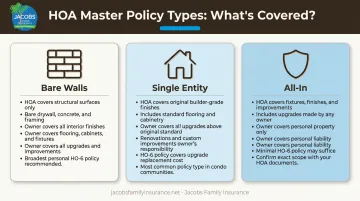
Bare Walls Coverage
Bare walls is the narrowest approach: the HOA insures only structural elements — walls, floors, and ceilings as raw surfaces — but nothing attached to them. No carpets, no cabinets, no appliances, no fixtures.
Under bare walls coverage, virtually every interior upgrade falls entirely on your HO-6 policy. If your building carries bare walls coverage and you've renovated extensively, your personal policy needs to reflect that full value.
Single Entity Coverage
Single entity is the most common arrangement: the HOA covers original builder-grade fixtures and finishes, but not improvements or upgrades made by current or prior owners. So if you installed custom tile where basic linoleum used to be, the difference between those two is entirely your responsibility.
This is what most Santa Fe condo owners are working with — meaning any upgrade above the original standard must be covered by your personal policy.
All-In (All-Inclusive) Coverage
All-in is the broadest master policy type. It may include fixtures, installations, and improvements inside units — not just the structural shell. Even under all-in coverage, though, verify the specifics with your HOA. Exclusions vary, and personal property and liability coverage remain your responsibility regardless.
Quick comparison:
| Policy Type | What HOA Covers | Your HO-6 Must Cover |
|---|---|---|
| Bare Walls | Structural surfaces only | Everything inside the unit |
| Single Entity | Original builder-grade finishes | All upgrades above original standard |
| All-In | Fixtures, finishes, and improvements | Personal property and liability |
Action step: Request a copy of your HOA's master policy from your property manager before assuming any upgrades are already protected. Don't guess — the answer has real financial consequences.
Interior Upgrades Typically Covered by Your HO-6 Policy
A properly structured HO-6 policy with additions and alterations coverage protects your upgrades against named perils: fire, water damage from a burst pipe, vandalism, and wind or hail.
Flooring and surfaces:
- Hardwood, tile, and custom carpet installations
- Custom wall treatments, crown molding, and wallpaper
- Upgraded ceiling finishes
Kitchen and bathroom upgrades:
- High-end appliances and custom cabinetry
- Countertops and backsplashes
- Luxury fixtures, custom tile, upgraded showers and tubs
Built-in features and systems:
- Built-in bookcases, entertainment centers, and shelving
- Custom lighting fixtures and electrical upgrades
- HVAC systems installed by the owner
- Home security and smart home systems
Structural changes:
- Removed or added walls
- Altered unit layout
Say a fire spreads from a neighboring unit and damages your newly renovated kitchen. With additions and alterations coverage set at the right limit, your policy pays to restore the upgraded kitchen — not just the original builder-grade version. Without adequate limits, the payout reflects original value, not what you actually invested.
What Condo Insurance Usually Does NOT Cover for Upgrades
Even with solid dwelling coverage, several scenarios fall outside what a standard HO-6 policy will pay for.
Excluded Perils
Standard home and condo policies do not cover flooding or earthquakes. These require separate policies — a real concern for New Mexico condo owners. The Santa Fe area sits in a region with moderate seismic hazard, and FEMA flood maps identify flood risk zones throughout the state. Neither risk is covered by your HO-6 without a separate policy.
Wear, Tear, and Workmanship Issues
Condo insurance is not a maintenance policy. The following are universally excluded:
- Gradual deterioration and normal wear and tear
- Damage from poor or faulty workmanship
- Renovation defects and improper installation
If tile cracks over time due to inadequate substrate preparation, or if a plumbing upgrade fails because it wasn't installed correctly, insurance won't pay. Proper contractor documentation protects you from both liability and coverage disputes. That paper trail becomes especially important once you factor in what underinsurance can cost you.
The Underinsurance Gap
This is the most common and costly mistake after renovating. If you upgraded your unit but never updated your policy limits, the insurance payout reflects the original value of the unit — not what it costs to restore it in its improved state. That gap can easily reach tens of thousands of dollars — money you'd owe out of pocket before repairs even begin.
How to Make Sure Your Upgrades Are Fully Protected
After any significant renovation, notify your insurer and request a coverage review. Jacobs Family Insurance, an Allstate Elite Agency serving Santa Fe and northern New Mexico, works with condo owners to update limits before a gap in coverage becomes a problem.
Set Limits Based on Replacement Cost, Not Purchase Price
The number that matters is what it costs to rebuild your upgraded unit today — materials, labor, current market rates. That figure is often higher than what you paid, particularly as construction costs have risen steadily in recent years.
Keep these documents organized and accessible:
- Contractor invoices and signed contracts
- Material receipts and product specs
- Before-and-after photos with dates
These records support your claim and establish what was actually installed.
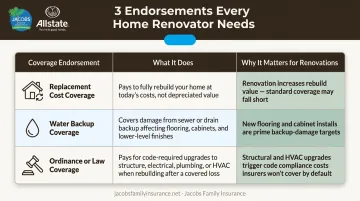
Consider These Optional Endorsements
Talk to your agent about which of these apply to your renovation before finalizing your policy:
| Endorsement | What It Does | Why It Matters for Upgrades |
|---|---|---|
| Replacement cost (vs. ACV) | Pays full rebuild cost without depreciation | Protects the full value of renovations |
| Water backup coverage | Covers sewer/drain backup and sump failure | Relevant for upgraded flooring, cabinets, and finishes |
| Ordinance or law coverage | Pays extra costs to meet current building codes | Important for structural, electrical, or HVAC changes |
Steps to Take Before and After You Renovate
Before Renovating
- Review your current HO-6 limits — confirm whether dwelling or additions and alterations coverage is included and at what amount
- Request your HOA's master policy — identify whether your building carries bare walls, single entity, or all-in coverage
- Verify permit requirements — confirm whether your renovation requires permits, and let your insurer know about any structural changes
- Check contractor credentials — New Mexico law requires licensed contractors to carry workers' compensation insurance (per the NM Workers' Compensation Administration) — ask for proof of coverage before work begins
During Renovation
Active construction can affect your coverage — don't assume your existing policy covers everything automatically:
- Confirm with your agent whether vacancy clauses apply if the unit will be unoccupied
- Ask about builder's risk endorsements if the scope of work is significant
- Keep records of any contractor invoices and change orders throughout the project
After Renovating
- Notify your insurance agent promptly with documentation of upgrades and costs
- Update your coverage limits to reflect the added value
- Update your home inventory with photos and receipts for all improvements
- Schedule a follow-up review if you plan additional work within the year
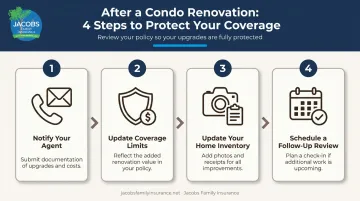
Staying current with your agent after every project ensures your policy reflects what your unit is actually worth — not what it was worth before you renovated.
Frequently Asked Questions
Does condo insurance cover renovations?
Yes — condo insurance can cover renovations through dwelling or additions and alterations coverage, but only if your policy limits are adequate and the damage results from a covered peril like fire or a burst pipe. The renovation work itself is not covered during construction.
What is not covered by condo insurance?
Standard condo insurance does not cover flooding, earthquakes, wear and tear, intentional damage, or damage from poor workmanship. Upgrades damaged by any of these events would not be reimbursed without separate or additional coverage in place.
What is additions and alterations coverage in condo insurance?
It's the part of an HO-6 policy that covers improvements made to a condo unit beyond the original builder-grade finishes — including flooring, cabinetry, fixtures, and structural changes. Some policies label this "improvements and betterments," but the protection it provides is identical.
Does my HOA's master policy cover my interior upgrades?
It depends on the master policy type. All-in policies may cover upgrades; bare walls and single entity policies typically do not. Under most arrangements, improvements above the original standard finishes are the individual owner's responsibility.
How do I know how much coverage I need for my condo upgrades?
Total the replacement cost of all upgrades (not the original purchase price), then review what your HOA master policy covers. Work with a licensed agent to set dwelling coverage limits that fully reflect the renovated value of your unit.
Do I need to notify my insurance company after renovating my condo?
Yes. Failing to update your policy limits after significant upgrades can leave you underinsured. A claim payout may only cover the original unit value, not the cost to restore it to its improved state — meaning you pay the difference out of pocket.