
Coverage starts on the effective date shown in your declarations, typically at 12:01 AM — not at the moment your payment processes. For a condo buyer closing next week, or someone switching providers tomorrow, that distinction matters a lot.
Getting the timing wrong can mean an uninsured gap, a violation of your mortgage agreement, or a frantic call to your HOA proving you have coverage. This article walks through exactly when condo insurance activates after an online purchase, what can delay it, and how to make sure your effective date lines up with what you actually need.
Key Takeaways
- Most online HO-6 purchases let you choose your start date — same-day or next-day activation is common
- Coverage begins at 12:01 AM on your chosen effective date, regardless of when you complete the purchase
- Payment problems, incomplete applications, or complex property profiles can delay binding
- Match your effective date to your closing date, old policy expiration, or HOA deadline to avoid coverage gaps
How Soon Does Condo Insurance Coverage Start After an Online Purchase?
For a straightforward condo — newer construction, no recent claims, standard occupancy — the online purchase process is fast. State Farm notes that an online condo unit-owners quote can be completed in less than 10 minutes, and most major carriers including GEICO, Progressive, Nationwide, and Liberty Mutual offer comparable online quote flows.
But quote speed and coverage activation are two different things. Understanding the difference comes down to one technical detail: when your policy clock actually starts.
What "Immediate" Actually Means
When an insurer confirms your policy, coverage doesn't begin at the timestamp on your confirmation email. The Nevada Division of Insurance's HO-6 form states clearly that insurance begins and ends at 12:01 AM Standard Time on the policy-period dates shown in the declarations.
So if you buy a policy at 3 PM on a Tuesday and set your effective date to that same day, your coverage technically started at 12:01 AM. A loss that occurred at 2 PM that day could potentially fall within the policy period. A loss at 4 PM the day before your effective date would not be covered, regardless of when you paid.
The Three Stages of Online Condo Insurance
| Stage | Typical Duration |
|---|---|
| Getting a quote | Minutes |
| Application and underwriting (standard condo) | Minutes to a few hours |
| Coverage activation | Based on your chosen effective date |
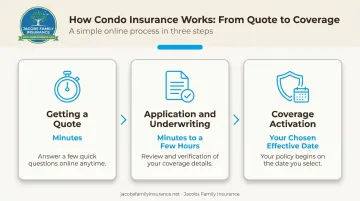
The key point: you control when coverage starts by selecting your effective date during the application. Set it intentionally.
One More Timing Factor — Your First Payment
Coverage cannot begin until your initial premium is processed. Several things can delay that processing:
- A declined card or insufficient funds
- A bank hold on a new account
- Choosing check payment instead of instant electronic transfer
If same-day or next-day activation matters, use a payment method that clears immediately.
What Is the Effective Date of Your Condo Insurance Policy?
The NAIC defines the effective date simply as the date at which an insurance policy goes into force. In practice, that means it's the date and time — typically 12:01 AM — when claims can be filed against your policy.
You choose this date during the online application. That flexibility is valuable, but it also puts the responsibility on you to pick the right one.
Matching Your Effective Date to Real-World Events
Closing on a condo: Set your effective date no later than your closing date. Most mortgage lenders require proof of active coverage at closing. Purchase your HO-6 policy a few days in advance so you have the declarations page ready.
Switching providers: Your new policy's effective date must match the exact moment your old policy expires. If your current policy ends at 12:01 AM on August 1st, your new one should start at 12:01 AM on August 1st — not August 2nd.
Satisfying an HOA requirement: Some associations require minimum coverage levels and may need to be listed as an interested party. Check your condo documents before setting your start date.
The Cost of Getting It Wrong
Getting any of those scenarios wrong by even a single day can violate your mortgage agreement. At that point, your lender has the authority to purchase insurance on your behalf. The CFPB's force-placed insurance regulations warn that lender-placed coverage may cost significantly more than what you'd purchase yourself and often provides less protection. The cost difference can be substantial — and the coverage weaker — simply because you didn't control the timeline.
The Step-by-Step Online Condo Insurance Purchase Process
Before you start an online HO-6 application, gather this information:
- Unit address, floor level, and unit number
- Approximate square footage and year built
- Construction type and any major renovations
- Estimated value of personal belongings
- Five-year claims history and previous carrier
- HOA master policy details (coverage type, per-unit deductible)
- Mortgage lender name and address, if applicable
- Your desired coverage start date
Having these ready eliminates the mid-application pauses that commonly push back binding.
What You'll Configure During the Application
You'll set your personal property limit (furniture, electronics, clothing, and similar items), interior fixtures and improvements ("walls-in" coverage), and your liability limit. For HOA-governed communities, add loss assessment coverage to your endorsements — it covers your share of costs when the association files a claim that exceeds the master policy.
Once you submit, automated underwriting checks the property address, construction details, claims history, and occupancy type. Most standard applications resolve in minutes and produce a bindable quote.
What You Receive After Purchase
Once you complete the transaction, expect a digital declarations page and proof of insurance binder by email — typically within minutes for standard condos. The binder is temporary evidence of coverage until the formal policy is issued. Under standard insurance regulations, a binder must include the effective date and coverage duration — exactly what your HOA or lender will ask to see when verifying your policy.
What Can Delay Your Condo Insurance Coverage?
Most online condo applications bind quickly — but two categories of issues can push your timeline from minutes to days: property-related factors and application or payment problems.
Property-Related Delays
Automated underwriting works best with standard, well-documented condos. These factors can push an application into manual review:
- Older building construction or unrenovated units
- Prior water damage claims — even one can trigger manual review, per Texas DOI guidelines
- Location in a high-crime area or wildfire-prone zone
- Pending litigation against the HOA
- The unit being used as a rental rather than a primary residence
- Gaps in the master policy requiring the unit-owner policy to cover interior improvements
Note: Freddie Mac requires HO-6 coverage when master policy gaps exist, which can add documentation requirements before closing. Any of the above conditions can push your application into manual review, extending the timeline from hours to a few days.
Application and Payment Delays
- Inaccurate or incomplete information — if the insurer can't verify property details, they may pause and request documentation
- Declined payment — a failed transaction means no binding until payment clears
- Check payment — slower to process than electronic payment; avoid this if timing is critical
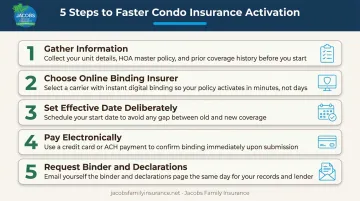
How to Get Your Condo Insurance Active Faster
Follow these steps to minimize delays:
- Gather your information first — unit details, claims history, HOA master policy certificate, lender requirements, and your target start date before you open a browser tab
- Choose an insurer with online binding — carriers with streamlined digital quote-to-bind flows reduce the chance of mid-application holds; working with an agency can add a layer of verification that catches problems early
- Set your effective date deliberately — pick the date that aligns with your closing, policy renewal, or HOA deadline; 12:01 AM is the standard start time, which eliminates ambiguity about "same-day" coverage
- Pay electronically — credit or debit card payments process faster than checks and reduce the risk of a payment-related delay
- Request your binder and declarations immediately — coverage isn't confirmed until you have documentation showing your effective date in writing. Don't skip this step.
If any of these steps feel uncertain, working with a local agent can simplify the process considerably. As an Allstate Elite Agency serving Santa Fe and northern New Mexico, Jacobs Family Insurance can walk you through the condo insurance purchase process and confirm your effective date aligns with your closing or existing policy timeline. Call the team at (505) 557-2067, Monday through Friday, 9AM–5PM.
Frequently Asked Questions
Can condo insurance coverage start the same day I buy it online?
Yes, many insurers allow same-day activation if you set the effective date to today and your payment processes without issue. Note that coverage begins at 12:01 AM on that date, not at the moment of purchase. Any loss occurring before midnight would not be covered under that policy.
What is the difference between the purchase date and the effective date of condo insurance?
The purchase date is when you complete the transaction and pay your premium. The effective date is when your coverage actually begins, as shown on your declarations. These can be the same day or several days apart, depending on when you schedule your policy to start.
How long does the underwriting process take for a condo insurance policy?
For most standard condos, automated underwriting takes just a few minutes online. Properties with prior claims, older construction, rental use, or master policy gaps may require manual review, which can extend the timeline from a few hours to a few days.
Do I need condo insurance in place before my closing date?
Most mortgage lenders require proof of active HO-6 coverage before or at closing. Purchase your policy at least a few days ahead of your closing date, set the effective date to match the closing, and have your declarations page ready to submit to your lender and title company.
What happens if there is a gap between my old and new condo insurance policies?
Even a one-day gap can violate your mortgage agreement and prompt your lender to purchase force-placed insurance, which the CFPB notes typically costs more and covers less than a policy you select yourself. Set your new policy's effective date to the exact day your old one expires.
Does my HOA need to be notified when I buy or activate condo insurance?
Many HOA bylaws require unit owners to carry minimum HO-6 coverage and submit a declarations page showing the HOA as an interested party. Requirements vary by association, so review your condo documents before purchasing.