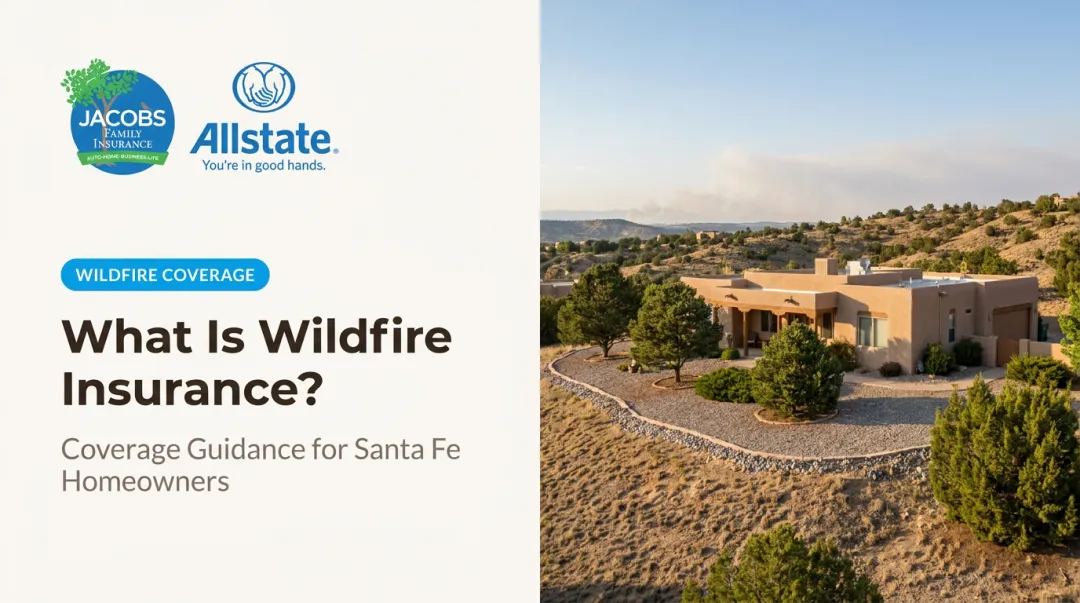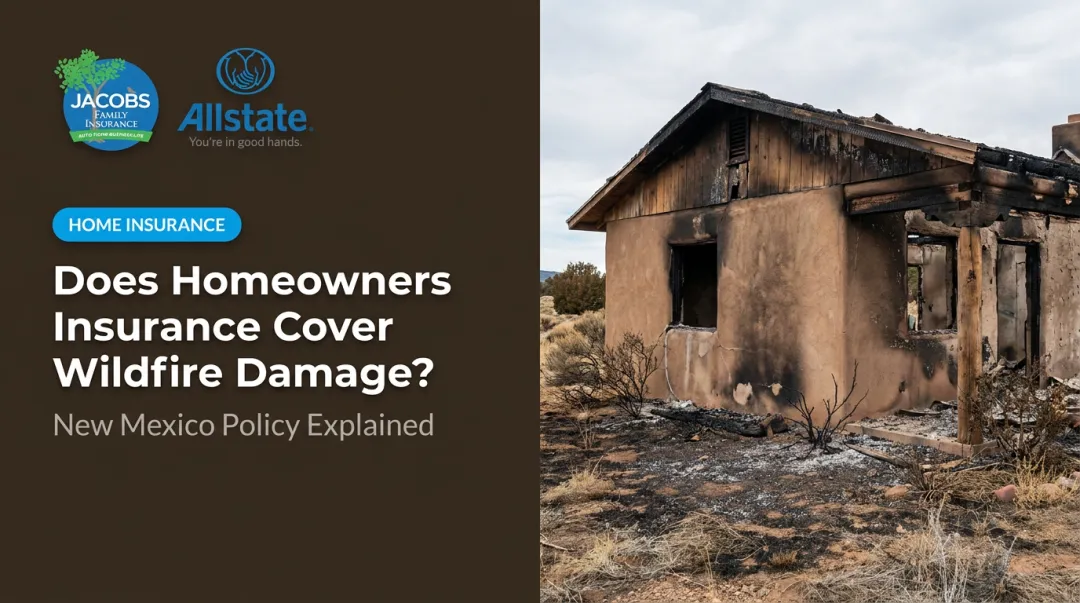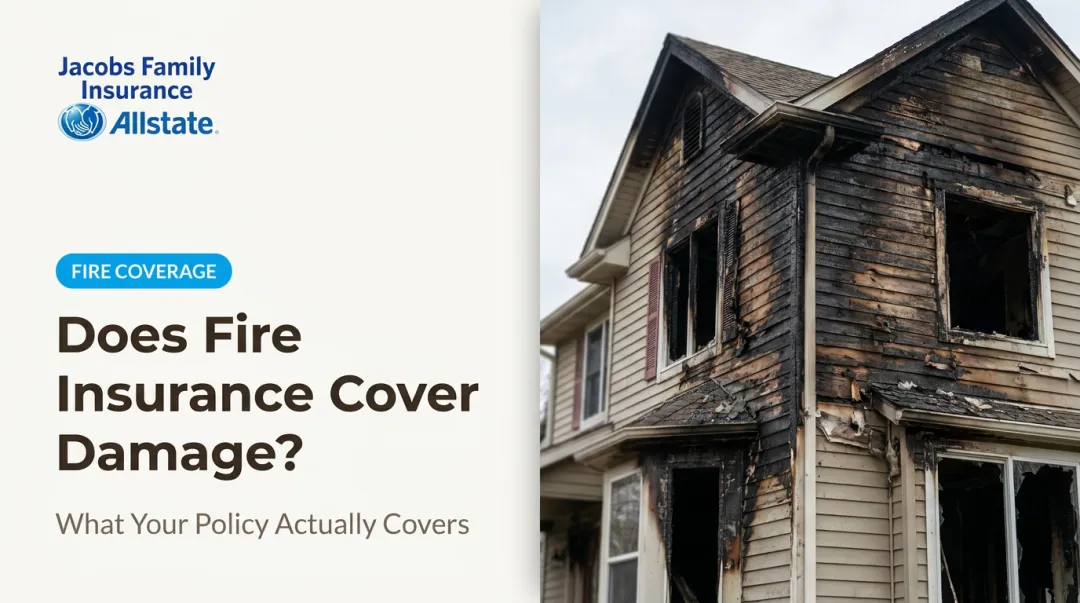
Many homeowners assume their policy has them fully covered. Then they discover separate wildfire deductibles, tighter exclusions, or a nonrenewal notice they never saw coming.
This guide breaks down what standard homeowners insurance actually covers, what wildfire protection tends to cost, and what your options look like when private insurers pull back. We'll also cover mitigation steps and what to do if the worst happens, with local insight from Jacobs Family Insurance in Santa Fe.
Key Takeaways
- Most HO-3 policies cover fire and wildfire damage, though high-risk zones often carry separate deductibles
- Coverage typically spans your dwelling, other structures, personal belongings, and additional living expenses
- Premiums and deductible structures vary widely by state, risk score, and property specifics
- State FAIR Plans offer a costlier, more limited safety net when private coverage disappears
- An annual policy review with a local agent catches gaps before they become expensive surprises
Does Homeowners Insurance Cover Wildfire Damage?
Yes. According to the Insurance Information Institute, a standard homeowners policy covers destruction and damage caused by fire, including wildfire, subject to your policy's terms and limits. That's the good news.
The complication: insurers in extreme-risk areas are increasingly adding wildfire-specific exclusions or endorsements that change how a fire claim gets paid. It's no longer safe to assume your policy treats wildfire the same way it treats a kitchen fire.
Dwelling and Structure Coverage
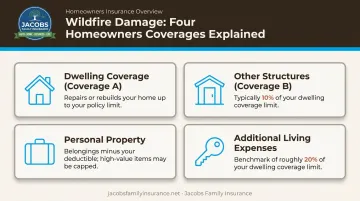
Your dwelling coverage (Coverage A) pays to repair or rebuild your home up to the policy limit. That sounds straightforward until a wildfire tears through a region and demand for contractors and materials spikes.
Post-disaster demand surges have historically pushed rebuilding costs up 15% to 30% for six to twelve months, according to Insurance Journal reporting on past California wildfire recoveries. If your dwelling limit doesn't account for that surge, you could face a rebuild shortfall.
Extended or guaranteed replacement cost coverage helps close that gap. Jacobs Family Insurance offers extended replacement-cost endorsements through Allstate for homeowners in wildfire-exposed areas of northern New Mexico. This gives your coverage room to flex if rebuild costs climb after a major fire event.
Other Structures and Personal Belongings
"Other structures" coverage (Coverage B) protects detached garages, sheds, fences, and similar structures. It's typically set at around 10% of your dwelling limit as a standard convention, though this varies by insurer.
Personal property coverage reimburses belongings lost to fire or smoke damage, minus your deductible. A few things to know:
- Standard policies cap high-value item categories like jewelry, often around $1,000 to $2,000 for loss or theft claims
- Art, collectibles, and firearms usually need scheduled endorsements or floater policies for full protection
- Scheduling an item means insuring it at an agreed or appraised value, not a blanket sub-limit
If you're sitting on family heirlooms or a serious jewelry collection, it's worth reading our breakdown on high-value personal property insurance in New Mexico before assuming your standard policy has you covered.
Additional Living Expenses (Loss of Use)
If a wildfire forces you out of your home, additional living expense (ALE) coverage pays for temporary housing, meals, and related costs above your normal spending. As a reference point, California's Department of Insurance notes that ALE coverage is commonly limited to around 20% of dwelling coverage — a helpful benchmark, though your policy's actual limit and time restrictions will vary.
Common gaps to watch for:
- Landscaping and trees are often covered only up to a small sub-limit, nowhere near what mature trees or professional landscaping actually cost to replace
- Vehicles destroyed by wildfire aren't covered under homeowners insurance at all. You'll need comprehensive auto coverage for that
How Much Does Wildfire Insurance Cost?
There's no such thing as standalone "wildfire insurance." The cost is baked into your homeowners premium, driven largely by how insurers score your property's fire risk.
To illustrate the range: a 2026 Insurance Journal analysis using modeled rate data for a $350,000 dwelling with a $1,000 deductible found average premiums of $2,395 nationally, compared with $1,413 in California.
That gap might surprise you given California's wildfire reputation, but it reflects rate caps and regulatory constraints that have historically kept published averages lower than the risk would suggest, a dynamic now shifting as regulators approve larger increases.
What actually drives your premium:
- Location and wildfire risk score for your specific property
- Home replacement value and square footage
- Construction materials (fire-resistant roofing costs less to insure than wood shake)
- Defensible space and vegetation management around the structure
- Claims history, both yours and the property's
- Coverage limits and deductible choice
Percentage-Based Deductibles Are Changing the Math
Many high-risk zip codes now carry wildfire-specific deductibles calculated as a percentage of your dwelling value, commonly somewhere between 1% and 5%, rather than a flat dollar amount.
Here's why that matters: on a $500,000 dwelling, a 5% deductible means you're covering the first $25,000 of a loss out of pocket, not $1,000 or $2,500. That's a dramatically different exposure than homeowners in lower-risk regions are used to.
Beyond deductibles, regulators have also been approving real premium increases tied to wildfire risk. California, for example, approved an interim 17% rate increase for State Farm homeowners policies in 2025, below the insurer's original 21.8% request, signaling how fast costs are moving in high-risk states.
New Mexico's own wildfire-prone areas (the northern forests and WUI communities around Santa Fe, Los Alamos, and Taos) don't always track national averages. Local risk scoring, forest density, and fire history all factor in differently. A personalized quote from a local Jacobs Family Insurance agent will tell you far more than any nationwide statistic ever could.
Getting and Keeping Coverage in High Wildfire-Risk Areas
Private insurers are pulling back in extreme-risk zones, and New Mexico isn't immune to the trend. According to the New Mexico Office of Superintendent of Insurance, the state's ten largest insurers issued more than 10,000 homeowners nonrenewals between January 2021 and July 2024.
In response, New Mexico's FAIR Plan raised its residential coverage cap from $350,000 to $750,000 in 2025, and enrollment had already reached more than 7,200 residents.
FAIR Plans: A Fallback, Not a First Choice
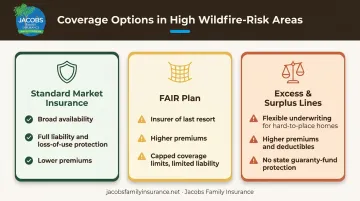
FAIR Plans exist as insurers of last resort for homes private companies won't cover, and enrollment climbs whenever the standard market tightens. They come with real tradeoffs:
- Charge higher premiums than standard-market policies
- Cap coverage at lower limits than most homeowners expect
- Exclude liability and full loss-of-use protection in many cases
Excess and surplus (E&S) lines carriers offer another route for high-value or hard-to-place homes. Premiums and deductibles run materially higher, though, and these non-admitted carriers don't carry state guaranty-fund protection, so it pays to compare terms carefully.
Why an Annual Review Matters
Reviewing your policy every year with a local agent helps you:
- Check your wildfire deductible — confirm whether it's a flat dollar amount or a percentage of dwelling value
- Verify your dwelling limit still matches current rebuild costs, not what your home was worth five years ago
- Catch nonrenewal risk early, before a surprise letter forces a last-minute scramble
That proactive check turns a potential nonrenewal notice into a manageable conversation. Jacobs Family Insurance, a family-owned Allstate Elite agency based in Santa Fe, works with homeowners across northern New Mexico's rural, ranch, and high-value properties. Rather than navigating wildfire coverage changes alone, homeowners can request a free wildfire coverage review to check dwelling limits, endorsement options, and whether their current setup still fits their property.
Reducing Wildfire Risk to Protect Your Home (and Possibly Your Premium)
Defensible space increasingly factors into whether insurers renew your home coverage, not just how well your home resists fire.
| Zone | Distance from home | What to do |
|---|---|---|
| Ember-resistant zone | 0-5 feet | Keep noncombustible materials immediately around the structure |
| Vegetation break | 5-30 feet | Clear brush, remove dead material, space out mature trees |
Documenting this work with photos and dates can support your case if an insurer questions your risk profile at renewal.
Home hardening upgrades insurers increasingly reward:
- Class A fire-resistant roofing
- Ember-resistant vents (mesh openings no larger than 1/8 inch)
- Non-combustible siding, especially at the base of exterior walls
Mitigation certifications like the IBHS Wildfire Prepared Home designation can also open the door to discounts with some carriers. Ask your agent directly which credits apply to your policy, since requirements vary by carrier. Jacobs Family Insurance offers pre-season mitigation planning that covers defensible space, roof and vent hardening, and ember-resistant landscaping, so homeowners aren't guessing at what actually helps.
What to Do If Your Home Is Damaged by Wildfire
The first hours after a wildfire loss set the tone for your entire claim. Move through these steps in order:
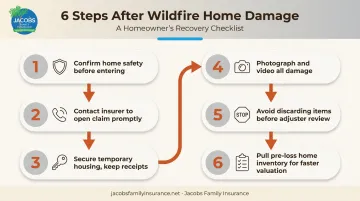
- Confirm the home is safe to enter before returning, and don't assume habitability just because the structure is standing
- Contact your insurer promptly to open a claim, since delays can complicate the process
- Secure temporary housing, keeping receipts since these costs may be reimbursed under your loss-of-use coverage
Documentation That Speeds Up Claims
- Photograph and video every room and area of damage before cleanup begins
- Avoid discarding damaged items until an adjuster has reviewed them
- Pull up your pre-loss home inventory if you have one — it dramatically speeds up the valuation process
With your documentation gathered, shift focus to the administrative side of the claim. Filing deadlines vary by state and insurer, so check your policy documents or ask your Jacobs Family Insurance agent directly. If a claim gets denied or underpaid, you have the right to appeal and request further review.
Frequently Asked Questions
How much does wildfire insurance cost in New Mexico?
There's no single "wildfire insurance" cost since it's part of your homeowners premium. Rates vary based on your property's location, defensible space, and construction materials, especially in fire-prone areas like the Santa Fe foothills. A local agent can give you a personalized quote rather than a statewide estimate.
Does normal homeowners insurance cover wildfires?
Yes, fire including wildfire is a standard covered peril on most HO-3 policies. High-risk areas may carry exclusions or separate wildfire deductibles, so check your specific policy language.
What is a FAIR Plan and when do I need one?
A FAIR Plan is a state-backed insurer of last resort for homes private companies won't cover. You'd turn to one if you've been declined or nonrenewed elsewhere, though expect higher costs and more limited coverage.
Does renters insurance cover wildfire damage?
Renters insurance covers your personal belongings and additional living expenses after a wildfire, but not the building itself. The landlord's policy handles structural repairs.
Can my insurer cancel my policy because of wildfire risk?
Insurers can nonrenew or cancel coverage in high-risk areas, but state law requires advance written notice. Timelines and permissible reasons vary, so review your renewal notices closely.
Will making my home more fire-resistant lower my insurance premium?
Many insurers offer credits for defensible space and home hardening upgrades like Class A roofing or ember-resistant vents. Confirm exactly which discounts apply with your agent, since programs vary by carrier.