
Introduction
Picture this: a kitchen fire breaks out in your Santa Fe condo. The flames damage your custom cabinets, hardwood floors, and tile backsplash. You file a claim — and then learn your HOA's master policy doesn't cover any of it. The repair bill lands squarely on you.
This isn't a rare edge case. Condo insurance works differently from standard homeowners insurance, and dwelling coverage is where most owners get caught off guard. Two separate policies apply to your unit, and the line between what your HOA covers and what you personally must insure is far less obvious than most people expect.
This guide breaks down exactly what dwelling coverage means for condo owners, covering:
- How dwelling coverage is defined for condo policies
- How your HOA's master policy changes what you need
- What's covered, what's excluded, and where the gaps are
- How to make sure you're not left holding the bill after a loss
Key Takeaways
- Condo dwelling coverage protects your unit's interior — floors, walls, fixtures, built-ins — not the building's exterior
- Your HOA's master policy type — all-in, single entity, or bare walls-in — determines how much personal coverage you need
- Set your dwelling coverage at replacement cost value, not purchase price or market value
- Being underinsured means paying the difference out of pocket, even on partial losses
- Review your limits annually and after any interior renovation
What Is Dwelling Coverage on a Condo Policy?
Dwelling coverage — formally called Coverage A on an HO-6 condo policy — pays to repair or rebuild the interior of your unit after a covered loss. In plain terms, it covers the physical elements of your unit that you own or are responsible for insuring under your condo association agreement.
The ISO HO 00 06 05 11 Unit-Owners Form defines this as alterations, appliances, fixtures, improvements, and any real property that is exclusively yours — essentially everything from the walls in.
What Condo Dwelling Coverage Actually Protects
The interior elements that fall under your dwelling coverage typically include:
- Hardwood, tile, or laminate flooring
- Wall and ceiling finishes (paint, drywall, plaster)
- Built-in cabinetry and shelving
- Countertops and kitchen or bathroom fixtures
- Permanently installed appliances
Knowing what's covered inside your unit is only half the picture. The other half is understanding where your responsibility ends and your HOA's begins.
How This Differs from Homeowners Coverage
With a standard homeowners policy, dwelling coverage protects the entire structure — from foundation to roof. Condo owners only own their unit's interior. The HOA owns and insures the building shell, roof, exterior walls, common hallways, and shared systems. Your policy picks up where theirs ends.
Condo dwelling coverage does not cover your personal property. Furniture, clothing, and electronics fall under a separate component of your HO-6 policy called personal property coverage. Dwelling coverage is strictly for the physical structure of your unit's interior.
How Your HOA Master Policy Affects Your Dwelling Coverage
Every condo association carries a master insurance policy covering the building exterior and shared spaces. What varies — and what determines how much individual coverage you need — is whether that master policy extends to anything inside your unit.
There are three types of master policies, and your coverage needs look completely different depending on which one your association carries:
| Master Policy Type | What the HOA Covers | What You Must Insure |
|---|---|---|
| All-In (All Inclusive) | Original and improved interior fixtures, flooring, cabinets, and built-ins | Primarily upgrades beyond original build; minimal personal dwelling coverage needed |
| Single Entity | Original installed fixtures and finishes as built | Any improvements or renovations you've made to the unit |
| Bare Walls In | Only the bare structure — drywall, studs, framing | Everything inside the walls: all flooring, cabinetry, countertops, fixtures, appliances |
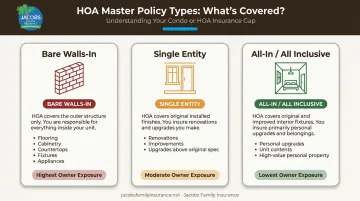
The bare walls-in scenario creates the greatest financial exposure for individual condo owners. If a fire or burst pipe damages your unit, you're responsible for replacing every fixture, floor, and cabinet — none of which the HOA policy touches.
Before purchasing your individual policy, request your HOA's master policy declarations page and read it carefully. If the language is unclear, your condo association board can clarify — or bring it to a local agent who can review it with you. The team at Jacobs Family Insurance in Santa Fe regularly helps New Mexico condo owners sort through exactly this question.
What Does Dwelling Coverage Include — and Exclude?
Covered Perils
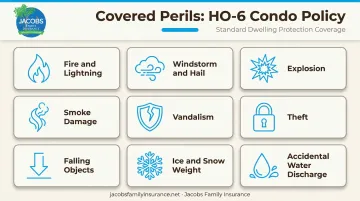
The ISO HO-6 form lists 16 named perils that standard condo dwelling coverage protects against. The most common include:
- Fire and lightning
- Windstorm and hail
- Explosion
- Smoke damage
- Vandalism or malicious mischief
- Theft
- Falling objects
- Weight of ice, snow, or sleet
- Accidental water discharge or overflow
Condo policies use named perils coverage, meaning they only pay for losses from events explicitly listed in the policy. Many homeowners policies use open perils coverage instead, which pays for any event not specifically excluded. If a peril isn't on your condo policy's list, it isn't covered — no matter how reasonable the claim.
What Dwelling Coverage Does Not Cover
Standard exclusions found in virtually all HO-6 policies include:
- Flooding — storm surge, overland water, overflow from any body of water
- Earthquake and earth movement — landslides, mudslides, subsidence
- Sewer or drain backup
- Neglect — failure to reasonably protect or maintain the property
For condo owners in Santa Fe and northern New Mexico, these exclusions carry real weight. FEMA's National Risk Index classifies Santa Fe County's wildfire risk as Very High, and the 2022 Hermit's Peak/Calf Canyon Fire — the largest wildfire in New Mexico history — burned 341,735 acres across the region. Monsoon season also brings flooding risk that standard policies won't touch.
Given those local risks, coverage gaps for flood and water backup are worth taking seriously — not treating as theoretical. Both can be addressed with separate policies or endorsements. FEMA's NFIP flood insurance program covers losses that standard policies exclude, and wildfire-related water damage endorsements are also available. Understanding your specific exposure in New Mexico is the first step toward deciding which layers make sense.
How Much Dwelling Coverage Do You Need?
Start with Replacement Cost Value
Your dwelling coverage limit should equal the replacement cost value (RCV) of your unit's interior — the cost to rebuild it today using comparable materials and labor. This is not your purchase price, market value, or remaining mortgage balance. Market value includes land and broader real estate factors that have no bearing on an insurance claim.
Two Common Estimation Approaches
1. Square footage method: Multiply your unit's square footage by the local per-square-foot rebuild cost. NAHB's 2024 construction cost survey puts the national average at roughly $162 per square foot — but that figure is for single-family homes, not condo interiors in Santa Fe. Local labor markets, finish levels, and material availability all shift the number.
2. Percentage of appraised value: Some lenders require condo owners to carry coverage equal to approximately 20% of the unit's total value. This can serve as a rough starting point but shouldn't be treated as a substitute for a proper replacement cost estimate.
What Pushes Your Number Higher
Both methods have limits. These factors commonly require higher coverage than the baseline estimate:
- Custom or high-end finishes (granite countertops, designer tile, custom millwork)
- Recent kitchen or bathroom renovations
- Upgraded flooring beyond builder-grade materials
- Upgraded flooring beyond builder-grade materials
- Older units requiring code-compliant upgrades during reconstruction
- Unique architectural features like vaulted ceilings or custom built-ins
A local agent can pull these variables together into an accurate estimate. Jacobs Family Insurance works with Santa Fe and northern New Mexico condo owners to assess their unit's true rebuild cost — factoring in HOA master policy type, finish level, and current construction costs in the area.
The Risk of Being Underinsured
Underinsurance isn't a theoretical concern. A 2025 University of Colorado Boulder study of Marshall Fire homeowners found that 74% were underinsured and 36% were severely underinsured after the disaster. While that data reflects homeowners rather than condo owners specifically, the core problem applies equally to condo owners: coverage limits set years ago that no longer reflect actual rebuild costs.
The 80% Rule
Most insurers require you to carry dwelling coverage equal to at least 80% of your unit's replacement cost value to receive full claim payouts. If your coverage falls below that threshold, your insurer reduces your payout proportionally — even on partial losses. A $60,000 fire claim can result in a significantly smaller check if your coverage limit is outdated.
Endorsements That Close the Gap
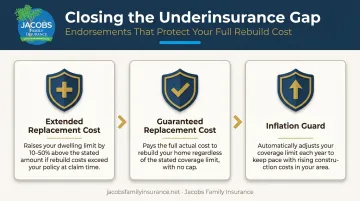
The good news: three endorsements are specifically designed to address this problem.
- Extended replacement cost — raises your coverage limit by a set percentage (typically 10–50%) above the stated dwelling limit if rebuild costs exceed it
- Guaranteed replacement cost — pays whatever rebuilding actually costs, regardless of the stated limit
- Inflation guard — adjusts your coverage limit annually to track rising construction costs
How to Keep Your Dwelling Coverage Current
Building material prices rose 3.5% year over year as of January 2026 — the largest annual increase since early 2023, according to NAHB. A coverage limit that was accurate two or three years ago may already be inadequate simply due to material and labor inflation, with no renovation required.
Two situations require an immediate coverage review:
- At every annual renewal — even without any changes to your unit, reconstruction costs shift with the market. Don't assume last year's limit still holds.
- After any interior improvement — a kitchen remodel, new flooring, upgraded countertops, added built-in shelving. Each of these increases your unit's rebuild cost and should be reflected in your coverage limit.
Either trigger is worth a quick conversation with a local agent. Jacobs Family Insurance works with New Mexico condo owners on exactly these reviews — at renewal or after improvements — with direct agent access and no call centers. Reach them Monday through Friday, 9:00 AM to 5:00 PM, at (505) 428-4735.
Frequently Asked Questions
What does dwelling coverage on a condo policy cover?
Condo dwelling coverage pays to repair or rebuild the interior structure of your unit — including floors, walls, ceilings, built-in cabinetry, fixtures, and permanently installed appliances — after a covered loss such as fire, storm damage, or vandalism. It does not cover personal belongings like furniture or electronics.
Is dwelling coverage worth it for condo owners?
Yes, particularly if your HOA carries a bare walls in or single entity master policy. Without it, rebuilding your unit's interior after a fire or major loss falls entirely on you — costs that can reach $30,000 or more depending on your finishes.
What is the rule of thumb for condo insurance coverage amounts?
A common starting point is insuring your unit for 20% of its appraised value, or multiplying its square footage by the local per-square-foot rebuild cost. Working with your agent and reviewing your HOA master policy type gives you the most accurate limit for your unit's actual rebuild cost.
What is the difference between a bare walls in and all-in master policy?
A bare walls in policy covers only the building's outer structure, leaving all interior finishes as your personal responsibility. An all-in policy also covers built-in fixtures and finishes inside each unit. The difference determines whether you need substantial dwelling coverage personally or relatively little.
How often should I update my condo's dwelling coverage?
Review your limits at least annually at renewal to account for rising construction costs, and immediately after any interior renovations or upgrades. A limit set two or three years ago may no longer be adequate even if nothing in your unit has changed.
Does dwelling coverage apply to renovations I make to my condo?
It depends on your master policy type. With a bare walls in or single entity policy, improvements you make, such as new countertops, upgraded flooring, or custom cabinets, are your responsibility to insure. Notify your insurer after any significant upgrade so your dwelling coverage limit accurately reflects your unit's current rebuild cost.