Unlike auto insurance, no single standardized product carries that label in the marine world. What most people mean when they say full coverage is a combination of liability, collision, and comprehensive protections that goes well beyond a bare-bones liability policy. Annual costs for most recreational boats fall somewhere between a few hundred dollars and several thousand, depending on the vessel, where it's used, and how the policy is structured.
This article breaks down exactly what full coverage includes, what it costs across different boat types, and what factors move the price up or down — with specific context for New Mexico boaters.
Key Takeaways
- Full coverage combines liability, collision, and comprehensive protection — not a single standardized product
- Progressive's 2023–2024 data places New Mexico in the medium-cost group at ~$400/year average
- Cost is typically 1%–1.5% of the boat's insured value annually for most recreational vessels
- Key price drivers: boat type, horsepower, age, storage location, and claims history
- New Mexico inland boaters generally pay less than those in coastal or hurricane-prone states
- Getting quotes from multiple carriers — including Allstate — can reveal meaningful price differences for identical coverage
What Is Full Coverage Boat Insurance?
"Full coverage" is not a defined insurance term for boats the way collision and comprehensive are defined for auto policies. No insurer sells a product with that exact label. Instead, it describes a combination of protections that together cover your boat, your liability, and the people on board.
What Full Coverage Typically Includes
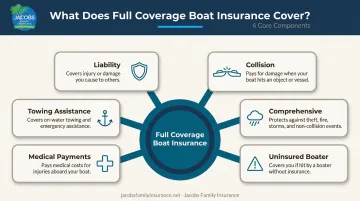
Most full coverage boat policies bundle these six core protections:
- Liability — pays for bodily injury or property damage you cause to others, including other boats, docks, and structures
- Collision — covers repair or replacement of your boat after an accident with another vessel or object
- Comprehensive — covers non-collision losses: theft, vandalism, fire, storm damage, and sinking
- Uninsured/underinsured boater — protects you when another boater causes damage but lacks adequate insurance
- Medical payments — covers medical expenses for you and your passengers regardless of who's at fault
- Towing and on-water assistance — emergency towing, fuel delivery, and on-water labor when you're stranded
What Full Coverage Does NOT Include
That coverage list is reassuring — until a claim gets denied. Understanding what's excluded is just as important as knowing what's covered. Standard exclusions across most carriers include:
- Normal wear and tear and gradual deterioration
- Mechanical breakdowns (typically excluded and available only as an add-on)
- Damage from improper maintenance or neglect
- Gradual weathering of hull materials
Mechanical breakdown and neglect are the two exclusions that catch boat owners most off guard — especially when they assume "full coverage" means exactly that.
How Much Does Full Coverage Boat Insurance Cost?
There's no single price tag. The cost of full coverage depends on the boat's value, your location, how the policy is structured, and several other variables covered in the next section.
The most useful benchmark: Bankrate estimates boat insurance at approximately 1.5% of the boat's value per year, with some sources citing a broader range of 1%–5% depending on boat type and coverage level. That translates to real dollar figures across different price tiers:
| Boat Category | Approximate Value | Estimated Annual Premium |
|---|---|---|
| Small fishing boats, jon boats, small pontoons | Under $20,000 | $200–$500/year |
| Mid-range pontoons, bowriders, bass boats | $20,000–$75,000 | $500–$1,500/year |
| Speedboats, cabin cruisers, yachts | $75,000+ | $1,500–$5,000+/year |
These are directional ranges, not guaranteed quotes. Your actual premium will reflect the specific factors below.
New Mexico Context
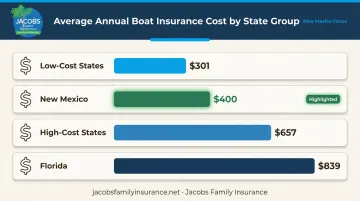
Progressive's 2023–2024 data places New Mexico in the medium-cost state group, averaging $400/year for a boat insurance policy — compared to $301/year in low-cost states and $657/year in high-cost states. Florida sits at the top at $839/year.
New Mexico boaters benefit from that spread. No hurricane exposure, no year-round boating season, and no liability risks from crowded coastal marinas. Boating on Elephant Butte or Cochiti Lake carries a fundamentally different risk profile than the Gulf Coast, which is why New Mexico premiums typically run hundreds of dollars below coastal states.
Key Factors That Affect Full Coverage Boat Insurance Costs
Full coverage pricing is shaped by a mix of the vessel itself, how and where it's used, and the owner's profile. Understanding these factors helps you anticipate your quote — and find ways to reduce it.
Boat Type, Size, and Horsepower
Larger, faster boats cost more to insure. A small fishing boat with a 25-horsepower motor presents a very different risk profile than a performance speedboat capable of 50+ mph. Insurers weigh:
- Boat length and overall size
- Engine horsepower and type
- Hull material and construction
- Intended use (recreational fishing vs. high-speed recreation)
The Insurance Information Institute confirms that the size, type, and value of the vessel — along with the waters in which it's used — all factor into both coverage needs and premium calculation.
Boat Age and Condition
Newer boats typically cost more to insure because they're worth more. Older boats aren't automatically cheaper, either — deferred maintenance raises the risk of mechanical failure and hull deterioration, which can lead to higher rates or underwriting complications.
Well-maintained boats, regardless of age, generally qualify for better terms.
Location, Storage, and Seasonal Use
Where your boat lives when it's not on the water affects your premium. Relevant factors include:
- Secure indoor dry storage vs. open marina slip — protected storage reduces theft and weather exposure
- Length of the boating season — New Mexico's shorter season means less time on the water and lower exposure
- Geographic risk — no hurricane zone, no saltwater corrosion, no year-round flood risk
Storing your boat on land during the off-season can reduce premiums noticeably. Some carriers offer lay-up credits for boats that are out of the water for extended periods.
Coverage Level, Deductible, and Policy Type
Higher limits and lower deductibles increase your premium — and your policy valuation method adds another layer. Whether you choose agreed value or actual cash value affects both your premium and what you'd receive after a total loss.
Selecting appropriate limits rather than automatically choosing the maximum is one of the more effective ways to manage cost without stripping away meaningful protection.
Boating History and Safety Credentials
An experienced boater with a clean claims record pays less. Common discounts across carriers include:
- Claims-free discount — Progressive rewards policyholders who complete a policy period without an at-fault or comprehensive claim over $1,000
- Safety course discount — Progressive recognizes NASBLA-approved courses; Nationwide offers a similar credit for approved water safety training
- Organization membership — membership in the U.S. Coast Guard Auxiliary or U.S. Power Squadrons can qualify for additional savings with select carriers
Allstate's available discounts through Jacobs Family Insurance are worth confirming directly — a quick call to the agency at (505) 557-2067 can clarify what applies to your policy.
Agreed Value vs. Actual Cash Value: How Your Policy Type Affects Cost
The policy type you choose — agreed value or actual cash value — directly determines how much you receive after a total loss, and the difference can be thousands of dollars.
Agreed value means the insurer pays a pre-set amount if the boat is totaled. No depreciation deduction. You and the insurer agree on the value when the policy is written, and that's what you receive.
Actual cash value (ACV) pays what the boat is worth on the market at the time of the loss — meaning depreciation is factored in. A boat worth $30,000 when purchased might only be worth $18,000 five years later, and that's all an ACV policy pays.
Both types have their place, but the right choice depends on your boat's age, value, and how you're financing it.
Which Type Is Right for You?
| Factor | Agreed Value | Actual Cash Value |
|---|---|---|
| Premium | Higher | Lower |
| Payout certainty | Set at policy inception | Subject to depreciation |
| Best for | Newer or high-value boats | Older, lower-value boats |
| Common when financing | Often required | May not satisfy lender |
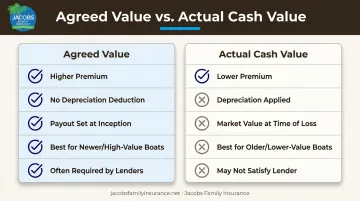
ACV policies have lower premiums but can leave you significantly short after a loss on a mid-range or newer boat. Agreed value costs more upfront, but you know exactly what you'll receive if the boat is totaled — no surprises after a major claim.
If your boat is financed, your lender will likely require physical damage coverage — comprehensive and collision at minimum. Whether agreed value is specifically required depends on the lender. Ask before you buy.
How to Lower Your Full Coverage Boat Insurance Premium
Reducing your premium doesn't have to mean cutting coverage. These strategies work:
- Complete a certified boating safety course — NASBLA-approved courses can qualify you for discounts with multiple carriers
- Bundle with existing policies — Jacobs Family Insurance offers bundling options for New Mexico boaters who already carry Allstate auto or homeowners coverage, which can reduce overall costs
- Store securely during off-season — land storage or indoor dry dock reduces theft and weather exposure
- Install anti-theft devices or GPS tracking — reduces theft risk and may qualify for underwriting credits
- Maintain a claims-free record — some carriers reduce deductibles or premiums for extended claim-free periods
- Choose appropriate limits — don't default to maximum coverage if your boat's value doesn't warrant it; right-sizing limits cuts cost without creating gaps
That said, savings strategies only help if you're starting from a solid policy. The cheapest option is rarely the best one — a low premium paired with a high deductible, significant exclusions, or an ACV payout structure can leave you badly exposed after a major loss. Apparent savings can turn into a major out-of-pocket expense after a hull strike or theft.
Working with a local agent who knows New Mexico's boating context makes that evaluation straightforward. Jacobs Family Insurance helps boaters across the state find coverage that fits — without paying for protection they don't need.
Frequently Asked Questions
How much is full coverage on a boat?
For most recreational boats, expect to pay roughly 1%–1.5% of the boat's value per year. That puts a $20,000 boat at around $200–$500/year and a $60,000 boat closer to $600–$1,500/year. New Mexico boaters average around $400/year based on Progressive's state-level data, though your actual rate depends on the boat, usage, and coverage choices.
How much does a $1,000,000 boat liability insurance policy cost?
A $1 million liability limit is standard for larger vessels and often required by marinas for slip rentals. For most recreational boats, standalone liability-only coverage typically runs $150–$500/year — far less than full coverage. The exact cost depends on your boat type, horsepower, and insurer, so rates vary meaningfully from one vessel to the next.
What does full coverage boat insurance include?
Full coverage typically bundles six protections into one policy:
- Liability — covers damage you cause to others, including other boats and docks
- Collision — covers damage to your boat from accidents
- Comprehensive — covers theft, vandalism, fire, and weather events
- Uninsured boater — protects you if the at-fault party has no insurance
- Medical payments — covers injuries to you and your passengers
- Towing and on-water assistance — roadside-style help on the water
Is full coverage boat insurance required in New Mexico?
New Mexico law does not require boat insurance for recreational vessels. However, lenders will require physical damage coverage for financed boats, and some marinas require proof of liability coverage. Given what most boats are worth, carrying full coverage is strongly advisable regardless.
Does full coverage boat insurance cover theft?
Yes — comprehensive coverage, which is part of a full coverage policy, typically covers theft, vandalism, and storm damage. Secure storage and anti-theft devices can reduce your premium and strengthen your claim position if theft does occur.
How is full coverage different from liability-only boat insurance?
Liability-only covers damage you cause to others — other boats, docks, and people. Full coverage also protects your own boat from accidents, theft, weather events, and other covered losses. If your boat is worth $15,000 or more, liability-only means you're absorbing the full cost of any damage to your own vessel — which can easily run into thousands after a single accident.