This scenario plays out across Northern New Mexico condo communities more often than owners expect. HOA condo insurance, known as the master policy, and your individual condo policy (HO-6) are two separate but complementary pieces of coverage. Confuse them, and you're left holding the bill.
This guide breaks down what your HOA's master policy actually covers, how it differs from HO-6 insurance, and why Santa Fe condo owners still need a policy of their own.
Key Takeaways
- Master policies cover the building's structure, common areas, and shared liability—not your unit
- Your interior finishes, belongings, and personal liability need a separate HO-6 policy
- Your master policy type—bare walls, single-entity, or all-in—determines your HO-6 needs
- Loss assessment coverage helps cover your share when damage costs exceed the master policy limit
What Is HOA Condo Insurance and Who Pays for It?
HOA condo insurance, also called a master policy, condo association policy, or HOA master insurance, is coverage the association purchases to protect the building itself and its shared spaces. It doesn't cover what happens inside your four walls.
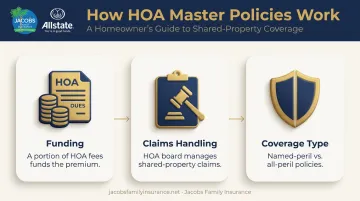
Here's how the money and management work:
- Funding: A portion of your monthly or annual HOA fees goes directly toward the master policy premium
- Claims handling: The HOA board, not you, files claims and manages the insurer relationship for shared-property damage
- Coverage type: Named-peril policies only pay for damage caused by specifically listed events (fire, theft, vandalism), while all-peril policies cover everything except what's explicitly excluded
The Insurance Information Institute confirms that two policies are necessary for full protection. You need the building master policy, plus an individual policy covering your belongings, liability, and any structural elements the master policy leaves out.
Why This Matters More in New Mexico
Northern New Mexico's weather doesn't make this an academic exercise. The National Weather Service reports that all 33 New Mexico counties experience severe thunderstorms with high winds and large hail at some point every year.
Add wildfire exposure into the mix, and knowing exactly what your association's policy covers, and what it doesn't, is essential before you ever need to file a claim.
What Does an HOA Master Policy Actually Cover?
Master policies focus on the building and everyone's shared spaces. Core coverage typically includes:
- Building exteriors, roofs, and structural elements the association owns
- Shared amenities like lobbies, hallways, elevators, parking lots, pools, and clubhouses
- Liability protection for accidents in common areas, such as a slip-and-fall by the pool
Nationwide's research adds walkways, sidewalks, and boilers to that common-area list, along with premises liability for injuries occurring anywhere on shared property.
Types of HOA Master Policies
Not all master policies are built the same, and the type your HOA carries determines exactly where your personal coverage responsibility begins.
| Policy Type | What It Covers | What's Left to You |
|---|---|---|
| Bare walls | Structure up to studs, drywall, and subfloor | Everything inside: flooring, cabinets, fixtures, appliances |
| Single-entity | Bare walls plus original fixtures and appliances installed when built | Upgrades, remodels, and personal improvements |
| All-in | Structure, original fixtures, and owner improvements/upgrades | Personal belongings and liability |
State Farm describes all-in as the most comprehensive option an association can carry, but even that doesn't touch your personal property or personal liability.
Practical step: Request a copy of your HOA's master policy declarations page. It's the only document that tells you, in writing, which type your community carries and where your personal coverage needs to pick up the slack.
HOA Master Policy vs. Individual Condo (HO-6) Insurance: Where Coverage Ends and Begins
Your condo insurance policy is classified as HO-6, not HO-3 (that's for single-family homes). It's your individual policy, separate from anything the association carries.
HO-6 policies typically cover:
- Personal property inside your unit
- Interior improvements the master policy doesn't include
- Personal liability for accidents inside your home
- Loss of use and additional living expenses if you can't stay in your unit
Here's the split in plain terms:
| Master Policy Covers | HO-6 Covers |
|---|---|
| Exterior, roof, structure | Unit interior (based on master policy type) |
| Common areas and amenities | Personal belongings |
| Shared-space liability | Personal liability inside your unit |
Loss Assessment: The Gap-Filler You Shouldn't Skip
Even a well-run HOA can face a claim that exceeds its master policy limits. When that happens, the shortfall gets divided among unit owners, a bill known as a loss assessment.
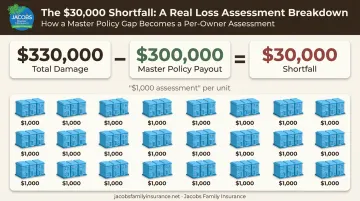
Progressive walks through a realistic scenario: a fire causes $330,000 in damage to a hallway and elevator. The master policy pays $300,000, leaving a $30,000 gap. Split across 30 owners, that's a $1,000 assessment per unit, an amount loss assessment coverage on your HO-6 policy can help absorb.
A few more things worth knowing:
- Lenders require it. Most mortgage lenders financing a condo purchase require proof of an HO-6 policy, regardless of how strong the HOA's master policy is
- Premiums stay affordable. Since the master policy handles structural risk, HO-6 coverage typically costs less than a standalone homeowners policy
- Coverage gaps vary widely from one association to the next, so reviewing both policies side by side is the only real way to confirm you're protected
How Much Does HOA and Condo Insurance Cost?
HOA master policy premiums get built into your association dues, and they shift based on the building's size, age, location, and amenities. A high-rise with a pool and elevator costs more to insure than a small, low-amenity complex.
Your individual HO-6 premium depends on different factors:
- Unit location and local risk exposure
- Personal claims history
- Coverage limits you choose
- Deductible amount
- Your master policy's coverage type (bare walls costs you more personally than all-in)
For context, NerdWallet's 2026 modeled data offers a useful cost benchmark for a sample two-bedroom condo:
| Region | Average Annual Premium |
|---|---|
| U.S. average | $490 |
| New Mexico average | $405 |
Your actual premium will vary based on your specific coverage choices and building.
Because all-in and bare-walls communities create different personal insurance needs, comparing your options matters. Santa Fe and Northern New Mexico condo owners can request a personalized quote from Jacobs Family Insurance, compared directly against their HOA's specific master policy terms.
Why You Still Need Your Own Condo Insurance Policy
Even a well-insured community leaves gaps. No master policy, no matter how comprehensive, protects your personal belongings, your interior upgrades, or your personal liability inside your own unit. That responsibility stays with you.
Consider what falls outside master policy protection:
- A remodeled kitchen you paid for out of pocket
- Furniture, electronics, and personal items inside your unit
- A guest injury that happens inside your condo, not in a common area
These gaps are exactly what HO-6 coverage is built to close.
Jacobs Family Insurance, a local Allstate Elite agency serving Santa Fe and Northern New Mexico, helps condo owners review their HOA's master policy and build the right HO-6 coverage. That typically includes:
- Interior structure and upgrades
- Furniture, electronics, and other personal belongings
- Personal liability inside your unit
- Loss assessment for shared claims
- Additional living expenses if displaced

Your agent matches this to whether your association's policy is bare walls, single-entity, or all-in.
Bundling your HO-6 policy with an existing auto or home policy can also unlock multi-line discounts worth exploring before you commit to a plan.
Frequently Asked Questions
How much does HOA insurance cost?
HOA master policy costs are shared through association dues and vary by building size, coverage type, and location. Individual HO-6 costs depend on your personal coverage choices, deductible, and claims history.
Is condo insurance HO3 or HO6?
Condo insurance is classified as HO-6. HO-3 policies are designed for single-family homes and cover the residential structure itself, which HO-6 does not cover.
What is HOA insurance called?
It's commonly called a master policy, condo association insurance, or HOA master insurance policy. All three terms refer to the same coverage the association carries.
Does HOA insurance cover my personal belongings inside my unit?
No. The master policy protects the building structure and common areas, not your personal property. You need an individual HO-6 policy to cover your belongings.
What is loss assessment coverage and do I need it?
Loss assessment coverage helps pay your share of costs when a shared-area claim, like fire or storm damage, exceeds your HOA's master policy limits. It's a smart addition, since repair costs after a major shared-area claim can add up fast.
Is condo insurance required if my HOA already has a master policy?
Usually, yes. Mortgage lenders typically require an individual HO-6 policy regardless of the HOA's master policy, since it covers risks the master policy doesn't touch.