That's a wide spread, and for good reason. There's no single "sailboat insurance price." Your rate depends on the boat's length, value, and age, where you sail it, and what coverage you choose.
This guide breaks down typical pricing ranges, the biggest cost factors, what actually goes into your premium, and how to trim it. We'll also touch on what this looks like for New Mexico owners sailing lakes like Cochiti and Elephant Butte.
Key Takeaways
- Annual sailboat premiums typically range from $250 to $1,500, with luxury yachts costing more
- Boat length, value, age, cruising area, and experience drive most of the cost difference
- Small lake sailboats typically cost far less to insure than offshore cruising vessels
- Bundling policies, taking a safety course, and raising your deductible can lower your premium
How Much Does Sailboat Insurance Cost? (Pricing Overview)
There's no fixed price tag on sailboat insurance. Insurers calculate it individually, weighing the vessel itself against your personal risk profile as an owner.
A few common budgeting mistakes trip up new sailboat owners:
- Assuming powerboat rates apply: sailboats and powerboats are underwritten differently, and pulling a number from a friend's powerboat policy won't get you close
- Underestimating liability needs: a modest sailboat can still cause serious injury or property damage in a collision
- Ignoring cruising-area restrictions: a suspiciously cheap policy may exclude the waters you actually plan to sail
Typical Cost Range
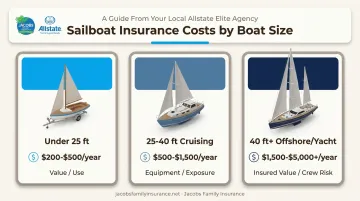
With those pitfalls in mind, here's what you can generally expect: insurers don't publish exact size-based averages, but industry patterns suggest these rough annual ranges:
| Sailboat Category | Typical Annual Range | What Drives It |
|---|---|---|
| Under 25 ft | $200 – $500 | Lower value, inland/coastal use |
| 25 – 40 ft (cruising) | $500 – $1,500 | Higher value, more equipment, coastal exposure |
| 40 ft+ (offshore/yacht) | $1,500 – $5,000+ | High insured value, worldwide navigation, crew risk |
These figures generally cover liability and physical damage only. Add-ons like trailer coverage, towing, or personal effects usually cost extra.
Small Sailboats (Under 25 Feet)
What's typically included: Basic liability plus hull coverage for inland or coastal use.
Best for: Weekend sailors, lake or bay boating, and first-time owners easing into the sport, where deductibles often run $250–$500.
Mid-Size Cruising Sailboats (25-40 Feet)
What's typically included: Liability, hull and machinery coverage, and often an Agreed Value option for total-loss claims.
Best for: Coastal cruisers, racers, and owners with moderate sailing experience, especially those with updated safety equipment.
Large/Offshore Sailboats and Yachts (40+ Feet)
What's typically included: Higher liability limits, worldwide navigation coverage, and crew coverage on larger vessels.
Best for: Bluewater cruisers, charter operators, and owners of high-value vessels, most of which require a marine survey before coverage begins.
Key Factors That Affect the Cost of Sailboat Insurance
Insurers don't look at one number in isolation. They weigh factors tied to the vessel itself, how you use it, and your record as a boater to land on your premium.
Boat Length and Value
Longer, pricier sailboats cost more to insure because they cost more to repair or replace. It's a straightforward equation: more hull to fix, more gear to cover, higher payout if something goes wrong.
Most insurers also cap what they'll write. Nationwide, for instance, generally limits eligibility to sailboats up to 50 feet, $350,000 in value, and 40 model years old (an underwriting ceiling rather than a pricing guide).
Age and Condition of the Boat
Older boats often cost less to insure since depreciation lowers their insured value. But a very old, poorly maintained vessel can push rates back up due to breakdown risk.
Many insurers require a marine survey once a boat crosses a certain age or value threshold. As Progressive notes, requirements vary by insurer and are tied to a boat's age, length, or value: new boats typically skip this step, while an unsurveyed used boat may not qualify for coverage at all.
Cruising Area and Navigation Limits
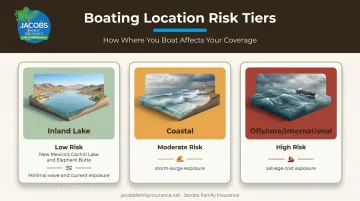
Where you sail matters almost as much as what you sail. Coastal, hurricane-prone, or offshore/international waters carry higher risk of storm damage and salvage costs, and insurers price accordingly.
Inland lake sailing, on the other hand, skips storm-surge and open-ocean exposure entirely. For New Mexico owners cruising Cochiti Lake or Elephant Butte, that inland profile generally lands in a lower-risk category than coastal cruising grounds.
Coverage Type and Deductible
Two big choices shape your premium:
- Liability-only vs. comprehensive: Liability-only skips hull coverage and costs less; comprehensive (hull and machinery) protects your investment but raises the premium
- Agreed Value vs. Actual Cash Value: Agreed Value pays a pre-set amount after a total loss with no depreciation; Actual Cash Value costs less upfront but pays out based on depreciated market value
Boater Experience and Claims History
A clean record pays off. Experienced, claims-free sailors typically see lower rates, while accidents or violations push premiums up. Completing a recognized course, such as one through the American Sailing Association or the BoatUS Foundation, can also work in your favor.
Storage and Safety Equipment
Marina or indoor storage tends to reduce weather and theft exposure, and safety gear like EPIRBs, fire suppression systems, and GPS tracking devices signal lower risk to underwriters. Ask your agent directly whether your setup qualifies for a credit — it varies by carrier.
Cost Breakdown: What Goes Into Your Premium
Your quoted premium is only one line item in the total cost of owning and insuring a sailboat.
| Cost Component | Frequency | What It Covers |
|---|---|---|
| Base premium | Annual (recurring) | Liability and physical damage per your policy terms |
| Survey | Periodic (every few years for older/high-value boats) | Structural condition, wiring, safety gear, and valuation — commonly $15–$20 per foot, or roughly $400–$600 for a mid-size boat |
| Optional add-ons | Recurring | Trailer coverage, towing/salvage, personal property, and uninsured boater protection |
Beyond these line items, it helps to know what a bundled policy actually includes. Jacobs Family Insurance's boat and watercraft coverage extends to sailboats as well as powerboats, typically bundling:
- Liability protection
- Physical damage coverage
- Theft protection
- Medical payments coverage
Towing assistance is available as an add-on.
How to Lower Your Sailboat Insurance Premium
A few practical moves can bring your premium down without cutting corners on protection:
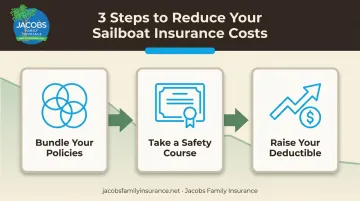
- Bundle your policies. Combining sailboat coverage with your home and auto insurance often unlocks multi-policy savings. A local agency like Jacobs Family Insurance can review your full portfolio and flag savings you might otherwise miss.
- Take a certified boating safety course. Courses through recognized organizations often qualify for a discount, even if the exact percentage varies by carrier.
- Raise your deductible. A higher deductible lowers your annual premium, and staying claims-free over time can earn renewal discounts on top of that.
One mistake to avoid: chasing the lowest upfront premium without checking cruising-area limits, confirming your Agreed Value figure is accurate, or reading the exclusions. A cheap policy that leaves you underinsured after a loss isn't actually cheap.
Conclusion
Sailboat insurance costs swing widely based on size, value, cruising area, and coverage choice — there's no universal "average" price to lean on. Understanding what drives your specific premium, from boat length to where you sail, helps you budget accurately and avoid gaps that surface only after something goes wrong.
If you're sailing New Mexico's inland lakes and want a policy that reflects your actual risk, talk with Jacobs Family Insurance. A quick conversation can show you how bundling your boat coverage with your home and auto policies can close gaps while lowering your overall premium.
Frequently Asked Questions
How much is sailing yacht insurance?
Yacht-size sailboats (40+ feet, higher value) commonly see annual premiums in the thousands, sometimes reaching 1-2% of the boat's insured value for larger or high-value vessels.
Do you need insurance on a small sailboat?
It's usually not legally required in New Mexico, but marinas, lenders, and everyday liability risk make coverage a smart move even on a modest, inexpensive sailboat.
What factors affect sailboat insurance costs the most?
Boat length and value, age, cruising area, coverage type, and boater experience carry the most weight when insurers calculate your rate.
Can I lower my sailboat insurance premium?
Yes, bundling policies, completing a boating safety course, raising your deductible, and maintaining a claims-free record can all reduce your premium.
Does homeowners insurance cover a small sailboat?
Some homeowners policies extend limited property coverage to small, low-value watercraft, but liability is often excluded. Larger or higher-value sailboats typically need a standalone policy.
How much does it cost to insure a 40-foot sailboat?
Expect roughly $1,500 to $5,000+ annually, depending heavily on the boat's value, age, and where it's sailed. New Mexico doesn't legally require boat insurance, but a lender or marina contract may still make it mandatory.