
That misconception surfaces at the worst possible moment: after a pipe bursts in the unit above yours, or a kitchen fire chars your cabinets and flooring. Suddenly you're staring at a repair bill your association's policy won't touch, and wondering why you didn't have more coverage of your own.
This gap between what the HOA insures and what you're personally on the hook for is exactly what condo dwelling coverage, part of an HO6 policy, is designed to close. Below, we'll break down what this coverage actually pays for, how your association's master policy shapes the amount you need, and how to calculate a limit that won't leave you exposed.
Key Takeaways
- Dwelling coverage rebuilds your unit's interior, not the exterior or shared spaces
- Your HOA's master policy type determines how much personal coverage you need
- Renovations and rising construction costs mean your limit needs an annual check-up
- A local agent can review your association's master policy to help avoid over- or under-insuring
What Is Condo Dwelling Coverage?
Condo dwelling coverage is the part of an HO6 policy that pays to repair or rebuild the interior structure of your unit after a covered loss like fire, smoke, or certain water damage. That includes:
- Walls, floors, and ceilings inside your unit
- Built-in cabinets and countertops
- Permanently installed fixtures (think light fixtures, built-in shelving)
- Interior doors and trim
It's one piece of a larger HO6 policy. Personal property coverage handles your furniture and belongings; loss assessment coverage handles your share of an HOA-related bill. Dwelling coverage is strictly about the bones of the unit itself.
Why "Condo" and "Dwelling" Aren't the Same Thing
Here's where a lot of confusion starts. A condo describes the ownership structure: you own your unit, while the building's exterior, hallways, and common areas are shared among all owners. A dwelling, in insurance terms, refers to the physical structure being insured.
In a single-family home, the dwelling is the entire house. In a condo, your personal dwelling coverage only applies to what's inside your unit's walls, because everything outside those walls is the association's responsibility under its own policy.
That's also why HO6 dwelling limits look dramatically smaller than the dwelling coverage on a detached home. The National Association of Insurance Commissioners' Condominium Unit Owners Form description confirms this scope directly. HO6 coverage applies to personal property and to the unit's walls, floors, and ceiling, not to an entire freestanding structure.
That narrower footprint is by design. Your association's master policy already pays for the roof, siding, and shared systems, so your personal policy doesn't need to duplicate that coverage.
Master Policy vs. Unit Owner's Policy: How They Work Together
Every New Mexico condo association is generally required to carry a master policy covering the building's structure, common areas, and shared liability exposure. When a claim hits that policy, the deductible is often split among owners as a shared cost, separate from anything your individual HO6 policy handles.
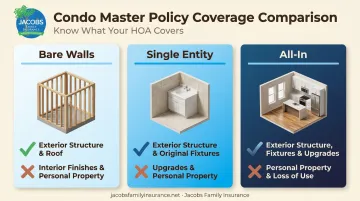
But not all master policies cover the same amount of your unit's interior. There are three common structures, and knowing which one your association uses changes everything about how much personal dwelling coverage you need.
| Master Policy Type | What the Association Covers | What You Need to Insure |
|---|---|---|
| Bare Walls | Ceilings, walls, and floors only (studs and subfloor) | Cabinets, appliances, flooring, fixtures, everything else |
| Single Entity | Original built-in fixtures as installed by the builder | Any upgrades or improvements you've made since purchase |
| All-In (All-Inclusive) | All original fixtures and finishes, including upgrades in some cases | Mainly post-purchase upgrades, plus any excluded items |
Bare Walls Coverage
This is the leanest master policy structure. The association's insurance stops at the studs and subfloor, leaving the owner responsible for essentially everything visible: cabinets, countertops, flooring, light fixtures, even interior paint. If your HOA carries a bare walls policy, expect to need the highest personal dwelling limit of the three types.
Single Entity Coverage
This middle-ground option covers original fixtures under the master policy, but not owner-made upgrades. If you've renovated a bathroom or added built-ins since buying the unit, those improvements need to be insured separately through your own dwelling coverage.
All-In (All-Inclusive) Coverage
At the other end of the spectrum, an all-in master policy covers original built-in fixtures and finishes as they existed when the unit was built. Owners mainly need coverage for anything added or upgraded after purchase, custom cabinetry, upgraded flooring, that sort of thing.
Before setting your dwelling limit, request your HOA's master policy declaration page or ask an agent to review it. Guessing which category your association falls into is one of the most common reasons owners end up over- or under-insured.
Loss Assessment: The Other Piece of the Puzzle
Loss assessment coverage kicks in when the master policy's deductible or claim shortfall gets passed on to unit owners. Insurers commonly include a modest base amount, sometimes as low as $1,000, with the option to raise it into the $10,000 to $100,000 range depending on the carrier.
If your association's deductible or coverage limits are on the higher end, bumping up this coverage is worth a conversation.
What's Covered and What's Not Under Condo Dwelling Coverage
Standard condo dwelling coverage responds to a defined list of perils. Commonly covered events include:
- Fire and lightning
- Smoke damage
- Windstorm and hail
- Vandalism and theft
- Certain water damage from plumbing or appliance failures
Common Exclusions
Most HO6 dwelling coverage won't pay for:
- Flood damage
- Earthquake damage
- Sewer or water backup (unless you've added an endorsement)
- Pest infestation
- Normal wear and tear or mechanical breakdown
These exclusions catch a lot of condo owners off guard, particularly the flood and sewer backup gaps. A single sewer backup claim can run $5,000 or more in cleanup costs, yet it's rarely covered without an added endorsement.
Separate endorsements or standalone policies typically exist to cover these risks, so it's worth asking specifically about them rather than assuming they're bundled in.
Named Perils vs. Open Perils
Here's a distinction that matters more than most owners realize. According to the NAIC's Consumer's Guide to Home Insurance, named-peril coverage only pays for causes of loss specifically listed in the policy, while open-peril coverage pays for any cause except those explicitly excluded.
Most condo dwelling policies default to named perils, which is more limited by definition. If broader protection matters to you, ask your agent whether upgrading to a more comprehensive form is available.
How to Calculate the Right Amount of Dwelling Coverage
Getting this number right starts with one question: what does your master policy already cover? That answer determines the size of the gap your personal policy needs to fill.
From there, two common calculation approaches come into play:
- Per-square-foot method – Multiply your unit's interior square footage by the local cost to rebuild finishes (cabinets, flooring, drywall, fixtures). This differs from a whole-home rebuild estimate: an itemized quote based on your specific finishes beats a generic per-square-foot number pulled from national housing data.
- Percentage-of-value method – Some mortgage lenders require dwelling coverage tied to a set formula, often the greater of the cost to restore uninsured interior improvements or the master policy's per-unit deductible. If you have a mortgage, confirm your lender's specific minimum before finalizing your limit.
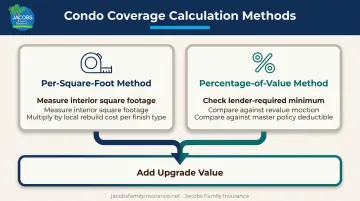
Beyond the base calculation, don't overlook upgrades. Custom cabinetry, upgraded flooring, and remodeled bathrooms are almost never covered by the master policy, even under an all-in structure. Keep receipts and photos of any renovation work, and add that value on top of your baseline interior coverage. This is one of the most frequently missed steps in setting a dwelling limit.
Revisit Your Coverage Annually
A dwelling limit that was accurate three years ago probably isn't anymore. Reconstruction costs in the U.S. rose 3.5% for residential rebuilds between October 2024 and October 2025 alone, with materials up 2.19% and labor up 4.49%, according to Verisk's reconstruction cost data. These increases compound year over year, eroding your coverage faster than you'd expect. Reviewing your policy every year, and definitely after any renovation, keeps your limit aligned with what it would actually cost to rebuild today.
Why Local Expertise Matters for Condo Coverage in New Mexico
Master policy structures vary widely from one condo association to the next, even within the same city. New Mexico law generally requires associations to insure common elements and, in horizontally bounded buildings, the units themselves, according to New Mexico Statute Section 47-7C-13.
That coverage doesn't have to extend to owner-made improvements or betterments, though. This leaves real gaps depending on your specific HOA's documents.
This is exactly where a local agent earns their keep. Jacobs Family Insurance has served Santa Fe and northern New Mexico for more than 10 years as a family-owned Allstate Elite Agency.
Rather than routing you through a call center, a local agent can sit down with your HOA's master policy declaration page and help you:
- Identify coverage gaps between the master policy and your unit
- Set a dwelling limit based on your actual improvements
- Confirm which upgrades need separate protection
That same hands-on approach extends beyond condo coverage. Bundling your HO6 policy with an auto or umbrella policy through a local Allstate agent can add savings across your insurance portfolio.
If you're unsure whether your current condo coverage lines up with your association's master policy, request a free coverage review from Jacobs Family Insurance. Call (505) 557-2067 or visit the office at 1547 South St. Francis Drive, Santa Fe, NM 87505.
Frequently Asked Questions
How do I calculate dwelling coverage?
Use an itemized estimate of your interior finishes and upgrades, adjusted for current rebuild costs, then compare it against any lender-required minimum. A local agent can confirm the figure based on your association's master policy type.
What does HO6 insurance actually cover?
HO6 policies typically include dwelling coverage (interior structure), personal property, liability, loss of use, and loss assessment, all subject to the specific limits you choose on your policy.
What is the difference between a condo and a dwelling?
A condo refers to a shared-ownership property where you own your unit and share common areas with other owners. A dwelling is the physical structure being insured, in this case, the interior of your specific unit.
Is condo dwelling coverage required by my HOA or lender?
Many HOAs require unit owners to carry an HO6 policy, and mortgage lenders typically require proof of adequate dwelling coverage before closing or renewing a loan.
Does condo dwelling coverage cover flood or earthquake damage?
No. Standard condo dwelling coverage excludes both flood and earthquake damage. You can usually add separate policies or endorsements for protection against these risks.
How much dwelling coverage do I need if my association has an "all-in" master policy?
With an all-in master policy, you generally only need personal dwelling coverage for upgrades and improvements made after your original purchase, since the master policy handles original fixtures and finishes.