Introduction
Living aboard a boat is nothing like owning one for weekend trips. Your vessel is your address, your primary asset, and in many cases, your largest financial exposure — all floating in a marina slip or anchored offshore. Standard recreational boat insurance wasn't built for that reality.
Progressive's boat insurance product makes this gap explicit: it excludes "boats used as a primary residence (live-aboards)" entirely. That means if you're living aboard under a standard recreational policy, you may be one claim away from discovering you have no coverage at all.
This guide walks you through what liveaboard boat insurance actually covers, what insurers require before they'll write a policy, what it costs, and how to find the right coverage for your situation. The goal is a clear, informed decision — not an expensive assumption discovered after a claim.
Key Takeaways
- Liveaboard policies cover your vessel as a primary residence — hull damage, liability, personal property, and emergency services
- Insurers require more from liveaboards upfront: marine surveys, documented experience, and safety equipment
- Failing to disclose liveaboard status can result in denied claims — disclose it on every application
- Named storm deductibles are typically calculated separately, often at 5–10% of hull value
- Specialty marine insurers offer broader liveaboard coverage and fewer exclusions than standard carriers
What Is Liveaboard Boat Insurance and How Does It Differ From Standard Coverage?
Liveaboard boat insurance is a policy designed for people who use their vessel as a primary residence. It covers more ground than standard recreational boat insurance because you're sleeping, cooking, and storing your belongings aboard full time — not just heading out on weekends.
Those differences have real underwriting consequences:
- Higher usage risk — a vessel in continuous daily use faces more wear, more electrical load, and more exposure than one used recreationally
- Expanded personal property needs — your clothes, electronics, tools, and furniture are all aboard, not in a house
- Greater liability exposure — guests, contractors, and service workers come aboard your home regularly
- Different underwriting classification — some insurers treat liveaboard coverage similarly to a homeowners policy, not a boat policy
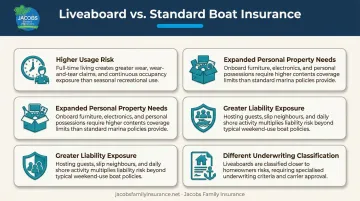
These distinctions show up in how insurers structure their products. Markel's yacht coverage lists "specialized liveaboard coverage" as a distinct category that may include personal liability for people using a yacht as a primary residence. Bluewater Yacht Insurance's quote application asks directly whether the applicant lives aboard year-round, because the answer changes the entire underwriting picture.
If you carry a standard recreational policy and live aboard without disclosing it, you've changed the risk profile from what was underwritten. In a claim scenario, that gap becomes grounds for denial. Always disclose liveaboard status at the time of application — not after something goes wrong.
What Does Liveaboard Boat Insurance Cover?
Most comprehensive liveaboard policies are built from four core coverage types. Recreational boaters often carry only one or two; full-time liveaboards need all four.
Hull Coverage (Physical Damage)
Hull coverage protects the vessel itself from physical damage — collisions, storms, fire, sinking, and vandalism. The key decision here is how your policy values the boat in a total loss:
- Agreed Value — the insurer pays a pre-agreed amount, with no depreciation applied. Per the Insurance Information Institute, partial losses are also replaced new-for-old under agreed value policies.
- Actual Cash Value (ACV) — the payout reflects current market value after depreciation. Lower premiums, but you absorb the depreciation gap.
Agreed Value policies are the stronger choice for liveaboards with upgrades, custom outfitting, or older vessels where ACV has fallen well below replacement cost. On a 20-year-old cruiser, depreciation can widen that gap by tens of thousands of dollars.
Liability / Protection & Indemnity (P&I) Coverage
P&I coverage handles your legal and financial liability if your vessel damages another boat, injures someone, or causes environmental damage such as a fuel spill. Markel's yacht coverage includes wreck removal and pollution liability as part of this protection.
When guests, repair technicians, or contractors regularly come aboard, robust P&I limits aren't optional. A vessel used as a primary residence carries liability exposure that's fundamentally different from a boat used occasionally for fishing.
Personal Property Coverage
Standard recreational boat policies typically cap personal property coverage at modest limits — Progressive lists personal effects coverage up to $10,000. That's inadequate for someone whose entire wardrobe, electronics, tools, and home furnishings are aboard.
Liveaboard-specific policies expand this coverage. If gaps remain after policy limits, a renters insurance policy may supplement personal property protection for belongings not adequately covered under the marine policy.
Medical and Emergency Services Coverage
This covers two distinct needs:
- Medical payments — for injuries sustained aboard by you or guests
- Emergency services — on-water towing, soft un-groundings, fuel delivery, and salvage
Markel and Progressive both include emergency towing to the nearest repair facility as a coverage feature. BoatUS routes emergency services through its TowBoatUS network, providing 24-hour dispatch through a nationwide network of towers and salvors. Anchored in a remote cove or transiting offshore, a breakdown without towing coverage can mean waiting days for help — and paying salvage rates out of pocket.
What Do Insurers Require for Liveaboard Coverage?
Liveaboards face stricter underwriting requirements than recreational boaters. Higher daily usage, greater liability exposure, and the complexity of insuring a primary residence on water all mean insurers look harder before they write the policy. Knowing what's expected before you apply saves time and often results in better rates.
Marine Survey Requirement
Most insurers require a marine survey conducted by a certified member of NAMS (National Association of Marine Surveyors) or SAMS (Society of Accredited Marine Surveyors). The survey covers:
- Structural condition and hull integrity
- Safety and electrical systems
- Rigging (for sailboats)
- Overall seaworthiness
The ABYC confirms that many insurance companies and lenders specifically require NAMS- or SAMS-credentialed surveyors. If you're shopping for a liveaboard policy on a vessel without a recent survey, budget time for this step — getting one completed is required before underwriting can begin.
Sailing and Boating Experience Documentation
Underwriters assess owner competency before writing liveaboard coverage, particularly for offshore situations. Bluewater Yacht Insurance states that 10 years of boating experience is often required, with supporting documentation such as logged miles, USCG Auxiliary training, U.S. Power Squadron courses, or USCG licenses.
Insufficient experience documentation is one of the most common reasons liveaboard applications are declined or restricted — particularly for offshore cruising plans. Putting together a sailing résumé before you apply gives underwriters what they need and keeps your application moving.
Safety Equipment Requirements
The USCG's 2023 federal boating guide recommends additional offshore equipment including:
- EPIRB (Emergency Position Indicating Radio Beacon)
- Inflatable life raft
- Communications gear
- Visual signaling means
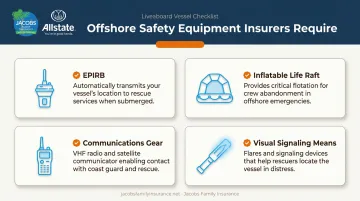
Insurers writing liveaboard and offshore policies look for this equipment — and document it. Photograph your safety gear and keep a current inventory ready as part of your application package.
Cruising Area and Navigation Limits
Every marine policy defines an approved cruising area. Sailing outside those navigational limits can void your coverage mid-voyage.
Bluewater requires applicants to disclose where the vessel will be located from July 1 through November 1 — the core of hurricane season. The insurer offers discounts for vessels outside hurricane zones and requires a Hurricane Preparedness Plan for windstorm coverage in Florida and the Caribbean. Concept Special Risks restricts windstorm coverage in the central Caribbean and Bahamas for new business entirely.
If you're planning offshore or international passages, confirm your policy explicitly covers those waters before you leave the dock.
How Much Does Liveaboard Boat Insurance Cost?
Liveaboard premiums are higher than standard recreational boat policies, but no clean average exists — the coverage is too individualized. The factors below account for most of the price variation you'll see between quotes.
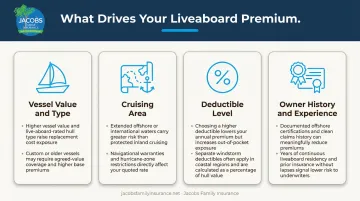
Key Factors That Affect Your Premium
- Vessel value and type: Higher hull values produce higher premiums. Newer boats in documented good condition may qualify for underwriting credits; older vessels with deferred maintenance face higher rates. Vessel type — monohull vs. catamaran, sailboat vs. powerboat — shapes how underwriters assess risk.
- Cruising area: Where you sail matters. Bluewater explicitly discounts vessels that operate outside hurricane zones during storm season. Boats in hurricane-prone coastal areas or international waters pay more than those in protected inland waterways.
- Deductible level: Choosing a higher deductible reduces your annual premium. Named storm deductibles are calculated separately — United Marine Underwriters notes that 5% of hull value is the most common named storm deductible, with 10% applied in some hurricane-prone areas.
- Owner history and experience: Progressive's underwriting requires no watercraft or motor vehicle violations in the past three years. Clean records and documented certifications lower premiums; accidents, DUIs, or thin experience documentation raise them — or result in declined applications.
How to Lower Your Liveaboard Boat Insurance Premiums
A few targeted actions produce real savings:
- Take a recognized safety course. Progressive offers discounts for state-approved boating safety courses, and USCG Auxiliary or U.S. Power Squadron memberships qualify for additional reductions. Certifications also strengthen your underwriting application.
- Upgrade your safety equipment. American Family documents discounts for built-in fire extinguishers. Additions like automatic fire suppression, EPIRB, and AIS transponders reduce your risk profile with underwriters, even when discounts aren't line-itemed on the schedule.
- Bundle policies where it makes sense. Progressive reports an average 5% savings on auto when pairing it with a property policy. Jacobs Family Insurance, an Allstate Elite Agency in Santa Fe, New Mexico, offers boat coverage with bundling options — ask about combining it with your auto or renters policy if you're already with Allstate.
- Shop specialty marine markets. Standard carriers often exclude liveaboards entirely. Insurers like Bluewater Yacht Insurance, Novamar, and Concept Special Risks are built for active cruisers and liveaboards, and they frequently offer broader coverage at competitive rates.
How to Find the Right Liveaboard Insurance Policy
For standard recreational boats, a general insurance agent often suffices. For liveaboards — especially those with offshore cruising plans, older vessels, or non-standard usage — a specialty marine insurance broker who works directly with marine underwriters is usually the more effective path.
Before you shop, prepare:
- A sailing résumé documenting logged miles, certifications, and vessel types operated
- A current maintenance log showing the vessel's condition
- Photographs of all safety equipment
- Your intended cruising area and storm-season plan
When comparing policies:
- Get multiple quotes annually — the liveaboard market is smaller and terms vary more than standard boat insurance
- Be completely transparent about liveaboard status on every application; omitting it is not a cost-cutting tactic — grounds for claim denial
- Understand that deductibles, survey timing, and cruising area limits are often negotiable with documentation
Liveaboard coverage sits in a specialized corner of the marine insurance market, but your broader insurance picture matters too. If you have questions about how a vessel fits alongside your home, auto, or personal property coverage, Jacobs Family Insurance can help you review what you have and identify any gaps. For the marine-specific policy itself, they can help you understand what to look for before you take it to a specialty underwriter.
Frequently Asked Questions
How much is insurance for a liveaboard sailboat?
Liveaboard sailboat insurance costs vary widely based on vessel value, cruising area, coverage level, and owner experience — no single average applies to all situations. Standard recreational boat premiums run $267–$839 annually, but liveaboard policies with broader coverage cost more. See the cost section above for the key variables.
What are the 4 types of insurance coverage for a liveaboard boat?
The four core coverage types are hull (physical damage), liability/Protection & Indemnity, personal property, and medical/emergency services. Most full-time liveaboards need all four for complete protection, since recreational policies typically cover only one or two.
Can I pause my boat insurance in winter?
Some insurers offer lay-up or storage endorsements that reduce premiums during winter months when the vessel isn't in use. United Marine Underwriters confirms the boat remains fully covered during lay-up, subject to policy terms— though operating the vessel during that period voids the endorsement.
Is liveaboard boat insurance required by law?
Most U.S. states don't mandate boat insurance, though Arkansas and Utah are exceptions. However, lenders, marina operators, and some foreign countries require proof of insurance. In practice, coverage is essential regardless of legal requirements.
Does homeowners insurance cover a liveaboard boat?
No. The NAIC confirms that boats of significant size are excluded from homeowners policies for both property and liability. Standard homeowners coverage may apply to very small, low-powered craft only, not a vessel used as a primary residence.
What happens if I don't tell my insurer I live aboard?
Failing to disclose liveaboard status is a material misrepresentation. The insurer may deny claims or cancel the policy entirely when they discover the actual use of the vessel. Always disclose liveaboard status upfront on every application.