Introduction
Picture this: a boat owner on Elephant Butte — New Mexico's largest state park and one of the most active boating destinations in the Southwest — files a total loss claim after a severe storm. They expect a check close to what they paid. Instead, the insurer hands them a settlement thousands of dollars lower, citing depreciation. The policy type they selected at signup made all the difference.
With 26,654 registered recreational vessels in New Mexico according to the U.S. Coast Guard's 2024 Recreational Boating Statistics report, this scenario plays out more often than most boaters expect.
The valuation method written into a boat insurance policy — agreed value or actual cash value — directly determines the payout after a loss. On a single claim, the gap between the two can reach tens of thousands of dollars.
Understanding which method your policy uses — before a loss occurs — can be the difference between full recovery and a painful shortfall. This guide breaks down both options and helps you decide which fits your situation.
Key Takeaways
- Agreed Value locks in a fixed payout at policy start — no depreciation deducted on a total loss claim
- Actual Cash Value (ACV) pays what the boat is worth at the time of loss, after depreciation is applied
- Agreed Value premiums run higher; ACV costs less upfront but can leave a significant gap at claim time
- Boat age, upgrades, and financing status are the three biggest factors in choosing the right policy type
- Both policies handle partial losses differently, not just total losses
Agreed Value vs. Actual Cash Value: Quick Comparison
Here's how the two policy types compare at a glance:
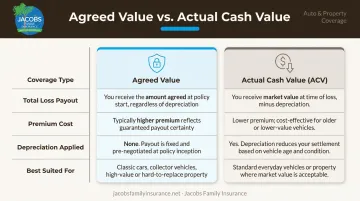
| Category | Agreed Value | Actual Cash Value (ACV) |
|---|---|---|
| Total Loss Payout | Full insured amount set at policy start, no depreciation | Market value at time of loss, after depreciation |
| Premium Cost | Typically higher | Generally lower |
| Depreciation Applied | None on total loss; may apply to high-wear components on partial losses | Applied to both total and partial losses |
| Best Suited For | Newer, financed, or upgraded boats; owners wanting payout certainty | Older boats, paid-off vessels, owners prioritizing premium savings |
What Is Agreed Value Boat Insurance?
BoatUS defines Agreed Hull Value as the amount paid if a boat is lost absolutely or if the cost of repairs exceeds the agreed value. In plain terms: at the start of the policy, the owner and insurer mutually set a fixed dollar amount, and that amount is what gets paid out in a total loss — no negotiation, no depreciation calculation at claim time.
That fixed amount matters because boats depreciate faster than most owners realize. J.D. Power's 2024 boat valuation data puts typical resale depreciation at 10–20% after one year, 20–30% after five years, and 30–40% after ten years. Locking in a value up front protects against that slide — so when something goes wrong two years after purchase, the payout reflects what the owner and insurer agreed the boat was worth, not what the open market says it's worth the day of the claim.
How Partial Losses Work Under Agreed Value
For partial losses, Agreed Value policies generally replace damaged components on a new-for-old basis — meaning a covered part is replaced with a new equivalent, without depreciation being applied. That said, carriers handle this differently on specific high-wear items.
Per BoatUS policy language, even under Agreed Hull Value, the following components are typically settled at actual cash value:
- Sails, canvas, carpeting, cushions, and fabric
- Outboard motors, outdrives, and propulsion machinery
- Generators
BoatUS also applies at least a 20% residual value to those components regardless of age. Chubb similarly notes that high-wear items like sails and trailers may still carry depreciation allowances. Read the policy language carefully — "agreed value" does not automatically mean every component is replaced at full cost.
Setting the Right Agreed Amount
If the agreed value is set too low, the owner is underinsured. Before finalizing coverage, get a current appraisal or reference tools like J.D. Power's boat valuations or the BUC Used Boat Price Guide — both widely used in the industry as market-pricing references. For older or higher-value vessels, some insurers require a marine survey before issuing or renewing a policy.
When Agreed Value Makes the Most Sense
Getting that valuation right also helps clarify whether Agreed Value is the right policy type. It's typically the better fit when any of these apply:
- The boat is under 10–15 years old
- The vessel carries major engine repowers or electronics upgrades
- The boat is financed — lenders often require comprehensive physical damage coverage, though requirements vary, so confirm with your lender
- A payout gap of even 15–20% would create a meaningful financial shortfall
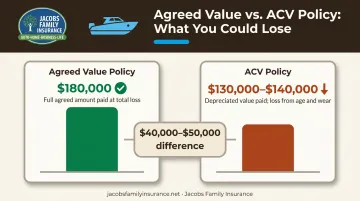
To put numbers to it: a 2020 center console insured for $180,000 under Agreed Value is totaled — the payout is $180,000. Under an ACV policy with depreciation factored in, the same boat might settle for $130,000–$140,000. That's a $40,000–$50,000 gap on a single claim, determined entirely by the policy type chosen at signup.
What Is Actual Cash Value (ACV) Boat Insurance?
BoatUS describes ACV as reimbursement for the boat's current market value at the time of loss — not its replacement value. Depreciation for age, condition, and wear is subtracted before the payout is made. The NAIC similarly defines ACV as the current value of a boat, minus deductible, in the event of a total loss.
In practice, adjusters reference tools like NADA/J.D. Power values or the BUC Used Boat Price Guide to establish market value, though the specific method varies by insurer.
Because ACV is tied to current market conditions rather than a fixed schedule, it can occasionally work in an owner's favor when used boat values rise. Relying on market appreciation as a coverage strategy isn't advisable, though — depreciation is the far more common outcome over time.
ACV policies generally carry lower premiums because the insurer's maximum liability decreases each year as the boat loses value — making them a practical fit for owners of older vessels where significant depreciation has already occurred.
Partial Losses Under ACV
Under ACV, depreciation applies to damaged components based on their age and condition. A five-year-old outboard that needs replacing won't be settled at today's new motor price — it will be paid at its depreciated used value. On high-use components, this difference adds up across multiple claims.
When ACV Makes the Most Sense
ACV is a reasonable choice when:
- The boat is 15–20+ years old
- The vessel has significant cosmetic wear or deferred maintenance
- The boat is paid off with no lender coverage requirements
- Keeping premiums low is the primary concern
ACV is often the default — or only — option available for older vessels. Age cutoffs are insurer-specific rather than an industry standard:
- Markel limits replacement-cost coverage to watercraft up to three years old
- Progressive publishes age and value eligibility caps
- Chubb may require a marine survey before insuring an older vessel
If your boat is on the older side, check what coverage options are available before committing to a policy.
How Each Policy Handles Upgrades
Most boaters focus on total losses, but partial losses make up the bulk of real claims — damaged upholstery, cracked fiberglass, broken electronics, outboard damage. Policy type shapes what gets paid on those everyday claims.
Upgrades add another layer of complexity that's easy to overlook:
Under ACV: If you repower with new engines or install a major electronics package, most ACV policies treat those new components as "used" for claims purposes the moment they're installed — which can reduce your settlement significantly if they're damaged soon after.
Under Agreed Value: The full upgraded value is generally protected — but only if you update your insured amount after the work is done.
The practical rule: after any major upgrade, notify your insurer and update your coverage. Whether you carry ACV or Agreed Value, an insured amount that doesn't reflect recent improvements can leave you covering thousands out of pocket when a claim hits.
Which Type of Boat Insurance Is Right for You?
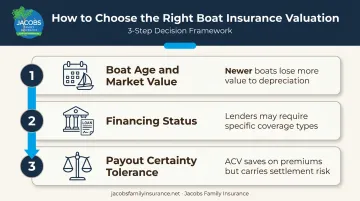
The decision comes down to three factors:
- The boat's age and current market value — newer boats have more to lose from depreciation
- Whether the boat is financed — lenders typically require comprehensive physical damage coverage; confirm the specific valuation requirement with your lender
- Tolerance for payout uncertainty — ACV offers premium savings in exchange for a less predictable settlement
Two New Mexico Scenarios
Scenario A: A Santa Fe-area boater keeps a 2021 ski boat on Cochiti Lake. It's financed, and they've added a new electronics package. Agreed Value makes clear sense — the payout is fixed, the upgrades are protected (provided coverage was updated), and a depreciated settlement would leave a gap between the insurance check and the remaining loan balance.
Scenario B: A boater in the Albuquerque area owns a 20-year-old aluminum fishing boat, paid off, used seasonally on Elephant Butte. The boat has already depreciated significantly. ACV keeps premiums lower, and even a depreciated settlement reflects most of the boat's current market value. The premium savings over several years may well outweigh the reduced payout exposure.
Neither choice is universally better — it depends on the specific vessel, its value, and the owner's financial position.
Getting the Right Guidance for Your Boat
A local agent can pull both options side by side for a specific vessel, factoring in the boat's age, market value, and financing requirements — something a generic online quote tool can't replicate. Jacobs Family Insurance in Santa Fe — an Allstate Elite agency with over a decade serving New Mexico boaters — offers that kind of hands-on review.
Their team can compare valuation options, walk through premium differences, and help boat owners across northern New Mexico find the right fit. Reach them at (505) 557-2067 or stop by 1547 South St. Francis Drive, Santa Fe.
Frequently Asked Questions
What does agreed value mean for boat insurance?
Agreed value means the owner and insurer set a fixed payout amount at the start of the policy. In the event of a total loss, that amount is paid out without any depreciation being deducted — regardless of what the boat's market value is at the time of the claim.
Is it better to insure for market value or agreed value?
For newer, higher-value, or financed boats, agreed value typically provides stronger protection by locking in the payout. For older boats where significant depreciation has already occurred, actual cash value (market value) can be the more cost-effective choice — especially when the owner's primary goal is lower premiums.
How much is boat insurance on a $200,000 boat?
Most boat insurance policies run between 1% and 1.5% of the insured value annually — so a $200,000 boat might cost $2,000–$3,000 per year, depending on valuation method, boat type and age, storage location, and owner experience. For an accurate quote on your specific vessel, contact a local agent who can review your coverage needs directly.
Does agreed value boat insurance cost more than actual cash value?
Yes, agreed value policies typically carry higher premiums because the insurer commits to a fixed payout no matter how the boat's market value shifts over time. For newer or high-value boats, that added cost often reflects significantly stronger protection at claim time.
What happens with partial losses under ACV vs. agreed value?
Under agreed value, partial losses are generally settled on a replacement-cost basis (new parts), though high-wear items like canvas, outboard motors, and generators may still carry depreciation. Under ACV, depreciation is applied to damaged components, which can reduce settlements on engines, upholstery, and electronics.
Do I need agreed value coverage if my boat is financed?
Lenders typically require comprehensive physical damage coverage on financed boats. Whether they require agreed value depends on the lender — confirm the exact requirement before selecting a policy type to avoid a coverage gap.