
This surprise trips up condo owners constantly. Condo insurance, known as an HO-6 policy, works differently than a standard homeowners policy because ownership itself is split. You own the inside of your unit; the association owns (and insures) the shared structure around it.
This guide breaks down what condo insurance actually covers in 2026, where the gaps show up, and how New Mexico condo owners can close them before they become expensive lessons.
Key Takeaways
- HO-6 policies cover belongings, structure, liability, and loss of use — not the exterior or common areas
- Master HOA and individual condo policies must align to avoid coverage gaps
- Loss assessment coverage applies when shared-area claims exceed the HOA's master policy limit
- HOA policy type (all-in, bare walls, or single-entity) determines how much personal coverage you need
What Is Condo Insurance (HO-6) Coverage?
An HO-6 policy is built to protect what's inside your condo unit, not the entire building. Think of it as insurance for your slice of the structure plus everything you own within it.
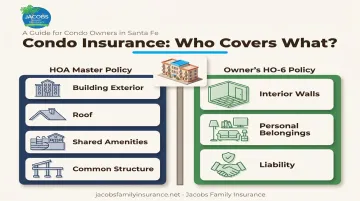
Condo ownership creates a shared responsibility model:
- The HOA or condo association insures common areas, shared amenities, and the building's structure through a master policy
- You, the unit owner, insure your unit's interior, personal belongings, and personal liability through an HO-6 policy
This split matters more than most buyers realize. The New Mexico Office of the Superintendent of Insurance confirms that the association's master policy generally handles common areas, while the unit-owner policy covers personal possessions and liability inside the unit. Confusing the two is a common mistake that can leave real gaps in your coverage.
HO-6 coverage isn't limited to traditional condos. Depending on the insurer, it can also apply to townhomes, rowhomes, and certain subdivision properties that aren't formally classified as condominiums but share similar ownership structures.
Whatever the property type, one trend affects almost every association right now: rising master policy premiums. In an April 2025 survey of over 500 community associations, 93% reported a premium increase at their most recent renewal, with 89% seeing increases the year before.
When master policy costs rise, associations sometimes adjust coverage terms too. It's worth double-checking your HOA's policy annually rather than assuming nothing's changed.
Condo Insurance vs. Homeowners Insurance
The core difference comes down to what's protected:
| Feature | Homeowners Insurance (HO-3) | Condo Insurance (HO-6) |
|---|---|---|
| Structure coverage | Entire building, inside and out | Interior only ("walls in") |
| Exterior/roof | Covered | Covered by HOA master policy |
| Personal belongings | Covered | Covered |
| Liability | Covered | Covered |
| Common areas | N/A (single-family home) | Covered by HOA, not owner |
Even though your HOA carries its own master policy, mortgage lenders typically still require you to carry an HO-6 policy. The association's coverage doesn't automatically protect your lender's interests.
Fannie Mae's current guidance specifically requires a unit-owner policy whenever the master policy doesn't cover the interior or has a per-unit deductible. This isn't just a formality lenders invented.
What Does Condo Insurance Typically Cover in 2026?
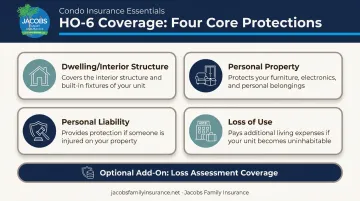
A standard HO-6 policy bundles four main types of protection, plus one crucial optional add-on. Here's how each one functions.
Dwelling/interior structure coverage pays to repair or replace built-in elements damaged by a covered peril, such as fire, windstorm, or water damage. This includes:
- Flooring and cabinets
- Drywall and interior walls
- Built-in fixtures and plumbing/electrical components
- Alterations or upgrades you've made
Personal property coverage protects your belongings, furniture, electronics, and clothing from covered perils like theft, fire, and vandalism. Some insurers combine this with dwelling coverage into a single limit, so check your declarations page to see how it's structured.
Personal liability coverage pays legal and medical costs if you're found responsible for injuring someone or damaging their property, including incidents involving guests or even a neighboring unit (think: your washing machine overflows into the unit below).
Loss of use coverage helps pay for temporary housing and additional living expenses if your unit becomes uninhabitable after a covered loss. This protection matters more than most owners realize.
If a fire or major water damage forces you out for weeks, this coverage covers your hotel costs, even while your mortgage payment still comes due.
Loss Assessment: The Coverage Most Owners Skip
Loss assessment coverage is often an optional add-on, and it's one of the most overlooked protections in condo insurance. It covers your share of a shared-area claim when that claim exceeds the master policy's limit or falls below its deductible.
Here's how it plays out: a fire breaks out in a stairwell and causes $600,000 in damage, but the HOA's master policy only covers $500,000. The association levies a special assessment, dividing the $100,000 shortfall among all unit owners. Without loss assessment coverage, that bill lands directly on you.
Standard HO-6 policies often include modest built-in loss assessment limits, sometimes just $1,000 to $2,000, which won't stretch far in a scenario like this. Increasing this limit is usually inexpensive and worth discussing with your agent.
What Condo Insurance Doesn't Cover
Knowing the exclusions is just as important as knowing what's included. Standard HO-6 policies generally exclude:
- Flood damage — requires a separate flood policy, even in areas that don't seem flood-prone
- Earthquake damage — needs its own endorsement or standalone policy
- General wear and tear — maintenance issues aren't insurable events
- Building exterior, common areas, or association-owned property — this responsibility belongs entirely to the HOA's master policy, not your HO-6
High-value items deserve a closer look, too. Jewelry, fine art, and collectibles often carry sublimits under a standard policy:
- Jewelry: often capped around $2,500 for theft, far short of replacing an engagement ring or family heirloom
- Fine art and collectibles: frequently subject to similar per-item caps regardless of appraised value
- Firearms and antiques: may need separate scheduling to reach full replacement value
If you own valuables above these thresholds, a scheduled endorsement or floater policy fills the gap. Jacobs Family Insurance sets up these endorsements for New Mexico condo owners who need coverage beyond standard limits.
Master Policy vs. Individual Condo Policy: Who Covers What
Your HOA's master policy comes in one of three common structures, and knowing which one your association carries directly determines how much personal coverage you need.
All-In (All-Inclusive) Coverage
This is the most comprehensive master policy type. It covers all property in the development plus original fixtures inside individual units. If a pipe bursts and damages your original bathroom tile, for example, the master policy typically pays for that repair. Under an all-in policy, you mainly need to insure your belongings and any personal upgrades, since the structure itself is largely handled.
Bare Walls Coverage
Bare walls coverage insures only shared areas and association-owned property. Interior walls, built-in fixtures, and finishes inside your unit are excluded entirely. A fire that destroys your kitchen cabinets, for instance, falls solely on your HO-6 policy, not the master policy. Owners under this structure need much higher dwelling coverage limits since almost nothing inside the unit is protected by the HOA.
Single-Entity Coverage
This sits in the middle. Single-entity coverage protects common areas plus original built-in fixtures as the unit was initially constructed, but it does not cover later upgrades or improvements made by the owner. Renovated a kitchen or added custom flooring? That upgrade is your responsibility to insure.
| Coverage type | Master policy covers | You need to cover |
|---|---|---|
| All-in | Structure, common areas, original fixtures | Belongings, upgrades |
| Bare walls | Common areas, exterior only | Interior structure, fixtures, belongings |
| Single-entity | Common areas, original fixtures | Upgrades, improvements, belongings |
Master policies generally cover outdoor spaces, recreational amenities, and common structural elements. Your individual HO-6 policy covers the unit interior, personal belongings, and valuables. But the exact line between the two depends entirely on your HOA's actual policy language, not just the category label.
Before buying or adjusting your condo policy, request a copy of your HOA's master policy declarations page and review it with an insurance agent. This single step prevents both coverage gaps and paying for duplicate protection you don't need.
How Much Condo Insurance Coverage Do You Need?
Coverage limits should start with a real number, not a guess.
Step 1: Build a home inventory. Walk through your unit and estimate the replacement value of your belongings, furniture, electronics, clothing. This figure determines your personal property coverage limit.
Step 2: Understand your cost factors. Several variables affect your 2026 premium:
- Location and local claims history
- Building age and construction type
- Coverage limits chosen
- Deductible amount
Nationally, NerdWallet's 2026 data models the average HO-6 premium using these benchmarks:
| Coverage Component | National Benchmark |
|---|---|
| Dwelling limit | $70,000 |
| Personal property limit | $50,000 |
| Liability limit | $300,000 |
| Average annual premium | $490 |
New Mexico's modeled average runs lower, around $405 per year, though your actual quote depends heavily on your specific unit, building, and HOA structure.
Step 3: Set liability limits based on your assets. Standard liability limits (often $300,000) may not be enough if you have significant savings, equity, or income to protect. Umbrella insurance is worth considering if you need coverage beyond what your HO-6 policy maxes out at.
These three steps cover your personal coverage, but HOA master policy types and coverage requirements vary widely across New Mexico communities, from Santa Fe's historic adobe-style complexes to newer developments in Albuquerque and Rio Rancho.
Jacobs Family Insurance, a local Allstate Elite agency, helps condo owners review their HOA's declarations page and build a personalized policy that closes the gaps. Whether you're buying your first unit or reassessing coverage you've had for years, we'll walk through the details with you.
Call (505) 557-2067 or visit the office at 1547 South St. Francis Drive to get a quote.
Frequently Asked Questions
How does insurance work in a condo?
Condo insurance works alongside your HOA's master policy. The association covers shared structures and common areas, while your HO-6 policy covers personal belongings, interior upgrades, and liability inside your unit.
What is personal liability coverage in condo insurance?
Personal liability coverage pays legal defense costs and damages if you're found responsible for injuring another person or damaging their property inside your unit. This includes incidents involving guests, such as a visitor slipping on a wet floor.
Is condo insurance required by mortgage lenders?
Most lenders require an HO-6 policy as a condition of the loan. HOAs may also mandate minimum coverage even after the mortgage is paid off, since it protects the shared community.
What's the difference between condo insurance and homeowners insurance?
Condo insurance covers only the unit's interior and your belongings, since the HOA insures the exterior structure. Homeowners insurance covers the entire structure, inside and out, because there's no association sharing that responsibility.
Can I bundle condo insurance with other policies?
Yes. Many insurers, including Jacobs Family Insurance, allow bundling condo insurance with auto or life insurance for potential savings and simpler policy management under one agency.
How much does condo insurance typically cost?
Cost varies based on location, coverage limits chosen, and deductible amount. Getting a personalized quote is the most accurate way to know what you'll actually pay.