The stakes are real. In 2024, the average bodily injury liability claim ran $28,278 — already above New Mexico's $25,000 per-person minimum. And with 24.1% of New Mexico motorists uninsured in 2023, compared to 15.4% nationally, the risk of ending up in an accident with no recovery path is genuine.
This guide explains what each coverage type actually includes, what it leaves out, how costs compare in New Mexico, and how to decide which option fits your situation.
Key Takeaways
- Liability insurance is legally required in New Mexico and covers injuries and damage you cause to others — not your own vehicle
- "Full coverage" is not a single policy; it's shorthand for liability plus collision and comprehensive
- New Mexico's modeled average costs: $464/year for minimum liability vs. $2,198/year for full coverage
- Lenders require collision and comprehensive on financed or leased vehicles — dropping to liability-only violates the loan agreement
- Choosing between the two comes down to three factors: your car's current value, whether you carry a loan, and how much out-of-pocket risk you can absorb
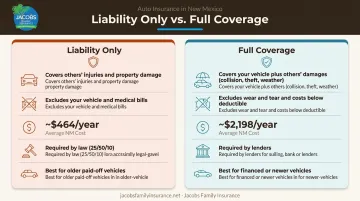
Liability vs. Full Coverage: Quick Comparison
| Category | Liability Only | Full Coverage |
|---|---|---|
| What It Covers | Injuries and property damage you cause to others | Others' damages + your vehicle (collision, theft, hail, wildlife, etc.) |
| What It Excludes | Your vehicle, your medical bills, theft, weather damage | Wear and tear, intentional damage, costs below your deductible |
| Average NM Annual Cost | ~$464 (modeled) | ~$2,198 (modeled) |
| Required by Law | Yes — New Mexico minimum is 25/50/10 | No |
| Required by Lenders | No | Yes — for financed or leased vehicles |
| Best For | Older paid-off vehicles with low market value | Newer or financed/leased vehicles; drivers with limited savings to cover out-of-pocket repairs |
Note: "Full coverage" is not a standardized insurance product. Exact inclusions — deductibles, limits, and optional add-ons — vary by insurer and are shaped by New Mexico regulations.
What Is Liability Car Insurance?
Liability insurance pays for harm you cause to other people. If you're at fault in a crash, your liability coverage handles the other driver's bills — not yours.
There are two components:
- Bodily Injury Liability (BI): Covers the other party's medical bills, lost wages, and legal costs if they sue you
- Property Damage Liability (PD): Covers repairs to their vehicle or other damaged property — another car, a fence, a storefront
New Mexico's Minimum Requirements
New Mexico law requires every driver to carry at least 25/50/10 liability coverage:
- $25,000 per person for bodily injury
- $50,000 per accident for bodily injury
- $10,000 per accident for property damage
The 2024 average bodily injury claim was $28,278 — already above the $25,000 per-person minimum before lost wages or legal fees enter the picture. When costs exceed your limits, you personally owe the difference, which is why carrying higher limits (say, 100/300/50) costs more but protects your savings and wages from a judgment.
What Liability Does NOT Cover
This is where drivers get caught off guard. Liability does not cover:
- Damage to your own vehicle in an at-fault accident
- Your medical bills or your passengers' medical costs
- Vehicle theft
- Hail, flood, fire, or other weather damage to your car
- Accidents caused by uninsured or underinsured drivers
If you total your own car in an at-fault accident and only carry liability, you pay out of pocket to replace it. Without savings to fall back on, that out-of-pocket cost can be financially devastating — which is exactly where full coverage fills the gap.
What Is Full Coverage Car Insurance?
"Full coverage" is not an official policy name. The NAIC is direct about this: there is no such thing as a full coverage auto insurance policy. The term is shorthand for combining liability with two additional coverages : collision and comprehensive.
Collision Coverage
Pays to repair or replace your vehicle after a crash with another car, a guardrail, or in a rollover, regardless of fault. Your lender almost certainly requires this if you're financing.
Comprehensive Coverage
Covers non-collision losses: theft, vandalism, fire, hail, falling objects, and animal strikes. For New Mexico drivers, these aren't remote scenarios. The state recorded 10,408 vehicle thefts in 2024, and drivers face estimated odds of 1 in 292 of hitting an animal in the 2025–26 reporting period. Hail season and wildfire risk across northern New Mexico add further exposure.
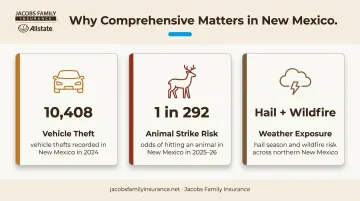
Wildfire damage is a covered comprehensive peril under Jacobs Family Insurance policies, which matters when you live near fire-prone terrain in the Santa Fe region.
Other Coverages Often Bundled In
Your policy may also include:
- Uninsured/Underinsured Motorist (UM/UIM): New Mexico insurers must offer this; drivers can opt out, but given the state's 24.1% uninsured driver rate, declining it is a risk worth considering carefully
- Medical Payments (MedPay): Covers driver and passenger medical expenses after an accident, regardless of fault (optional under New Mexico law)
- Rental Reimbursement: Covers a rental car while your vehicle is being repaired
What Full Coverage Still Doesn't Include
Despite the name, gaps remain:
- Routine maintenance, wear and tear, or mechanical breakdown
- Intentional damage
- Rideshare driving without a specific endorsement
- Costs below your deductible or above your policy limits
- Your medical bills : collision and comprehensive don't cover your injuries. You need MedPay or PIP for that.
Liability vs. Full Coverage: Which One Do You Need?
Liability is the legal floor — every New Mexico driver must carry at least 25/50/10. The real decision is whether to add collision and comprehensive on top.
When Liability-Only May Make Sense
- Your vehicle is older with a low market value
- The annual premium for collision and comprehensive approaches 10% or more of the car's current value — a Consumer Reports guideline suggesting the math may no longer work in your favor
- You have enough savings to replace or repair the vehicle without a payout
For example: if your car is worth $6,000 and adding collision and comprehensive costs $700/year, you're paying roughly 11% of the car's value annually for coverage that would net you $6,000 minus your deductible. The return shrinks fast.
When Full Coverage Is the Better Choice
- You're financing or leasing — your lender requires it, no exceptions
- Your vehicle is newer or high-value, and replacing it out of pocket isn't realistic
- You live or drive in areas with elevated hail, theft, or wildlife risk — all relevant across New Mexico's roads and seasons
- You wouldn't have cash available to cover a total loss
The Lender Requirement — Non-Negotiable
If you carry an active auto loan or lease, your lender contractually requires collision and comprehensive. Dropping to liability-only while still financing the vehicle can trigger force-placed insurance — coverage the lender buys on your behalf, charged to you. It protects only the lender, costs significantly more than coverage you'd buy yourself, and gives you far less in return. Once the loan is paid off, that's the right time to reassess whether full coverage still makes financial sense.

Getting It Right for New Mexico
That reassessment looks different depending on where you live and drive — and the liability-versus-full-coverage decision isn't the same in Santa Fe as it is in suburban Connecticut. Rural highways, hail-prone seasons, elevated uninsured driver rates, and wildfire exposure create a risk profile that's genuinely different here.
The team at Jacobs Family Insurance, an Allstate Elite Agency in Santa Fe, works through exactly these variables with local drivers — vehicle value, current loan status, coverage gaps, and regional risks — to match coverage to the actual situation rather than a generic template. Call them at 505-557-2067 (Monday–Friday, 9 AM–5 PM) or visit the office at 1547 South St. Francis Drive for a no-pressure coverage review.
Conclusion
Neither liability nor full coverage is universally better. The right answer depends on a short checklist:
- Vehicle value — is it worth insuring beyond liability?
- Loan or lease status — if yes, full coverage is required
- Financial cushion — could you absorb a total loss out of pocket?
- Regional risk — hail, wildlife, theft, and wildfire are real factors in New Mexico
New Mexico drivers face conditions that make comprehensive coverage especially worth evaluating. If you're unsure whether your current policy fits, the team at Jacobs Family Insurance can walk you through your options — no call centers, just a neighbor who knows New Mexico roads and what's at stake on them.
Frequently Asked Questions
Is it better to get liability or full coverage?
Neither is the right answer for everyone. Full coverage protects your vehicle from collision, theft, and weather damage — but costs more. Liability-only is cheaper but leaves your car, your medical bills, and weather-related losses uncovered. The right choice depends on your car's value, whether you carry a loan, and how much financial risk you can absorb.
When should I switch from full coverage to liability?
Switching makes sense when your vehicle's value has dropped far enough that the annual cost of collision and comprehensive approaches 10% or more of what you'd actually receive in a claim. Always pay off any auto loan before dropping coverage — lenders require collision and comprehensive as a condition of financing.
What does liability-only insurance cover?
Liability covers bodily injury and property damage you cause to other people in an at-fault accident. It does not cover damage to your own vehicle, your medical expenses, theft, or weather-related losses to your car.
Does full coverage cover at-fault accidents?
Yes — collision coverage pays to repair or replace your vehicle after an at-fault crash, while liability coverage handles the other party's costs. Your own medical expenses are not covered by collision or comprehensive; you need MedPay or PIP for that.
What are New Mexico's minimum car insurance requirements?
New Mexico requires $25,000 per person / $50,000 per accident for bodily injury and $10,000 per accident for property damage (25/50/10). These are legal minimums, not recommended limits — the average bodily injury claim now exceeds $28,000, so higher limits protect you far better.
Is full coverage worth it on an older car?
Start by checking your car's current market value through Kelley Blue Book or a similar tool. If the payout on a total-loss claim wouldn't justify the premium you're paying, liability-only is worth considering — provided you have no outstanding loan on the vehicle.