
Introduction
Rebuild costs are climbing, materials cost more, and wildfire risk in parts of New Mexico keeps expanding. Together, these shifts mean a condo policy that felt right in 2023 could leave you seriously exposed in 2026.
The stakes cut both ways. Too little coverage means paying out of pocket after a fire, burst pipe, or lawsuit. Too much means overpaying on premiums for protection you'll never use.
This guide breaks down exactly how to calculate the right amount of condo insurance for 2026, including factors specific to Santa Fe and northern New Mexico condo owners.
Key Takeaways
- HO-6 insurance fills gaps your HOA's master policy leaves open, so review that policy first.
- A complete policy needs five coverage types: dwelling, personal property, loss of use, liability, and loss assessment.
- 2026 cost trends (inflation, construction costs, wildfire risk) mean older coverage limits are likely too low now.
- A local Allstate agent can pinpoint your number instead of guessing from generic online calculators.
What Is Condo (HO-6) Insurance?
An HO-6 policy covers a condo owner's unit interior, personal belongings, and liability exposure, filling whatever gaps your HOA's master policy doesn't address. It's the piece that connects your homeowners association's building-wide coverage to what's actually inside your four walls.
HO-6 is easy to confuse with other policy types, but each one serves a different kind of owner:
- HO-3 covers an entire single-family home, structure and all, since there's no association master policy sharing the load.
- HO-4 (renters insurance) covers a tenant's belongings and liability only. The landlord insures the building.
- HO-6 sits in between: you own the unit, but a master policy also covers part of the structure.
Because that master policy varies from building to building, understanding its type is the real starting point for figuring out your coverage.
Understanding Your HOA's Master Policy
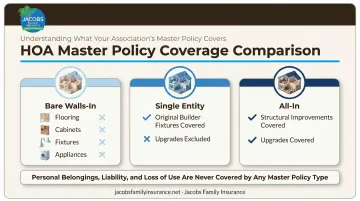
Before you set any limit on your own policy, find out what your association's master policy actually covers. Request a copy of the declaration, bylaws, or current certificate of insurance from your HOA board. Master policies generally fall into three categories.
Bare Walls-In
This is the most limited master policy type. It covers only the building's exterior and structural shell, leaving everything inside your unit boundary to you.
That includes:
- Flooring, cabinets, and countertops
- Built-in fixtures and lighting
- Appliances and plumbing inside the unit
- Any interior walls or wiring
If your HOA uses a bare walls-in policy, your dwelling coverage needs to be higher than average.
Single Entity
One step up from bare walls-in, single entity coverage includes original fixtures and equipment as installed by the builder, but it excludes anything you've upgraded or renovated. If you swapped in granite counters or refinished the kitchen, the master policy likely still treats those additions as your responsibility.
All-In
At the broadest end of the spectrum sits all-in coverage, sometimes called all-inclusive. It typically covers structural improvements and upgrades made by any owner, current or past.
One important limit: all-in policies never cover personal belongings, liability, or loss of use. Those always fall to your individual HO-6 policy, no matter how comprehensive the master policy is.
What a Personal HO-6 Policy Typically Covers
A complete condo policy is built from five coverage types, each addressing a specific gap left by the master policy:
- Dwelling coverage: Interior finishes, fixtures, and improvements the master policy doesn't cover
- Personal property coverage: Furniture, electronics, clothing, and other belongings
- Loss of use coverage: Temporary housing and living costs if your unit becomes uninhabitable
- Personal liability coverage: Legal and medical costs if someone is injured in your unit
- Loss assessment coverage: Your share of an HOA-wide assessment for damage or a deductible
Skip any one of these, and you've got a real gap waiting to surface at the worst possible time.
Benefits of Getting Your Condo Coverage Amount Right
Getting this number right carries real financial consequences, not just paperwork ones.
- Avoids out-of-pocket rebuild costs. Underinsured dwelling coverage means paying the difference yourself if you need to fully restore your interior after a fire or water damage.
- Protects savings and assets. Adequate liability coverage stands between a lawsuit and your bank account, investments, or future earnings.
- Satisfies lender and HOA requirements. Most mortgage lenders and many associations require proof of coverage, and getting the number right the first time avoids scrambling later.
- Prevents overpaying. Coverage sized to your actual exposure, not a generic online estimate, avoids paying for limits you'll never need.
What to Consider When Determining How Much Condo Insurance Coverage You Need in 2026
Condo coverage needs vary wildly based on your master policy type, unit value, personal belongings, and where you live. There's no single "average" number that applies to every owner. The factors below connect your specific situation to a defensible coverage figure.
Your HOA Master Policy Type
Whether your master policy is bare walls, single entity, or all-in directly determines how much dwelling coverage you need on your own policy. A bare walls-in building requires much higher personal dwelling limits than an all-in building.
Before buying or renewing a policy, request the master policy or bylaws from your HOA to confirm which type applies. Don't assume. Two buildings on the same street can have very different master policy structures.
Rebuild Cost of Your Unit's Interior
Dwelling coverage should reflect what it costs to replace your flooring, cabinets, fixtures, and any renovations, not your unit's market or purchase price. Those are two entirely different numbers.
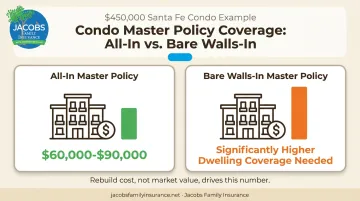
A condo that sold for $450,000 in Santa Fe might only need $60,000 to $90,000 in dwelling coverage if the master policy is all-in, since land and shared structure value aren't part of your interior rebuild cost. If your master policy is bare walls-in, that figure climbs sharply since you're insuring everything inside the unit boundary.
There's no universal per-square-foot number that applies everywhere. Local labor rates, material costs, and the specific finishes in your unit all factor in. This is exactly where a local agent's estimate beats a generic online calculator.
Value of Personal Belongings
Underestimating personal property value is one of the most common coverage gaps condo owners face. A 2023 Triple-I/Munich Re survey found only 47% of homeowners had prepared a possessions inventory, meaning roughly half of owners are guessing at their personal property value.
Walk through your unit room by room. Photograph belongings, note serial numbers, and keep receipts or appraisals where you have them.
High-value items need special attention. Standard policies typically cap jewelry theft coverage around $1,500, far below what a single engagement ring or watch might cost to replace. Items like:
- Fine jewelry
- Art and collectibles
- Firearms
- Antiques
...generally need a scheduled personal property endorsement to be fully protected.
Liability and Asset Protection Needs
Liability limits should scale with what you actually have to lose: savings, investments, home equity, and future income. A guest slipping on a wet floor or a dog bite claim can result in legal costs that exceed a low liability limit fast.
Allstate's guidance places typical condo liability limits between $100,000 and $500,000, but owners with significant assets often need more.
Once you max out your base liability limit, an umbrella policy is worth considering. Insurers generally require at least $300,000 of underlying liability coverage before offering a $1 million umbrella policy, so the two coverages need to be coordinated, not chosen independently.
Loss of Use / Additional Living Expenses
This coverage pays for temporary housing, meals, and related costs if your unit becomes unlivable after a covered loss. Size it around two realities: local rental costs in your area, and how long a genuine rebuild might take.
A quick repair after a burst pipe might take weeks. A total rebuild after a major fire could take many months longer, especially with today's construction timelines. Setting this limit too low means paying the difference yourself right when you're already displaced.
Loss Assessment Coverage
This protects you from personally covering a share of HOA costs when the master policy's deductible is high or a shared loss exceeds master policy limits. Think of it as your slice of a bill the whole building has to pay together.
Most standard HO-6 policies include just $1,000 of loss assessment coverage. That's frequently too low, especially for:
- Older buildings with aging shared systems
- Associations carrying high master policy deductibles
- Larger complexes where a per-unit assessment could still add up quickly
Increasing this limit through an endorsement is inexpensive relative to the exposure it removes.
2026 Cost and Risk Trends
Two forces are pushing recommended coverage limits higher this year.
First, construction costs keep climbing. Residential building material prices excluding energy rose 3.7% year-over-year as of April 2026, according to NAHB's analysis of federal pricing data. A dwelling limit set two or three years ago is almost certainly behind current rebuild costs.
Second, New Mexico's own risk landscape has shifted. New Mexico's Office of the Superintendent of Insurance reported more than 10,000 homeowner nonrenewals by the state's ten largest insurers between January 2021 and July 2024, a trend tied partly to wildfire exposure. The state also recorded 823 wildfires burning over 82,000 acres in 2024 alone.
None of that directly changes your HO-6 rate, but it does affect availability and underwriting scrutiny, which makes accurate, well-documented coverage more important than ever.
How Jacobs Family Insurance Can Help
Figuring out the right number for all five coverage types isn't something most owners want to calculate alone, and you shouldn't have to.
Jacobs Family Insurance has been helping Santa Fe and northern New Mexico condo owners find the right coverage for more than 10 years.
As a local, family-owned Allstate Elite Agency, the team reviews your HOA's master policy, your unit's value, and your personal risk factors before recommending a number. That's a more thorough approach than handing you a generic estimate pulled from an online tool.
What sets the agency apart:
- Allstate Elite Agency status, backed by nationally competitive pricing
- Family-owned and operated, with a decade-plus of local relationships
- Personalized, neighborly service, not a call center reading from a script
- Coverage across New Mexico, including Santa Fe, Albuquerque, Los Alamos, and Taos
If you're unsure whether your current policy matches your HOA's master policy type, reach out to Jacobs Family Insurance for a free condo coverage review.

Conclusion
Match your condo policy to your master policy gaps, your belongings, and your liability exposure, not to whichever plan has the lowest price tag. Aim for coverage that's exact: no more, no less.
That number isn't fixed forever, either. Renovations, new belongings, and changes to your HOA's master policy all shift what you need. Factor in 2026's construction cost inflation, and an annual coverage check becomes especially worthwhile.
Ready for a personalized condo coverage review? Contact Jacobs Family Insurance at (505) 557-2067 or visit the office at 1547 South St. Francis Drive, Santa Fe, NM 87505.
Frequently Asked Questions
What is the average condo insurance in Florida?
Florida's average HO-6 costs vary widely by county, ranging from roughly $683 to $3,474 annually including wind coverage, according to state insurance rate filings. Costs like this run far higher than New Mexico's more moderate rates, largely due to hurricane and storm exposure.
How much dwelling coverage do I need for a condo?
It depends on your master policy type and your unit's interior value, not its market price. A common guideline is insuring around 20% of the unit's value when the master policy is all-in, though bare walls master policies require significantly more.
What's the difference between an HO-3 and HO-6 policy?
HO-3 covers an entire single-family home, structure included. HO-6 covers only a condo owner's unit interior, belongings, and liability, since the HOA's master policy handles the building itself.
Does condo insurance cover water damage?
Sudden, accidental water damage like a burst pipe is typically covered under a standard HO-6 policy. Sewer backups and flooding are usually excluded and require separate endorsements or a flood policy.
Is condo insurance required in New Mexico?
Lenders financing a condo purchase typically require an HO-6 policy, and many HOAs mandate coverage even for owners who own their unit outright. Check your loan documents and HOA bylaws to confirm your specific requirement.
How often should I update my condo insurance coverage?
Review your policy annually at minimum, plus any time you renovate, make a major purchase, or your HOA changes its master policy. Rebuild costs and belongings change faster than most owners realize.