
Here's the problem many renters don't realize until it's too late: your landlord's insurance policy protects the building, not your stuff. If a pipe bursts and ruins your furniture, or a fire forces you out for three weeks, that policy won't cover a dime of your losses.
Roughly 45% of U.S. renter households still go without coverage, according to a 2025 Harvard Joint Center for Housing Studies analysis. This guide breaks down what renters insurance actually covers in 2026, the new considerations shaping policies this year, what's still excluded, what it costs, and what New Mexico renters specifically need to know.
Key Takeaways
- Renters insurance covers personal property, liability, guest injuries, and temporary housing costs
- Standard exclusions include structural damage, floods, earthquakes, and pest infestations
- 2026 brings inflation-adjusted property limits, cyber/identity theft add-ons, and home-office equipment coverage
- New Mexico renters face wildfire smoke, monsoon flood risks, and lease-based coverage requirements
What Does Renters Insurance Cover in 2026?
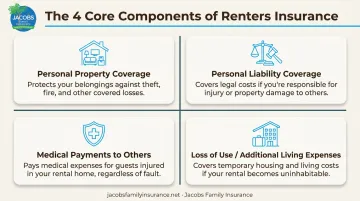
A standard renters policy (often called an HO-4) bundles four protections into one affordable package. Here's how each one works.
Personal Property Coverage
This is the coverage most people think of first. It pays to repair or replace your belongings, furniture, electronics, clothing, kitchenware, when they're damaged by a covered peril like fire, theft, or vandalism.
Here's a scenario worth knowing: if someone breaks into your car and steals your laptop, your renters policy can still cover that loss, even though it happened away from your apartment. Coverage typically extends off-premises, though often at a reduced sublimit.
A policy with $25,000 in personal property coverage might cap off-premises theft at around $2,500, according to the Insurance Information Institute. Always check your specific policy for the exact percentage.
Personal Liability Coverage
Liability coverage steps in if you're found legally responsible for injuring someone or damaging their property. Say a guest trips over a rug in your living room and decides to sue. Your policy pays for legal defense costs and any settlement, up to your coverage limit.
Insurers commonly offer liability in tiers:
- $100,000 – often the baseline starting limit
- $300,000 – a popular mid-tier choice for renters with more assets to protect
- $500,000 – recommended for higher net-worth renters or those who host frequently
Jacobs Family Insurance's standard renters policies start liability coverage at $100,000, with the option to raise that limit through an endorsement based on your personal risk profile.
Medical Payments to Others
This one's simple: if a guest gets hurt at your rental, medical payments coverage pays their bills regardless of who's at fault. Picture a friend slipping on a wet kitchen floor and needing a trip to urgent care. This coverage typically ranges from $1,000 to $5,000 per incident and kicks in without the drawn-out fault determination that liability claims require.
Because it applies no matter who caused the accident, this coverage often resolves small claims faster than a liability dispute would. It's a practical safety net for minor injuries that don't warrant a full lawsuit.
Loss of Use and Additional Living Expenses
If a covered loss, like a kitchen fire, makes your apartment unlivable, this coverage pays for temporary housing, hotel stays, and extra food costs while repairs happen. It's the difference between absorbing thousands in unexpected expenses and simply filing a claim.
Most policies cap this benefit at a percentage of your personal property limit, often 20-30%. A $30,000 policy might provide $6,000 to $9,000 for displacement costs, though your declarations page will list the exact figure.
Optional add-ons gaining traction in 2026 include:
- Water backup coverage for sewer or drain overflow
- Identity theft and cyber-fraud protection
- Scheduled coverage for high-value items like jewelry or specialty electronics
New Renters Insurance Considerations for 2026
A few shifts are reshaping how renters should think about coverage this year.
Replacement costs keep climbing. The cost of household furnishings and operations rose 2.5% year-over-year as of June 2026, according to Bureau of Labor Statistics data. That means the $20,000 in property coverage that felt adequate two years ago might come up short today. Revisit your limits annually rather than setting them once and forgetting them.
Climate-related perils remain typically covered, but confirm your policy wording. Wildfire smoke, soot, and ash damage are generally included under standard fire peril coverage, according to the National Association of Insurance Commissioners. That's good news, but "typically covered" isn't the same as "automatically covered" on every policy. Confirm the specifics with your agent.
Identity theft add-ons are becoming more visible, if not yet universal. More renters manage banking, shopping, and bill pay entirely online, which widens the door for scams and data breaches.
Product availability has grown; some carriers now offer cyber protection endorsements for as little as $25 a year. Adoption still lags awareness, though, so this is a coverage gap worth closing proactively.
Remote work exposes a common blind spot. Standard renters policies often cap business-property coverage around $2,500. If your home office includes multiple monitors, a standing desk setup, and specialized equipment, that sublimit won't stretch far. If you run a home-based business, ask about scheduling equipment separately.
Tech-heavy households need a second look at electronics coverage. Smart speakers, gaming consoles, multiple monitors, and connected devices add up fast. Rather than guessing at a scheduling threshold, build an inventory and compare it against your policy's sublimits for electronics.
What Renters Insurance Doesn't Cover
Knowing the boundaries of your policy matters just as much as knowing what's included.
| Excluded Item | Why It's Excluded |
|---|---|
| Structural damage (roof, walls, foundation) | The landlord's building policy covers the structure itself |
| Flood damage | Requires separate flood insurance, such as an NFIP contents policy |
| Earthquake damage | Needs a standalone earthquake endorsement or policy |
| Pest infestations | Classified as a maintenance issue, not a sudden loss |
| Intentional tenant damage | Deliberate damage isn't a covered peril, since insurance only protects against accidental losses |
A few of these deserve extra context. Flood coverage is a common point of confusion, since renters assume their landlord's policy protects their belongings too. It doesn't. The National Flood Insurance Program offers contents-only flood policies specifically for tenants, and they're worth considering if you're in a flood-prone area.
Landslides and mudslides follow the same pattern as earthquakes: excluded by default, available as an add-on where insurers offer one.
How Much Coverage Do You Need & What It Costs in 2026
Renters insurance remains one of the most affordable protections you can buy.
National average cost in 2026 is roughly $151 per year, or about $13 a month, based on modeled quotes for a typical two-bedroom apartment renter. New Mexico's average runs slightly higher, at approximately $168 per year, or $14 a month, according to NerdWallet's 2026 rate analysis.
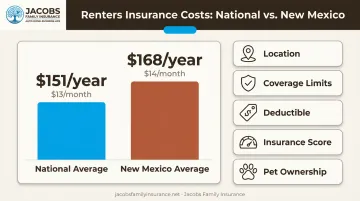
Several factors move that price up or down:
- Location – regional risk and local claim frequency
- Coverage limits – higher property and liability limits raise premiums
- Deductible – a higher deductible typically lowers your monthly cost
- Insurance score – renters with lower credit-based scores can pay up to 71% more, per NerdWallet's analysis
- Pet ownership – certain animals may increase liability premiums
Two of those factors—your coverage limits—are worth getting right from the start, since they shape both your premium and your protection. **Figuring out your property coverage limit** starts with a home inventory. Walk through each room, photograph your belongings, and note approximate replacement values. Categorize by room or item type: electronics, furniture, clothing, kitchen items. This exercise turns guesswork into a defensible number, and it speeds up any future claim.
Choosing your liability limit comes down to a simple question: what do you stand to lose in a lawsuit? Renters with higher net worth, frequent guests, or dogs typically choose $300,000 or $500,000 over the $100,000 baseline. Moving up a tier costs relatively little, and that cushion matters once a claim gets serious.
Renters Insurance in New Mexico: What Local Renters Should Know
New Mexico doesn't require renters insurance by state law. That said, more landlords across Santa Fe, Albuquerque, and Northern New Mexico are adding it as a lease condition. It's an easy requirement to meet, and it protects both sides: tenants keep their belongings covered, and landlords reduce disputes over liability.
Local risk factors worth flagging:
- Wildfire smoke and ash – New Mexico sees regular wildfire and prescribed-fire activity, and smoke can travel across wide areas. The New Mexico Environment Department tracks air quality impacts from these events regularly.
- Monsoon-season flooding – Monsoon season runs June 15 through September 30, bringing flash floods and burn-scar flooding near past wildfire areas. Standard renters policies exclude flood damage, so ask about separate flood coverage if you're in a flood-prone zone.
This is where local guidance beats a generic call center. Jacobs Family Insurance, a family-owned Allstate Elite Agency based in Santa Fe, has spent more than a decade helping renters throughout Santa Fe and Northern New Mexico. The agency matches coverage to actual local risks, not a one-size-fits-all template.
The agency offers free personal-property inventory guidance and competitive pricing, with real conversations instead of automated phone trees. If you're renting anywhere from Taos to Las Cruces and want a policy that fits your specific situation, reach out for a no-obligation quote.

Frequently Asked Questions
What does renters insurance cover?
Renters insurance covers four main areas: personal property (your belongings), personal liability (injury or damage claims against you), medical payments to guests, and loss of use (temporary housing costs if you're displaced).
Can I add my girlfriend to my renters insurance?
Most insurers let you add a live-in partner as a named insured, though this may adjust your coverage limits. Confirm the details with your agent, since requirements vary by carrier.
Is renters insurance required by landlords in New Mexico?
New Mexico doesn't legally mandate renters insurance statewide. Many individual landlords, however, require it as a condition of the lease, particularly in Santa Fe and other growing rental markets.
How much does renters insurance typically cost in 2026?
New Mexico renters pay around $168 per year (about $14 a month) on average, compared to the national average of roughly $151. Your actual cost depends on location, coverage limits, deductible, and credit score.
Does renters insurance cover my belongings if they're stolen from my car?
Generally, yes. Personal property coverage typically extends off-premises, including theft from a vehicle, though usually subject to a reduced sublimit. Check your policy for the exact off-premises percentage.
Does renters insurance cover pet damage or dog bites?
Liability coverage can address a guest's dog-bite injury, up to your policy's limit, commonly $100,000 to $300,000. Some insurers restrict certain breeds, so confirm your dog's eligibility with your agent.