The real question is whether you're financially protected when one of those moments involves your boat.
This guide covers everything New Mexico boaters need to know: what a standard policy actually covers, which optional add-ons are worth considering, what's excluded, how insurers price policies, and why your homeowners insurance almost certainly isn't enough.
Key Takeaways
- Standard boat insurance covers physical damage, liability, medical payments, and uninsured boater protection
- Boat insurance is not legally required in New Mexico, but marinas and lenders typically mandate it
- Agreed Value policies pay the full insured amount at total loss; Actual Cash Value deducts for depreciation
- Most recreational vessel owners pay under $500 annually — less than many expect
- Homeowners insurance caps boat coverage at roughly $1,000 — far too little for most watercraft
What Does Boat Insurance Cover?
A standard boat policy has two core sections: physical damage coverage (protecting your boat) and liability coverage (protecting you financially when others are hurt or their property is damaged). Most policies bundle several additional protections on top of those two pillars.
Liability Coverage
Liability coverage pays for bodily injury or property damage you cause to others while operating your boat — swimmers, other boaters, dock owners, marina operators. If you swing wide on Elephant Butte Lake and clip a dock, liability coverage handles the repair bill and any legal expenses, up to your selected policy limits.
It typically also covers:
- Fuel spill remediation costs
- Wreck removal if your vessel sinks and must be cleared
- Legal defense if someone sues after an incident
Because boat liability insurance isn't legally required in New Mexico, plenty of boaters on the water carry nothing. That reality makes your own liability limits worth thinking carefully about.
Physical Damage Coverage (Hull, Motor, and Equipment)
Physical damage coverage — sometimes called hull coverage — pays for accidental loss or damage to your boat, motor, trailer, furnishings, and permanently attached equipment. Common covered perils include:
- Collision with submerged objects, other boats, or docks
- Weather events: lightning, hail, windstorms
- Theft and vandalism
- Capsizing or sinking
- Fire
Coverage applies both on the water and while you're trailering to and from the launch ramp — which matters for New Mexico boaters who haul long distances to reach state reservoirs.
Medical Payments Coverage
Medical payments (MedPay) covers medical bills for you and your passengers injured in a covered boating accident, regardless of fault. Key features:
Medical payments (MedPay) covers medical bills for you and your passengers injured in a covered boating accident, regardless of fault. Key features:
- Pays out without a fault determination — useful when someone slips boarding the boat
- Typically carries no deductible
- Can apply alongside your health insurance when bills are significant
Uninsured/Underinsured Boater Coverage
If an uninsured boater hits you and injures your passengers, this coverage compensates for losses you'd otherwise absorb out of pocket.
New Mexico doesn't require boat insurance by law, so a meaningful share of vessels on state waterways carry no coverage. That gap makes this protection genuinely worth adding — especially on busy summer weekends at Elephant Butte or Cochiti Lake.
Optional Add-On Coverages Worth Considering
Standard policies handle the essentials. These add-ons fill specific gaps that matter most to active boaters.
On-Water Towing and Emergency Assistance
On-water towing coverage pays for towing, fuel delivery, jump-starts, and soft un-groundings if your boat becomes disabled on the water. This is distinct from roadside assistance — it only applies while you're afloat. On New Mexico's more remote reservoirs, commercial tow services can be scarce — making this coverage especially practical for boaters who venture beyond popular launch areas.
Fishing Equipment and Personal Property Coverage
Most base policies exclude fishing gear and personal belongings outright. This optional coverage protects items lost, stolen, or damaged while aboard, including:
- Rods, reels, and tackle
- Clothing and marine binoculars
- Scuba and dive equipment
Coverage limits vary by insurer — Nationwide, for example, offers packages with up to $10,000 for fishing equipment and $5,000 for personal effects.
Mechanical Breakdown Coverage
Physical damage coverage is designed for sudden, accidental losses — not engine failures from internal wear. Mechanical breakdown coverage (Progressive offers this as "Propulsion Plus") fills that gap by covering failures of the upper and/or lower drive units, including certain wear-and-tear situations. For owners of older vessels or high-use motors, the premium is typically modest relative to what a drive unit replacement actually costs.
Ice/Freeze and Seasonal Storage Coverage
Ice and freeze damage is typically excluded from standard policies unless you add an endorsement — and even then, many insurers require professional winterization as a condition. If you store your boat through winter, review your policy's lay-up terms with your agent before October — before temperatures drop and exclusions kick in.
What Boat Insurance Does NOT Cover
Understanding exclusions is just as important as knowing what's covered. Boat insurance is designed for sudden, accidental losses — not gradual deterioration.
Standard exclusions across most policies:
- Normal wear and tear
- Mold, rot, or insect damage
- Animal damage (including zebra mussels)
- Gradual weathering or oxidation
- Defective machinery that fails from poor maintenance
- Damage caused by the owner's negligence in maintaining the vessel
Most policies also exclude losses tied to how — and where — you use the boat:
- Commercial use — renting or chartering your boat requires a separate commercial policy
- Racing — competitive events need their own specialized coverage
- Navigation outside your policy's territory — venturing outside your policy's agreed waters can void your claim entirely
If you're unsure whether a planned use is covered, call your agent before the trip — it's a lot easier than disputing a denied claim afterward. Then review your full policy so there are no surprises on the water.
Agreed Value vs. Actual Cash Value: What's the Difference?
This distinction has more financial impact than almost any other choice you'll make when buying boat insurance.
Agreed Value: The policy specifies a predetermined payout amount. If your boat is totaled, you receive that amount — no depreciation deducted. Partial losses are also settled at replacement cost.
Actual Cash Value (ACV): The insurer pays the current market value of the boat at the time of loss, factoring in depreciation. A three-year-old boat insured for $30,000 under an ACV policy might pay out considerably less than $30,000, depending on how steeply that model has depreciated.
| Agreed Value | Actual Cash Value | |
|---|---|---|
| Total loss payout | Full insured amount | Depreciated market value |
| Depreciation deducted? | No | Yes |
| Premium cost | Higher | Lower |
| Best for | Newer, higher-value boats | Older boats with lower market value |
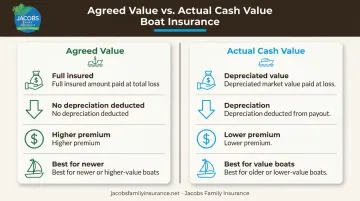
The right choice comes down to your boat's age, its current market value, and the premium difference between the two options. Before you sign, confirm which settlement method your policy uses. If the math isn't clear, the team at Jacobs Family Insurance can compare both options for your specific situation and help you decide what makes sense.
How Much Does Boat Insurance Cost?
Boat insurance is often more affordable than first-time buyers expect. According to Bankrate, boat insurance typically runs about 1.5% of the boat's value annually — meaning a $20,000 boat would cost roughly $300 per year to insure. Progressive's own data shows annual policy costs ranging from $267 in lower-risk states to $839 in Florida, where coastal exposure drives prices up sharply.
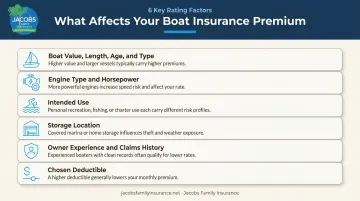
What Affects Your Premium
- Boat value, length, age, and type — larger or more powerful vessels cost more to insure
- Engine type and horsepower — high-performance motors raise rates
- Intended use — recreational vs. fishing vs. watersports
- Storage location — marina slip vs. garage vs. covered storage
- Owner's boating experience and claims history
- Chosen deductible — higher deductibles reduce premiums
Navigational Territory
Policies covering a limited inland area typically cost less than those with broad coastal or offshore coverage. New Mexico boaters who stay on state reservoirs year-round can control costs by selecting a territory that matches their actual patterns, rather than paying for Gulf Coast or oceanic coverage they'll never use.
Discounts Worth Asking About
- Completing a certified boating safety course — the Insurance Information Institute lists this as one of the most common discount triggers
- Bundling with an existing auto or homeowners policy
- Multi-year claims-free record
- Insuring multiple watercraft
- Installing fire suppression systems or anti-theft devices
Jacobs Family Insurance is a local Allstate Elite Agency serving Santa Fe and northern New Mexico. Their agents know New Mexico's waterways and can walk you through coverage options in plain language — no call centers, no hold music, just a neighbor who understands your situation.
Does Homeowners Insurance Cover Your Boat?
Most homeowners policies cover boats — but only barely, and rarely enough to matter.
Most standard homeowners policies (the widely used HO-3 form) cap watercraft coverage at $1,000 — including the boat, motor, trailer, and equipment combined. Since many homeowners deductibles are $1,000 or higher, filing a claim often isn't even practical. You'd pay the deductible and receive nothing.
Beyond that dollar cap, homeowners policies impose additional restrictions:
- Sailboats over 26 feet are typically excluded by size
- Engines above roughly 25–50 horsepower may be excluded depending on the policy
- Liability coverage does not extend to boat-related incidents unless specifically endorsed
- Jet skis and similar personal watercraft are excluded entirely
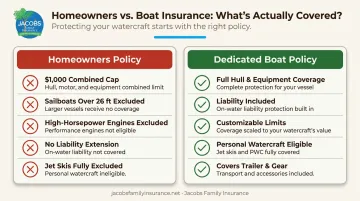
If your boat is worth more than a few thousand dollars, stored at a marina (which typically requires proof of liability coverage for docking), or financed (lenders require comprehensive and collision coverage), a dedicated boat insurance policy is the only way to be properly protected.
Frequently Asked Questions
What does boat insurance usually cover?
A standard policy typically covers physical damage to the hull, motor, and equipment; liability for injuries or property damage caused to others; medical payments for onboard passengers; and uninsured boater protection. Optional add-ons are available for towing, fishing equipment, and mechanical breakdown.
How much is boat insurance for a $30,000 boat?
Using the common industry benchmark of roughly 1.5% of boat value, a $30,000 boat typically runs $400–$500 per year. The actual figure varies based on the boat's age and type, your storage location, experience level, and chosen coverages. Jacobs Family Insurance can provide a precise quote for your specific situation in New Mexico.
Is boat insurance required in New Mexico?
New Mexico does not legally mandate boat insurance for most recreational vessels. However, marinas typically require proof of liability coverage for docking, and lenders require comprehensive and collision coverage for financed boats — making a dedicated policy a practical necessity for most boat owners.
Does my homeowners insurance cover my boat?
Homeowners insurance offers very limited coverage — typically capped at around $1,000 for the boat, motor, trailer, and equipment combined — with restrictions on size, horsepower, and use. A dedicated boat policy is strongly recommended for any vessel worth more than a few thousand dollars.
What is the difference between agreed value and actual cash value boat insurance?
Agreed value pays the predetermined insured amount at total loss with no depreciation deducted. Actual cash value pays the current depreciated market value at the time of loss. Agreed value provides stronger protection; ACV typically costs less in premium. The right choice depends on your boat's age and current market value.