
Figuring out the right amount of interior coverage isn't as simple as picking a number. It depends on your HOA's master policy type, what you've done to the unit since you bought it, and what your lender requires. This article walks through exactly how that calculation works for condo owners in New Mexico.
Key Takeaways
- Condo dwelling coverage (often called building property coverage) protects your unit's interior — not the exterior, which is the HOA's job
- Your HOA's master policy type (all-in, single-entity, or bare walls-in) determines how much interior coverage you need
- Calculate coverage by estimating interior restoration costs or multiplying square footage by local rebuild cost per square foot
- Lender minimums and any interior upgrades you've made must both factor into your final coverage amount
- Choose replacement cost value (RCV) over actual cash value (ACV) — lenders require it for most financed condos
What Is Dwelling Coverage for a Condo?
On a standard condo policy (the HO-6 form), the structural section is called Coverage A — Dwelling by the ISO policy form, though carriers like State Farm and others often label it "building property coverage" or "building property protection." The terminology varies, but the coverage refers to the same thing: the interior structural elements of your unit that you're responsible for insuring.
What that typically includes:
- Flooring, carpet, and hardwood
- Drywall and interior walls
- Cabinetry and countertops
- Fixtures, doors, and installed equipment
- Built-in appliances
This differs from a standard homeowners policy, which covers the entire structure. Your HO-6 only fills the gap left by the HOA's master policy. That's why reading the master policy document is the essential first step before buying coverage.
One important clarification: personal property coverage on a condo policy is not calculated as a percentage of your building property coverage. The ISO form treats personal belongings under a separate Coverage C, with its own limit that you estimate independently using a home inventory. Don't conflate the two.
How Much Dwelling Coverage Do You Need for a Condo?
The right coverage amount scales directly with what your HOA's master policy already covers. There's no universal figure: a condo owner under an all-in master policy needs far less individual building property coverage than one under a bare walls policy.
| HOA Policy Type | What the Association Covers | Your Coverage Responsibility |
|---|---|---|
| All-In | Building exterior + original interior finishes | Upgrades, improvements, per-unit deductible |
| Single-Entity | Building exterior + original unit fixtures | Owner-made improvements and betterments |
| Bare Walls-In | Building shell only | All interior finishes, fixtures, and appliances |
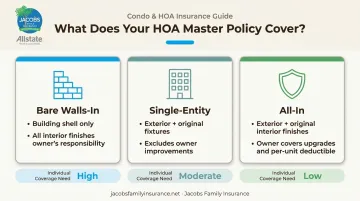
All-In (All-Inclusive) HOA Policy
Under an all-in policy, the association covers both the building exterior and interior unit fixtures — including original finishes, built-in appliances, and interior surfaces. You still need some building property coverage for:
- Upgrades or improvements you made after purchase (the master policy covers original finishes, not your renovations)
- Any per-unit deductible the master policy carries
- Items specifically excluded in the association's declarations
Single-Entity HOA Policy
A single-entity policy covers original real property throughout the building, including original unit fixtures — but it excludes owner-made improvements, betterments, and additions. If you replaced builder-grade carpet with hardwood floors or installed a custom kitchen backsplash, the association's policy won't touch those.
Owners under single-entity policies need moderate building property coverage to account for any changes they've made to the unit's original condition.
Bare Walls-In HOA Policy
This is the scenario requiring the most individual coverage. A bare walls policy restores the unit only to shell condition: raw walls, floors, and ceilings ready to be finished. Everything inside is your responsibility:
- Flooring
- Cabinetry and countertops
- Plumbing fixtures
- Built-in appliances
- Interior wall coverings and finishes
Underestimating coverage here is where the financial exposure is highest. If you're not sure which type your HOA carries, request the master policy documents from your association before setting any coverage limits.
Lender note: Your mortgage lender may set a minimum building property coverage requirement regardless of HOA policy type. Under updated Fannie Mae and Freddie Mac guidelines effective July 1, 2026, the minimum equals the greater of the interior restoration cost omitted by the master policy or the master policy's per-unit deductible — on a replacement cost basis.
Key Factors That Determine Your Coverage Amount
Five factors drive how much building property coverage you actually need — and getting any one of them wrong can leave a costly gap.
Type of HOA Master Policy
This is the single most influential factor. The master policy type determines your baseline exposure, meaning how much of the interior you're personally responsible for covering. Request and read the association's master policy declarations before purchasing individual coverage. Don't rely on what a neighbor tells you or what a listing description says.
Interior Upgrades and Improvements
Any improvements you've made since purchase add to your rebuild cost and must be included in your coverage calculation, regardless of which HOA policy type applies. Common examples that increase your rebuild exposure:
- Hardwood or tile floors replacing original carpet
- Custom cabinetry or kitchen remodels
- High-end bathroom fixtures
- Upgraded appliances
If you've invested $30,000 in a kitchen renovation, that cost needs to be reflected in your coverage limit.
Mortgage Lender Requirements
Lenders have a financial interest in the property and typically require a minimum level of dwelling coverage. The current Fannie Mae and Freddie Mac standard focuses on the cost to restore whatever the master policy doesn't cover, plus any per-unit deductible — and it must be written on a replacement cost basis. Confirm your lender's specific requirement and clarify whether their calculation assumes a bare walls or all-in master policy.
Local Rebuild Costs in New Mexico
Construction costs per square foot vary by region and shift with labor availability, material prices, and post-disaster demand. New Mexico has faced documented workforce shortages: a 2024 New Mexico Legislative Finance Committee report identified the state needing at least 2,000 additional construction workers in 2023, a gap that pushes labor costs upward.
Santa Fe's construction market runs higher than most of the state. Work with a local agent or licensed contractor for realistic interior rebuild cost estimates specific to your area, since national averages won't capture these regional differences.
Replacement Cost vs. Actual Cash Value
- Replacement cost value (RCV): Pays to rebuild or repair with like kind and quality, no depreciation deducted
- Actual cash value (ACV): Reduces the payout for age, wear, and depreciation
For condo building property coverage, RCV is strongly preferred. It's also required under current Fannie Mae and Freddie Mac rules when their individual policy requirements apply. An ACV policy on flooring or cabinetry can leave a significant out-of-pocket gap because depreciation on those materials adds up quickly.
How to Calculate Your Condo Dwelling Coverage
Before running any numbers, get a copy of the HOA's master policy and identify its type. That document determines your scope. Without it, any calculation is guesswork.
Method 1: Interior Restoration Cost (Current Lender Standard)
The current Fannie Mae and Freddie Mac formula works like this:
Coverage A minimum = the greater of:
- The replacement cost of interior elements and improvements not covered by the master policy
- The master policy's per-unit deductible
This approach focuses your coverage precisely on your actual exposure — not a rough percentage. To use it, you need to know what the master policy covers (hence reading the declarations) and what it would cost to restore everything it doesn't cover.
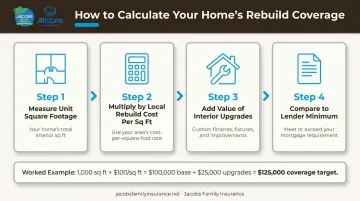
Method 2: Square Footage × Local Rebuild Cost Per Square Foot
This method works well as a cross-check:
- Determine your unit's interior square footage
- Find the current interior rebuild cost per square foot for your area
- Multiply the two figures
- Add the value of any upgrades on top
Example: A 1,000 sq ft condo with interior rebuild costs of $100/sq ft for standard finishes yields a $100,000 base estimate. If you've done $25,000 in kitchen upgrades, your target coverage amount is closer to $125,000.
This calculation covers interior rebuild only. The building exterior is the HOA's responsibility. Use regional figures rather than national averages, and consult a local contractor or your insurance agent for current cost data specific to New Mexico.
Keep Coverage Current and Account for Upgrades
Review your coverage at least once a year. Labor and material costs shift, and any of the following should trigger an immediate policy review:
- Kitchen remodel or appliance upgrades
- New flooring throughout the unit
- Bathroom renovation or fixture replacement
- Any structural interior improvement
Failing to update after a significant renovation is one of the most common ways condo owners end up underinsured.
A knowledgeable local agent can request and interpret the HOA master policy, apply current regional rebuild costs, and catch gaps before they surface at claim time. Jacobs Family Insurance, an Allstate Elite Agency serving Santa Fe and greater New Mexico, offers personalized HO-6 guidance and free coverage reviews with no commitment required.
Common Mistakes Condo Owners Make With Dwelling Coverage
Three mistakes consistently lead condo owners to discover they're underinsured — usually at the worst possible moment.
- Assuming the HOA covers everything. Many owners don't read the master policy until a claim reveals they were under a bare walls arrangement. The association's obligations are defined by the declarations, not by assumptions.
- Using market value instead of rebuild cost. Market value reflects land and real estate trends — neither of which matters when you're reconstructing interior finishes. In a market like Santa Fe, where construction costs run high, this substitution routinely produces the wrong coverage number.
- Letting coverage go stale after renovations or over time. A policy set at purchase may significantly underrepresent rebuild costs five or ten years later. Construction cost inflation and any improvements you've made both erode coverage adequacy if limits aren't reviewed regularly.

Conclusion
The right amount of condo dwelling coverage isn't a single universal figure. It depends on your HOA's master policy type, the value of your interior upgrades, your lender's requirements, and current local rebuild costs in New Mexico. Get those inputs right and the calculation becomes manageable.
Discovering a coverage gap at claim time costs far more than a quick conversation before one happens. If you own a condo in Santa Fe or elsewhere in New Mexico and haven't reviewed your HO-6 coverage recently, the team at Jacobs Family Insurance can walk you through it — no call centers, just a straightforward conversation with someone who knows the local market.
Frequently Asked Questions
How do I calculate dwelling coverage for a condo?
Start by reviewing the HOA master policy to identify what the association already covers. Then estimate the replacement cost of all interior elements and improvements you're responsible for — multiply your unit's square footage by the local cost per square foot to rebuild, and add the value of any upgrades you've made.
What does dwelling coverage for a condo include?
Condo building property coverage typically includes interior structural elements you're responsible for — flooring, cabinetry, countertops, built-in appliances, fixtures, and drywall. The exact scope depends on what the HOA's master policy already covers; a bare walls policy leaves the most to the individual owner.
What is not covered by dwelling coverage for a condo?
Standard condo building property coverage excludes flood, earthquake, sewer and drain backup, and normal wear and tear. It also does not cover personal belongings — furniture, electronics, clothing — which are insured separately under the personal property portion of the policy.
Do I need dwelling coverage if my HOA has an all-in policy?
Yes, some individual building property coverage is still advisable. All-in master policies typically cover original finishes only — any upgrades or improvements you've made are not included. Mortgage lenders may also require a minimum coverage amount regardless of the HOA's policy type.
Is dwelling coverage the same as building property coverage for condos?
Yes. "Building property coverage" is simply the term most condo insurers use instead of "dwelling coverage." Both describe the same thing: the portion of your HO-6 policy that covers the interior structural elements of your unit.
How often should I update my condo dwelling coverage?
Review your coverage limits at least once a year to account for rising labor and material costs. Update your policy immediately after any interior renovation or upgrade, since outdated limits after improvements are a leading cause of being underinsured at claim time.